Regole di Ikusa
Riassunto
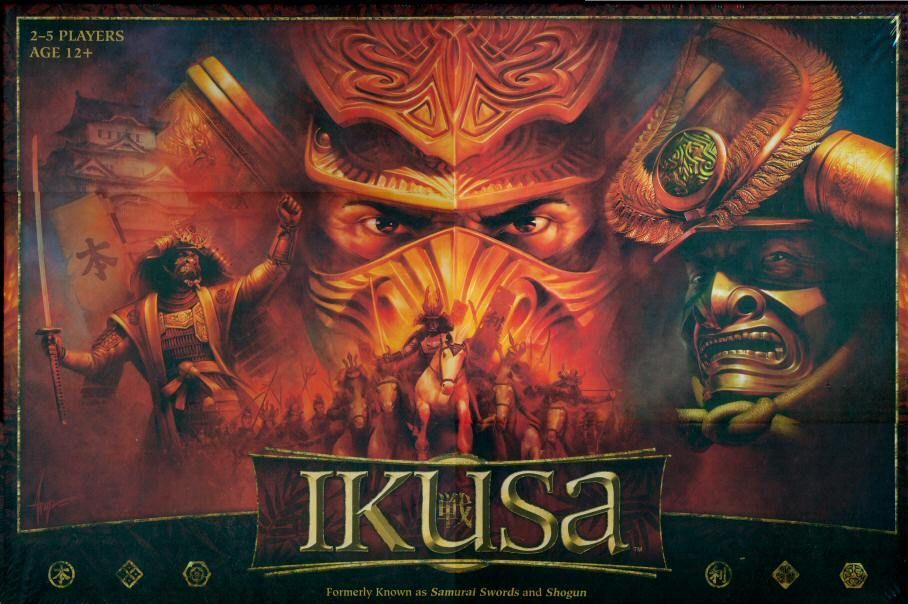
Ikusa is a game set in sixteenth-century Japan where each player leads daimyo warlords to conquer provinces, then guards them while attacking more. Players spend koku on units, ronin, ninja and castles, then fight battles with dice. The first player to control 35 provinces wins.
Preparazione
- Each player takes a planning tray, reference screen, army card and one color of military units, and puts the units in the tray.
- Set aside the four blank province cards, shuffle the rest and deal them out evenly. In a three- or five-player game, place the extra cards face up as unowned provinces.
- Each player takes koku equal to their province cards divided by 3, rounded down.
- Each player places one ashigaru spearman in each province they own.
- Set up the army card: one daimyo, two samurai units and two ashigaru gunners per army, with each army's experience marker in the level 1 hole.
- Turn order markers are drawn at random (removing the 5 marker in two- or four-player games, and the 4 and 5 markers in three-player games). Players then take turns placing their remaining spearmen two at a time in their own provinces, and then place their three army markers, one per province.
Un turno
Each round has nine actions:
1. Plan: Secretly place all your koku in the bins of your planning tray: Turn Order, Build, Levy Units, Hire Ronin and Hire Ninja. The Build bin takes exactly two koku or none. Reveal all trays at once.
2. Determine Turn Order: The player with the most koku in the Turn Order bin picks a marker first, and so on. Ties are settled by agreement or a random choice. Players with no koku there draw at random.
3. Build: Players who placed two koku may place one castle in an owned province without a castle, or add a fortification base to an existing castle.
4. Levy Units: Each koku buys units from a set list of options. Only one new unit may be placed in each province per round.
5. Hire Ronin: Each koku buys two ronin, which are deployed face down onto owned provinces, limited by the number of regular units there.
6. Hire Ninja: The most koku in this bin hires the ninja. The ninja can assassinate an enemy daimyo this round, or spy on an opponent's planning next round. Ties mean no one hires him.
7. Wage War: Players take turns in turn order, each completing all four phases:
- A: Move armies from friendly province to friendly province.
- B: Declare battles by placing battle markers against adjacent enemy or empty provinces.
- C: Resolve combat in dice rolls by unit type: bowmen, gunners, daimyos, swordsmen with ronin, then spearmen. Casualties are removed after the ranged and hand-to-hand steps.
- D: Make final movement, conquer empty provinces, and remove battle markers.
8. Remove Ronin: Return all surviving ronin to the master tray.
9. Collect Koku: Take koku equal to owned provinces divided by 3, rounded down, with a minimum of three if you have a daimyo.
Fine della partita
The game ends as soon as a player owns 35 provinces. Under the optional longer rule, the win is checked only after a full round. A player is eliminated when they lose their last daimyo, and the eliminating player takes that player's units and provinces.
Punteggio
There are no points. The winner is the first player to own 35 provinces, counted by the province cards they hold. If the game ends by elimination or by a tie in the optional longer rule, the rulebook does not give a further tiebreaker.
Varianti
- Two-player: Each player controls two color sets of units, with separate trays and screens. The sets can not fight or defend together, and the first player to 50 provinces wins.
- Quick-play: Use revised setup. Players receive fewer province cards and place extra spearmen to claim additional provinces. The game ends when a player is eliminated, and the player with the most provinces wins. Otherwise the first player to 30 (five players), 35 (four players) or 40 (three players) provinces wins.
Modifiche
- Varianti: bozza del regolamento, 23 novembre 2026 (mostrata ora)
- Punteggio: bozza del regolamento, 23 novembre 2026 (mostrata ora)
- Fine della partita: bozza del regolamento, 23 novembre 2026 (mostrata ora)
- Un turno: bozza del regolamento, 23 novembre 2026 (mostrata ora)
- Preparazione: bozza del regolamento, 23 novembre 2026 (mostrata ora)
- Riassunto: bozza del regolamento, 23 novembre 2026 (mostrata ora)