Regole di In the Year of the Dragon
Riassunto
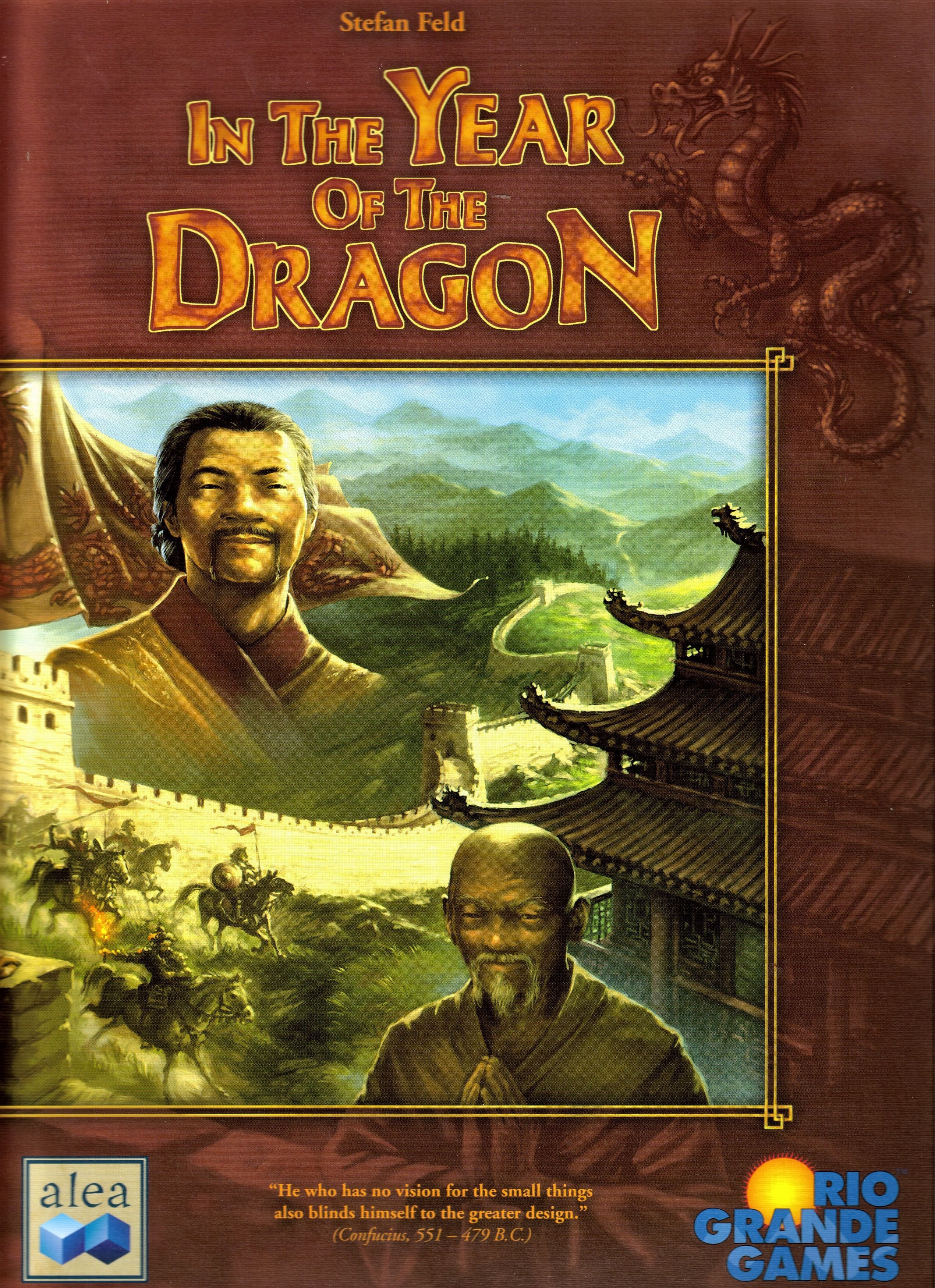
Each player is a Chinese prince trying to build the prosperity and prestige of his province in about 1,000 A.D. over 12 months, using courtiers and palaces to survive monthly events. Victory points are tracked on the scoring track, and the player with the farthest marker at game end wins.
Preparazione
Place the board in the middle of the table. Put the older persons in the first row and the matching younger persons below them. Craftsmen, court ladies and tax collectors come only as younger tiles in the middle spaces of the second row. With fewer than 5 players, remove 2 tiles of each type per missing player (1 younger and 1 older for the divided types, 2 younger for the others).
Place the 2 peace tiles first in the event row. Shuffle the other 10 event tiles and place them face up at random in the remaining spaces. Never leave two identical non-peace tiles side by side; slide the second one to the next free space. Shuffle the 7 action cards into a face-down pile in the large center space.
Each player takes a person marker (set on 0 of the person track), a scoring marker (set on 0 of the scoring track), a dragon with its stand, 11 person cards as a hand, a game overview, 4 palace floors to build 2 two-story palaces, and 6 yuan (3 silver and 1 gold). Keep the remaining supply above the board.
Starting with the oldest player and going clockwise, each player takes 2 different younger persons from the second row. No player may take the same pair of persons as an earlier player. Each person goes below one of his palaces, and his marker moves forward by that tile's value.
Un turno
Each round has four phases in order.
- Action: Shuffle the action cards, deal them face down into as many groups as there are players as evenly as possible, then turn them face up. The player whose marker is farthest on the person track goes first, then the others in track order. Each player places his dragon on a group and carries out one action from any card in it. A group already holding a dragon costs 3 yuan to the supply to use. Instead of acting, a player may pay just enough to bring his money up to 3 yuan. When everyone has acted, dragons and cards go back to the pile.
The actions are:
- Taxes: take 1 yuan per coin on the card and per coin on your tax collectors.
- Build: take 1 palace floor per hammer on the card and your craftsmen, then add floors to existing palaces or start new ones. No palace may exceed 3 floors, and placed floors cannot be moved.
- Harvest: take 1 rice tile per sack on the card and your farmers.
- Fireworks Display: take 1 fireworks tile per rocket on the card and your pyrotechnists.
- Military Parade: move your person marker 1 space per helmet on the card and your warriors.
- Research: move your scoring marker 1 space per book on the card and your scholars.
- Privilege: pay 2 yuan for a small privilege or 6 for a large one. You may buy only one per action.
- Person: In track order, each player plays a person card from his hand to the common discard pile and takes the matching person tile from the display. He places it below one of his palaces, then moves his person marker by the tile's value. A palace holds one person per floor. If all palaces are full, he may replace one of his persons, and the replaced person is removed from the game. If he does not want to replace anyone, he may release the new person at once without moving his marker. A card with a question mark lets him take any tile on the display. If the matching tile is gone, he gets nothing. Players skip this phase in round 12.
3. Event: Rounds 1 and 2 are always Peace. Afterward, each round's event is the next tile in the event row, from left to right. Turn that tile face down after resolving it. Events are:
- Peace: nothing happens.
- Imperial Tribute: each player pays 4 yuan. For each missing yuan, he releases one person.
- Drought: each player returns 1 rice tile per palace containing at least one person. Each palace without enough rice loses one person, chosen by the player.
- Dragon Festival: the player(s) with the most fireworks get 6 points and the player(s) with the second most get 3. Scoring players then return half their fireworks, rounded up.
- Mongol Invasion: each player moves his scoring marker by his total helmets on warriors. The player(s) with the fewest helmets each release one person. If everyone is tied, everyone releases one.
- Contagion: each player releases 3 persons, reduced by 1 for each mortar on his healers.
If several players must release persons, they do so in person track order.
After the event, decay happens: each player reduces every uninhabited palace by 1 floor, and a one-story palace with no person disappears.
- Scoring: Each player moves his scoring marker forward 1 point for each palace (inhabited or not, any height), each dragon on his court ladies' fans, and each dragon on his privileges.
Fine della partita
The game ends after the scoring phase of round 12, which is the 12th month. Then each player gets a final scoring:
- 2 points for each person tile in his palaces.
- For each monk, multiply the Buddhas on the monk by the floors of the palace it inhabits.
- He sells all remaining rice and fireworks tiles back to the supply for 2 yuan each, then gains 1 point per 3 yuan he holds.
These final points are added to the scoring track.
Punteggio
Points are scored during each round's scoring phase and from event effects such as Dragon Festival and Mongol Invasion, and at the end of the game from persons, monks and money.
The winner is the player whose scoring marker is farthest forward on the scoring track at game end. If players are tied there, the tie is broken by whose person marker is farthest ahead on the person track.
Modifiche
- Punteggio: bozza del regolamento, 23 novembre 2026 (mostrata ora)
- Fine della partita: bozza del regolamento, 23 novembre 2026 (mostrata ora)
- Un turno: bozza del regolamento, 23 novembre 2026 (mostrata ora)
- Preparazione: bozza del regolamento, 23 novembre 2026 (mostrata ora)
- Riassunto: bozza del regolamento, 23 novembre 2026 (mostrata ora)