Regole di Jaipur
Riassunto
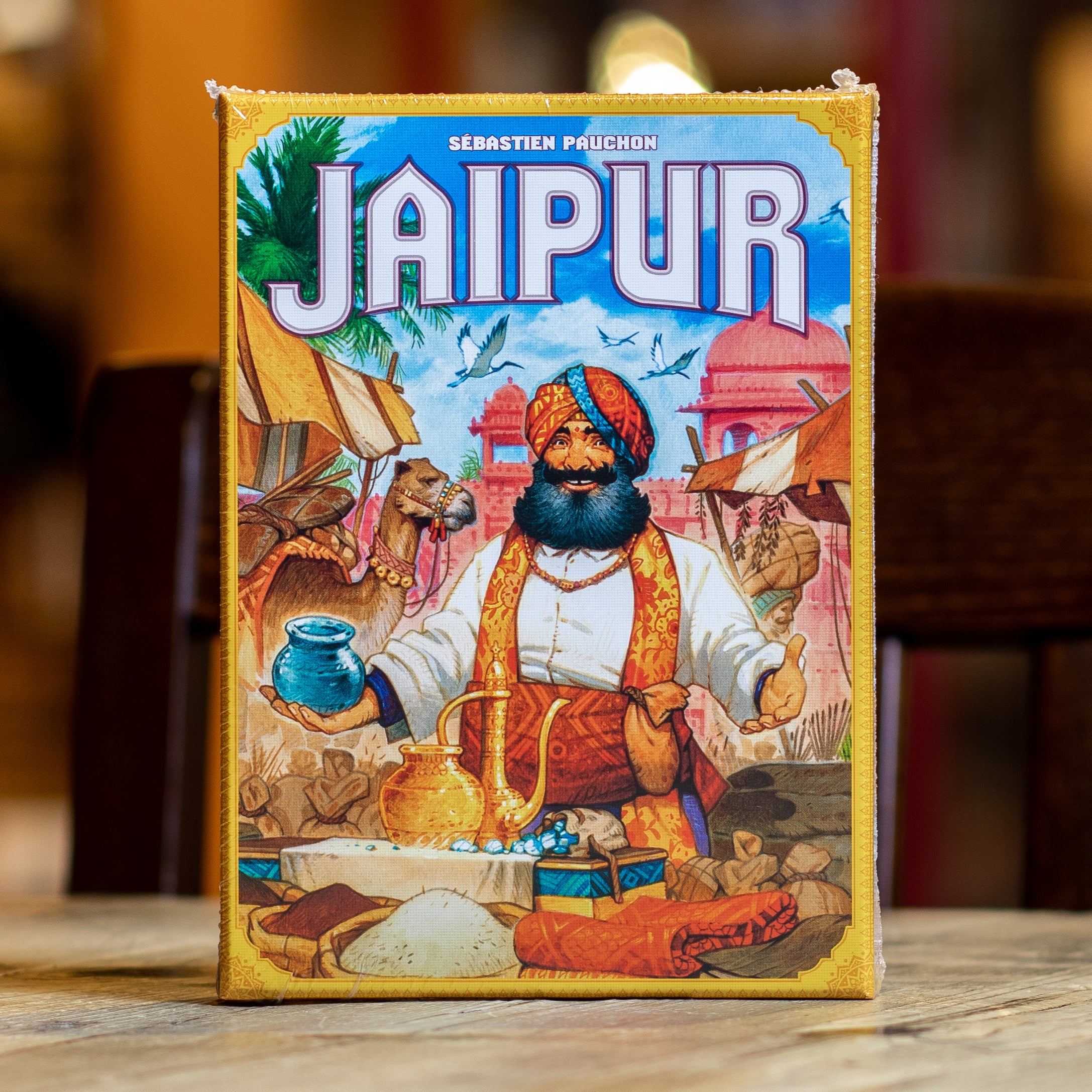
Two players act as traders for the Maharaja, competing to be richer than their opponent at the end of each round (called a week). Players collect and exchange goods cards at the market, then sell them for rupees on goods tokens and bonus tokens. The richer trader at the end of each round wins a Seal of Excellence, and the first player to collect 2 Seals wins the game.
Preparazione
- Place 3 camel cards face up between the players.
- Shuffle the remaining cards and deal 5 to each player. Place the rest face down as the draw pile (deck).
- Sort the goods tokens by type and make a pile for each type, in descending order of value. Spread each pile out so both players can see every value.
- Sort the bonus tokens by type, shuffle each type separately, and form 3 face-down piles.
- Put the camel token beside the bonus tokens and the 3 Seals of Excellence where both players can reach them.
- Choose a starting player.
- Take the top two cards from the deck and place them face up beside the camels. This is the market. If camels are among them, that is fine.
- Each player moves any camels in their hand face up into a stack in front of them. This stack is their herd.
Un turno
On your turn you must either take cards or sell cards, never both.
Taking cards has three options:
- Exchange: Take several goods cards from the market (they may be of different types). Then return the same number of cards from your hand. The returned cards can be camels, goods, or a mix. Refill the market from the deck.
- Take one good: Take a single goods card from the market, then refill that slot from the top of the deck.
- Take the camels: Take all the camels from the market into your herd, then refill the market from the deck.
Exchange rules:
- You can never swap just 1 card for 1 card; an exchange is at least 2 for 2.
- You cannot return a goods type that you also take from the market in the same exchange.
- When taking goods, you never take camels in the same turn, and vice versa.
At the end of your turn you may hold no more than 7 cards in hand. Camels in your herd do not count toward this limit.
Selling cards: Choose one goods type and discard as many cards of that type as you like onto the discard pile. Take one goods token for each card sold, starting from the top (highest value) of that type's pile, and stack them in front of you. If you sold 3 or more cards, also take a bonus token:
- 3 cards: bonus of 1, 2 or 3 rupees.
- 4 cards: bonus of 4, 5 or 6 rupees.
- 5 or more cards: bonus of 8, 9 or 10 rupees.
The bonus value is hidden until drawn. If there are fewer goods tokens left than cards sold, you still get the bonus. Diamonds, gold and silver can only be sold in lots of at least 2 cards, even if only one token of that type remains. You may sell only one goods type per turn.
Fine della partita
A round ends immediately when either of these happens:
- 3 of the goods token types are depleted.
- The deck is empty when you need to refill the market.
The game ends immediately when one player holds 2 Seals of Excellence. That player wins and is named the Maharaja's personal trader.
Punteggio
At the end of a round:
- Each player counts the camels in their herd. The player with the most camels takes the camel token, worth 5 rupees. If the camel count is tied, nobody takes it.
- Both players turn over their tokens and add up their values, including the camel token if won. The player with more rupees is the richer trader and takes a Seal of Excellence.
If the totals are tied, the tiebreakers are, in order:
1. The player with more bonus tokens takes the Seal.
2. If still tied, the player with more goods tokens takes the Seal.
If neither player has 2 Seals after a round, set up again and play a new round. The player who lost the previous round starts.
Modifiche
- Punteggio: bozza del regolamento, 23 novembre 2026 (mostrata ora)
- Fine della partita: bozza del regolamento, 23 novembre 2026 (mostrata ora)
- Un turno: bozza del regolamento, 23 novembre 2026 (mostrata ora)
- Preparazione: bozza del regolamento, 23 novembre 2026 (mostrata ora)
- Riassunto: bozza del regolamento, 23 novembre 2026 (mostrata ora)