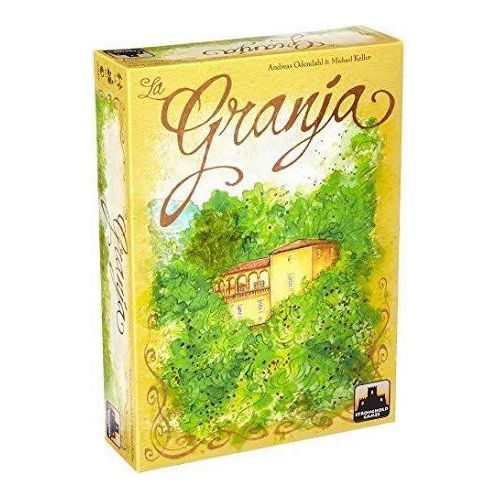
Regole di La Granja
Riassunto
La Granja is a game for 1 to 4 players, where each player runs a small farm near Esporles and tries to expand it while delivering goods to the village over six game turns. Players earn victory points by completely supplying craft buildings and by filling their own market barrows, which are then sent to the market. The player with the most victory points at the end wins.
Preparazione
Place the game board in the center and give each player a farm board, 25 player markers in one color, a set of four donkey markers, 1 victory point and 1 silver. Put one player marker on your farm's trade commodity space and keep the rest as your pool. Shuffle the 66 farm cards and deal four to each player, then place the remaining cards face down as the draw deck.
Sort the roof markers by game turn and place them on the board, with the turn 1 markers face up on top of the stacks. With fewer than four players, put back all but one randomly chosen roof marker per player, without looking at them.
Place one craft marker per player on each craft building, and 1 victory point on each gray space next to the buildings. Roll the die to place the three building order markers on three different craft buildings, and add 1 victory point beside each of them.
Randomly choose a start player, who takes game order marker 1. The others take the next numbers clockwise. Set aside revenue dice: 5 for 2 players, 7 for 3 players, 9 for 4 players. Each player places a player marker on the market spaces in turn order, starting with the lowest numbers. In 2 and 3 player games, the outer market spaces marked with an X are not used. Place each player's disc on the bottom of the siesta track, with the start player's disc on top.
Un turno
Each game turn has four phases: Farm, Revenue, Transportation and Scoring. Some actions can be taken at any time during your turn, such as using trade commodities, buying or selling resources, and upgrading resources.
- Farm phase: Play one farm card to one side of your farm (left for a field, top for a market barrow, right for a farm extension, bottom for a helper). Placing a field, barrow or helper is free, but farm extensions cost farm goods, with each extension costing more than the last. Then take income from blue craft markers and extensions, and receive a new harvest good on each empty field and a pig offspring if you have at least two pigs and room for it. Draw cards up to your hand limit. In the first game turn everyone plays two cards. Finally, buy one roof marker of the current turn, paying its silver cost and gaining victory points if it is not your first purchase. Roof markers are bought in turn order, except in turn 1 where they go in reverse.
- Revenue phase: The start player rolls the revenue dice and places them beside the revenue spaces. Players then take dice in turn order, one on their left die space and one on their right, and carry out the action of each die. Die results give pigs, cards or harvest goods, two different harvest goods, 4 silver, upgrades or siesta steps, or a delivery or 2 silver.
- Transportation phase: Each player secretly picks an available donkey marker, and all markers are revealed together. Then, in turn order, each player advances on the siesta track by 0 to 3 steps, as shown on the marker. The new turn order follows the siesta track, with the farthest player becoming start player. Next, in the new order, each player makes deliveries: one per donkey symbol, to unblocked craft buildings or to his own market barrows. Finally, players may buy extra deliveries at 1 silver each and carry them out.
- Scoring phase: Described in the scoring section below.
Fine della partita
The game ends after six game turns. After the scoring phase of turn six, the last two steps are skipped, and players then convert their remaining player markers on the farm and silver into victory points.
Punteggio
During each scoring phase, every player earns 1 victory point for each of his own player markers on the market, with no points for markers on craft buildings. Then each player earns 0 to 3 victory points based on the position of his disc on the siesta track. The discs are then returned to the 0 space, with the new start player's disc on top.
At the end of the game, players convert their player markers on the farm into silver at normal sales prices (resources) or conversion prices (trade commodities). Then all silver is converted to victory points at 5 silver for 1 victory point. The player with the most victory points wins. A tie is broken by the player with the most silver remaining. If the tie remains, the tied players share the win.
Varianti
The rulebook gives a solitaire game for learning the mechanics. Use the components of one player plus a player marker in a second color for a neutral player. Use five revenue dice and game order markers 2 and 3, which are shuffled and drawn to place your marker and the neutral player's marker on the central market. Place two roof markers. Revenue dice are discarded before you choose, with the lowest number discarded in turns 1 to 3 and the highest in turns 4 to 6. In the transportation phase, a card is drawn and the neutral player places a marker on the market space matching the card's victory point value. The neutral player tries to remove as many of your markers as possible. Scoring is adjusted: if you reach at least the third siesta space, you become start player next turn; otherwise you play second.
Modifiche
- Varianti: bozza del regolamento, 22 novembre 2026 (mostrata ora)
- Punteggio: bozza del regolamento, 22 novembre 2026 (mostrata ora)
- Fine della partita: bozza del regolamento, 22 novembre 2026 (mostrata ora)
- Un turno: bozza del regolamento, 22 novembre 2026 (mostrata ora)
- Preparazione: bozza del regolamento, 22 novembre 2026 (mostrata ora)
- Riassunto: bozza del regolamento, 22 novembre 2026 (mostrata ora)