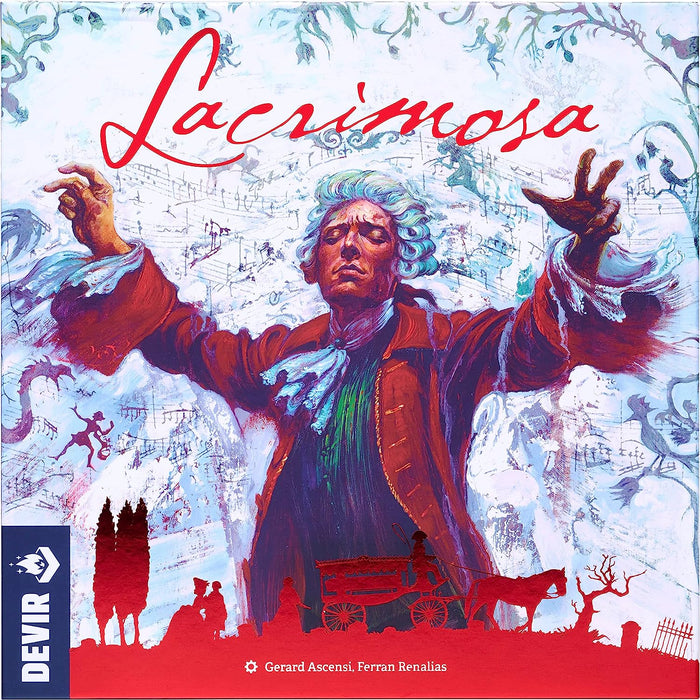
Regole di Lacrimosa
Riassunto
Lacrimosa is a game for two to four players who act as patrons of Mozart, telling Constanze their stories over five rounds. Players commission and perform works, collect memories and story points, travel to courts and cities, and fund parts of the unfinished Requiem. The player with the most victory points (VP) at the end of the game wins.
Preparazione
Place the main board in the middle of the table and put the Mozart's Journeys marker in Salzburg. Set the starting cards aside. Split the other Opus and Memory cards into five periods. With two players, remove 2 Opus and 2 Memory cards at random from each period; with three players, remove 1 of each. Shuffle each period separately and stack the five decks with period 1 on top and period 5 on the bottom. Place one random Period Bonus tile, reward side down, on each deck, and return the rest to the box. Show the first bonus tile in the Period bonus space, then fill the card row with 7 cards: Opus cards along the lower edge and Memory cards along the upper edge.
Choose two of the four composers (Eybler and Stadler are recommended for a first game) and place their portraits on the leftmost Requiem spaces. Take all Composer tiles for those two. With fewer players, remove tiles marked with 3 or 4 points as the rulebook specifies, then stack each composer's tiles by movement, most expensive at the bottom, in the matching spaces.
Shuffle the Constanze cards, draw one, and place the Constanze counters on the Requiem fragments it marks, according to player count. Shuffle the Royal Court and City tiles and place them gilded side down in their spaces (three Royal Court tiles are placed on the map at random). Keep ducats and Story Point counters beside the board.
Each player takes a personal board and summary tile, places their shield at the top left (+50 side down), and takes one starting Opus and nine starting Memory cards matching their shield. Place your 7 Requiem markers in the Instrument spaces, and the neutral marker in the top Horn space. Place Story markers on the 2 space of each Story Track and the Funds marker on the Finance Track as indicated. Starting ducats and scoring positions depend on seat order, with the 3rd and 4th players starting at 1 VP. Shuffle your nine Memory cards into a personal deck and draw 4 as your starting hand. Choose a first player at random; play proceeds clockwise.
Un turno
Each round has a Main Phase of four turns per player, followed by a Maintenance Phase. At the start of a round, every player draws up to 4 cards from their own deck.
On your turn, play two cards from your hand onto your personal board:
- Place one card in the Experiences section. It determines your actions. Take its reward if it shows one, then carry out its actions in any order you like.
- Place the other card in the Story section, just below. It gives Story Points at the Maintenance Phase.
As an alternative to the Experiences card's actions, you may take ducats from the bank equal to the current round number. After a Document Memories or Commission an Opus action, refill the card row on the main board by sliding cards right and drawing new ones from the period deck.
After your actions, draw from your deck until you have 4 cards. At the end of your third turn you draw only 1 card, so your fourth turn is played with 3 cards and the round ends with 1 card in hand.
The five actions are:
- Document Memories: buy a Memory card from the board by paying its ducat and Story Point cost, then swap it for the card in your Story section.
- Commission an Opus: buy an Opus card by paying its cost plus the board space cost, then gain its VP.
- Perform or Sell: pay the Mozart's Talent cost on one of your Opus cards. Performing earns the money shown and turns the card 90 degrees so it cannot be used again this round. Selling earns the listed money and finance changes, then removes the card from the game.
- Travel: move Mozart's Journeys marker along the map, paying the road costs and the Journey Story Point cost of the destination. Only the final destination's actions apply. Royal Court tiles are kept; City tiles are set aside after use.
- Requiem: place one of your Requiem markers on an empty instrument space of a movement, paying the cost of the matching Composer tile, and take that tile to your personal board.
Anytime during your turn you may exchange 3 ducats for 1 Story Point counter, or 1 counter for 1 ducat. Five one-ducat coins and one five-ducat coin can be exchanged freely.
Fine della partita
The game ends after the fifth round. Complete the Maintenance Phase's personal board step for round five, then perform the final VP count.
Punteggio
Final scoring, in order:
- Royal Court tiles: for each tile you can fulfil, gain its VP. Each Opus and each Requiem part can satisfy only one tile. Sold Opus cards no longer count.
- Requiem: for each movement, the composer with the most instrument markers (neutral markers count toward the majority but score nothing) awards the higher value to each of its matching markers. Other composers award the lower value. A tie awards the lower value to both.
- Story Points: 1 VP for every 2 Story Points remaining, including Story Track positions and counters.
- Money: 1 VP for every 3 ducats remaining.
The player with the most VP wins. Ties are broken first by who contributed more Requiem parts, then by who has more Opus cards. If still tied, the tied players share the victory.
Varianti
Solitaire module (Schikaneder's tale): you play against a virtual opponent, the Soloist, Emanuel Schikaneder. Setup follows the two-player game with changes: you use one composer, take 10 ducats, and set up a Soloist personal board with Requiem markers and a 9-card Soloist deck. Choose a difficulty level that determines which Soloist cards are used and the Soloist's starting ducats (Easy: 0, Middle: 2, Difficult: 11 ducats or 1 ducat-equivalent per the funds space). You are always the first player and never pass the marker to the Soloist.
The Soloist does not draw cards. Instead it plays the top two cards of its deck, then resolves the actions using arrows on the Soloist cards to pick Memory or Opus cards, move Mozart's Journeys marker, or place Requiem counters, all without paying costs. At the end, the Soloist scores only its earned VP, Royal Court tiles it collected, and the Requiem, not the story-point or ducat sections.
Modifiche
- Varianti: bozza del regolamento, 23 novembre 2026 (mostrata ora)
- Punteggio: bozza del regolamento, 23 novembre 2026 (mostrata ora)
- Fine della partita: bozza del regolamento, 23 novembre 2026 (mostrata ora)
- Un turno: bozza del regolamento, 23 novembre 2026 (mostrata ora)
- Preparazione: bozza del regolamento, 23 novembre 2026 (mostrata ora)
- Riassunto: bozza del regolamento, 23 novembre 2026 (mostrata ora)