Regole di Merkator
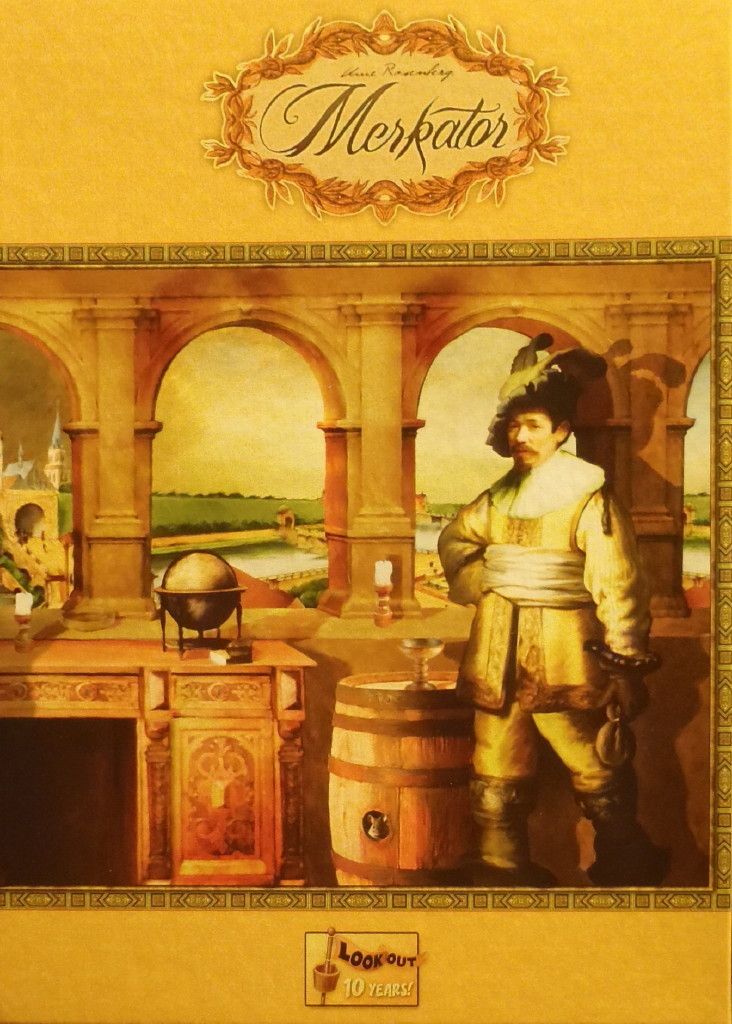
Riassunto
Merkator is a trading game set in Europe during the Thirty Years' War, where each player is a Hamburg merchant collecting and delivering goods to fulfill contracts. Completed contracts give you new, more valuable contracts, and efficient travel lets you save time to join other players' trips. The player with the most victory points at the end wins.
Preparazione
Join the two game board halves and place the colored sorting boxes in their slots. Sort the cubes by color into the boxes and put one cube of each color on each Major location. Set the time chart to its ULTIMO side and fill it with Time counters based on player count: with 4 players all rows are filled, with 3 the top row stays empty, and with 2 the top two rows stay empty. Put the leftover counters in a box, then shuffle the counters with the hourglass side up. Sort the Contracts by value, shuffle each stack and place them face up. Deal each player one Contract of value 2, 3, 4 and 5. Turn the remaining value 2 Contracts face down as the discard pile. Split the Bonus cards into two piles by coin value, shuffle each pile, give each player one card from each pile, then shuffle the rest together face down and place the top 4 face up beside the stack. Shuffle the Building cards, place the top 4 face up beside their stack, and keep the Merkator token and coins beside the board. Each player starts with one cube of each color on their Supply tile. The starting player is whoever was last in Hamburg, with ties or no visitors decided by who most recently ate a hamburger. The starting player gets no Time counters, the player to their right gets 2, and everyone else gets 1.
Un turno
On your turn, go through four steps in order. 1. Invest: this is optional while you hold 5 or fewer Contracts. With 6 or more, you must sell Contracts for their Taler value until you are at 5 or fewer. You may then buy Bonus or Building cards, paying their cost in Taler. Sold Contracts go to the discard pile. You may never sell your last Contract. Your cash cannot exceed 15 Taler; any excess must be spent on cards or discarded down to 15. When you buy a card, a new card of that kind is revealed so four remain open, and you may buy again. 2. Travel: move the Merkator token to any of the 12 locations, or leave it where it is. Traveling to Spain, Italy or Newfoundland costs 1, 2 or 3 Time counters, which you must be able to pay. Gain Time counters at Sweden, Danzig, the Dutch Republic, Bohemia and Denmark (1 each), and at Hamburg (2). Take counters from the topmost row that still has any. At a Major location, collect all cubes there and convert them into goods on your office board. A single cube may become either of its location's two goods; if you get two, they must become one of each; with more, you distribute them freely but include at least one of each type. Add 2 goods for each of your Bonus cards matching the location. Then place new cubes: at a Major location, one cube goes on each adjacent Major location; at a Minor location, one cube goes on each Major location holding at least the number shown there. Whenever you take the last counter in a row, a loss-of-goods check happens. 3. Fulfill Contracts: a Contract can be fulfilled if its location matches where you are, and each one only once per turn. Return the listed goods to the supply, then take the top Contract from the next higher level. Fulfilled Contracts stay in your office. You may trade 4 goods of one identical type for any single good you need, or pay 4 Time counters for one needed good. 4. Joining travels: going clockwise, other players may join the active player's trip. Each joiner pays the active player 1 Time counter at a Major location or 2 at a Minor location. Joiners may fulfill Contracts at that location, and a player who owns the matching Bonus card gets only 1 good instead of 2. Any player may at any time move one cube from the Supply tile into a storage or depot.
Fine della partita
The game enters a final round when either a player fulfills a value 10 Contract, which also earns the Peace of Westphalia card, or the last Time counter is removed from the time chart. Taking the last counter from the supply instead is handled by the rulebook's note on Hamburg travel. Every player, including the player who triggered the final round, gets one more turn. Forced investment does not apply in the final round. If the Peace of Westphalia is gained after the final round has started, or the final round was triggered by the other condition, it has no extra effect.
Punteggio
After the final round, count victory points. Up to 5 Contracts placed on your office board score their full Taler value in VP, and the Peace of Westphalia card counts 14 VP in this way. Any additional Contracts placed beside the office score half their value, without rounding. Building cards score the VP shown on them. Bonus cards, money and goods score nothing. The player with the most VP wins. The rulebook gives no general tiebreaker for the standard game; the solo rules use remaining Time counters to break ties.
Varianti
Solo version: the game lasts 17 turns. Use about 15 Time counters, with no time chart or loss-of-goods check. Place one cube on each Major location and deal yourself one random Bonus card of value 3 and one of value 4. Remove the five Building cards labeled for the sole player and all coins. Instead of selling Contracts for coins, you pay with Contracts directly, without getting change. Build a face-down Solo stack with the Peace of Westphalia on the bottom, then shuffled value 10, 9 and 8 Contracts on top. Each Travel step draws the top card of this stack for the matching value pile, and the game ends when the Peace of Westphalia is drawn. You cannot join travels, and 4:1 trades are not allowed to boost your score at the end. Benchmarks are 55 VP for beginners, 60 for experienced players and 80 for Über-Merkators. Long game: use the standard rules with changes. With 3 or 4 players, flip the time chart to its back and refill it as the backside runs out. With 2 players, use the ULTIMO side, fill all but the top row, start with no cubes on the Supply tile, no Bonus cards, one value 2 and one value 3 Contract, and no Time counters. Two-player game: banning joined travels can make it smoother. Expert rules: hand limit of one card, taken from an open stack during your turn and buyable later in the investment step. Additional variants: A ignores loss-of-goods; B replaces the 15 Taler cash limit with a rule forcing purchases of Building cards when a player can afford the priciest one; C revalues Bonus cards so buyers immediately get 1 good; D lets other players offer coins or Time counters to the active player to swap in a newly revealed Contract.
Modifiche
- Varianti: bozza del regolamento, 23 novembre 2026 (mostrata ora)
- Punteggio: bozza del regolamento, 23 novembre 2026 (mostrata ora)
- Fine della partita: bozza del regolamento, 23 novembre 2026 (mostrata ora)
- Un turno: bozza del regolamento, 23 novembre 2026 (mostrata ora)
- Preparazione: bozza del regolamento, 23 novembre 2026 (mostrata ora)
- Riassunto: bozza del regolamento, 23 novembre 2026 (mostrata ora)