Regole di Mexica
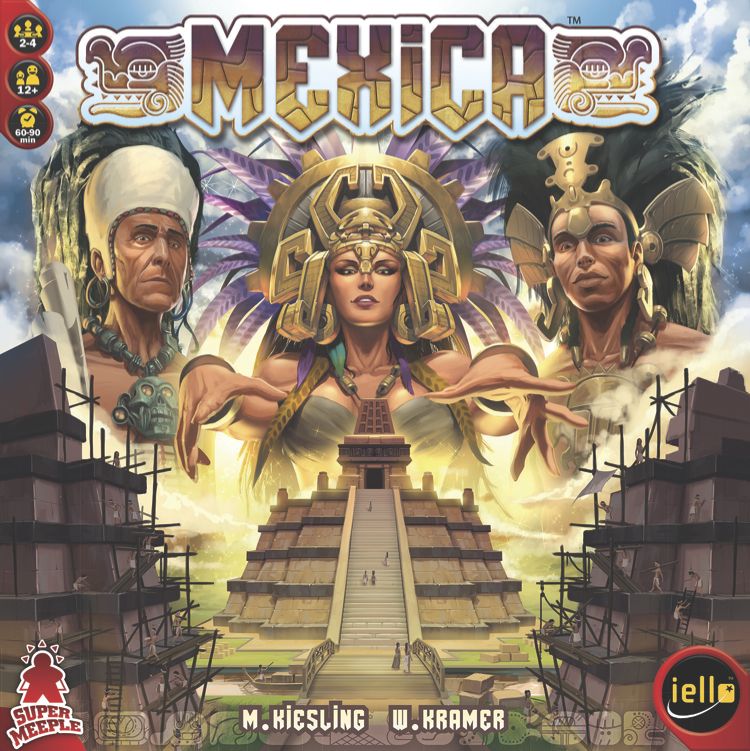
Riassunto
Mexica is a placement, blocking and majority game for 2 to 4 players in which you carve the island of Tenochtitlan into districts, found them, and build temples. You score prestige points by founding districts and by having the greatest spiritual grandeur (total temple levels) in them, first during the first period and again at the end of the second. The player with the most prestige points on the track at the end wins.
Preparazione
Place the board in the middle of the table. Shuffle the 15 calpulli tokens face down, reveal 8 at random and arrange them in ascending order by their large number on the Emperor's commands display. Set the other 7 aside face down.
Place the 43 canal tiles and the 11 bridges beside the board, the 12 Action Point tokens in a pile, and the 4 Pilli Mexica pawns and the 2 player-aid cards nearby. Lay the 2 two-space canal tiles and the 6 one-space canal tiles on the marked canal spaces so the illustrated canal positions are covered.
Each player takes a player aid and a color, places her prestige marker on space 0 of the track, and takes her Pilli Mexica pawn. Take 18 temples in your color and set aside 9 of them; from the other 9 take 3 one-level, 3 two-level, 2 three-level and 1 four-level temple and keep them in front of you for the first period.
The oldest player goes first and play passes clockwise. Starting with the first player and continuing in turn order, each player places her Pilli Mexica on one of the 5 palace spaces, which are not land spaces for founding, and cannot be built on.
Un turno
On your turn you have 6 Action Points (AP). You may take any actions in any order and repeat them as often as you can afford. Unspent AP are lost at the end of your turn.
- Construct a canal: 1 AP. Canals can go on empty land or lake, and must touch existing water diagonally or orthogonally.
- Found a district: 0 AP. Your Pilli Mexica must be in the district and a matching calpulli token must be available. Place the token on any empty land space in the district and score.
- Construct or relocate a bridge: 1 AP. The bridge must cross a canal, with both ramps facing land.
- Build a temple: 1 to 4 AP depending on the temple's levels. Your Pilli Mexica must be in the district, and the temple goes on an empty land space that is not on the palace.
- Move your Pilli Mexica: 1 AP per step on foot to an adjacent land space or bridge, or by boat from one bridge to the next along connected water. Teleport to any empty land space or bridge on the island for 5 AP. Movement is orthogonal only and cannot pass through opponents' pawns, temples or calpulli tokens.
- Take an Action Point token: 1 AP for one token or 2 AP for two, at most 2 per turn.
- Spend an Action Point token: 0 AP, gives you one extra AP this turn.
You cannot build or found on water, and cannot trap an opponent's pawn in the first round.
Fine della partita
The first period ends at the end of the round once all 8 calpulli tokens on the Emperor's display have been used to found districts or removed from play, and at least one player has placed all 9 of her first-period temples. Everyone finishes the round, then the first scoring takes place.
The second period begins with the 7 remaining calpulli tokens placed in ascending order on the display, and you take the other 9 temples in your color. It ends at the end of the round once all 7 tokens have been used or removed and at least one player has placed all of her temples. Everyone finishes the round, then the final scoring takes place.
The game ends immediately after the second scoring.
Punteggio
Founding a district: the player who founds it immediately earns prestige equal to the blue number on its calpulli token. Each other Pilli Mexica in the district at that moment earns the small white number.
At the end of each period, for each founded district, the player with the greatest spiritual grandeur there earns the large yellow number, the second greatest earns the blue number, and the third greatest earns the white number. Spiritual grandeur is the total number of temple levels you have in the district, not the number of temples. The fourth place scores nothing. Districts that were scored in the first period are scored again in the second, and you flip their tokens face down after scoring to keep track.
In the second period, unfounded districts are also scored: greatest spiritual grandeur earns points equal to the number of spaces in the district, second earns half of that rounded up, and third earns half of second place rounded up.
At each scoring, a Pilli Mexica standing on one of the palace's 4 starting spaces earns 5 extra points.
Ties: each tied player scores the full value for her place. If two players tie for first, nobody scores second but a third place still counts. If three players tie for first, nobody scores second or third. If several players tie for second, nobody scores third.
The player with the most points on the track wins. If points are tied, the tied player with the most unspent Action Points wins. If still tied, the tied players share the win.
Varianti
2-player game: choose a third color for a neutral player who gets 10 temples: 4 with 1 level, 3 with 2 levels, 2 with 3 levels and 1 with 4 levels, for 20 levels in total. Neutral temples cannot be placed on a space next to the lake and must be at least 4 spaces apart. Shuffle them and distribute them randomly to the neutral player for each of the two periods, taking spiritual grandeur into account by quarter place (1st, 2nd or 3rd) for the neutral player's scoring.
Increased difficulty: the neutral player may be given more than 20 total temple levels.
Modifiche
- Varianti: bozza del regolamento, 23 novembre 2026 (mostrata ora)
- Punteggio: bozza del regolamento, 23 novembre 2026 (mostrata ora)
- Fine della partita: bozza del regolamento, 23 novembre 2026 (mostrata ora)
- Un turno: bozza del regolamento, 23 novembre 2026 (mostrata ora)
- Preparazione: bozza del regolamento, 23 novembre 2026 (mostrata ora)
- Riassunto: bozza del regolamento, 23 novembre 2026 (mostrata ora)