Regole di Miyabi
Riassunto
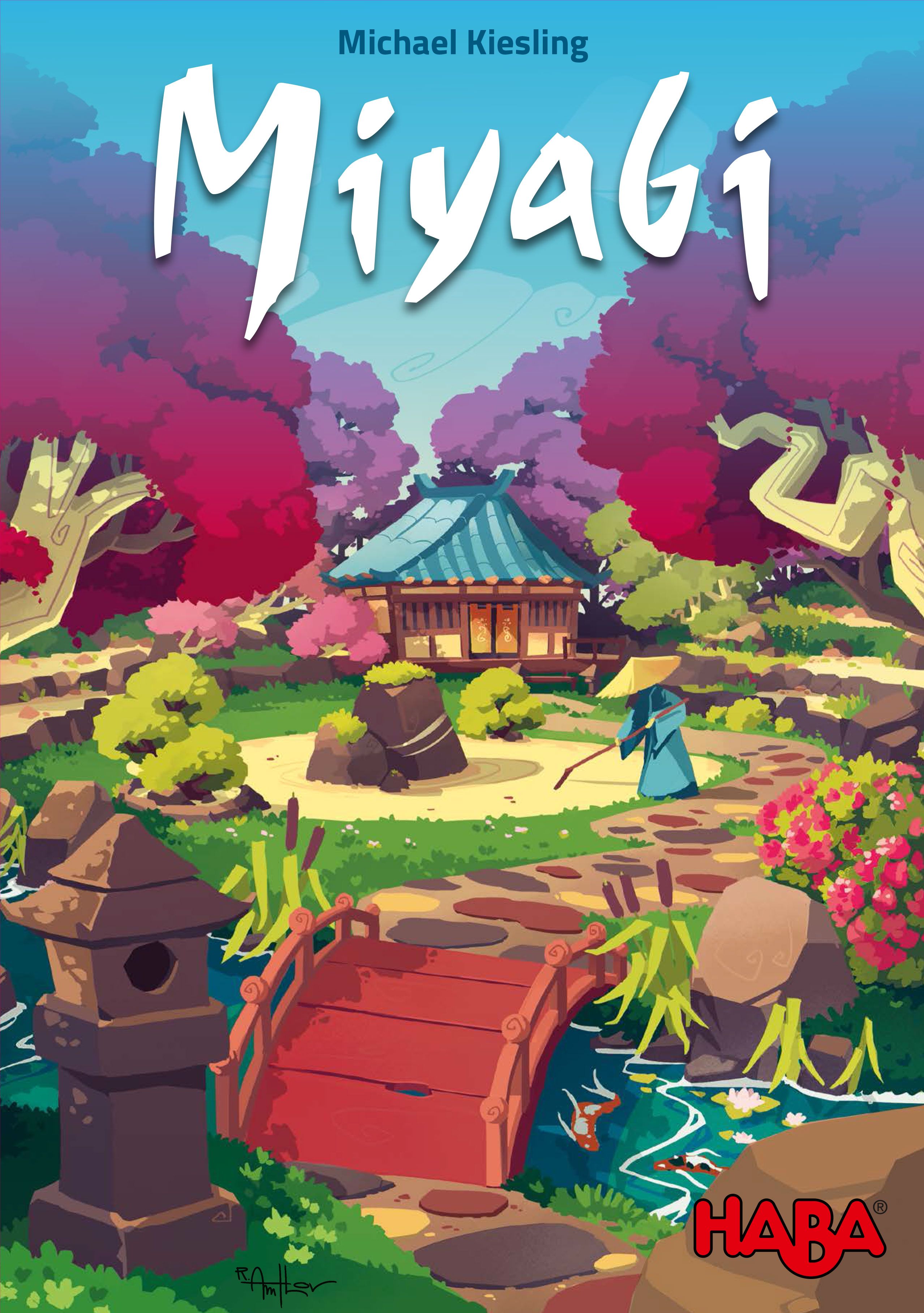
Players take turns designing Japanese-style gardens on a 6x6 board by placing garden tiles on layers and marking each placement with a lantern. Points come from objects scored as they are placed, plus bonuses and final row scoring. The player with the most points across their two scoring stones after the last building round wins.
Preparazione
- Place the score board in the center, with the building round marker on field 1.
- Each player takes a game board, 6 lanterns, and two scoring stones of one color. Put one stone just left of the first space on the score board, and the other on the 0 space of the 50-point strip.
- Place the 6 bonus tiles face-up beside the score board. Keep the info card and bonsai tree nearby.
- Put all 96 garden tiles face-down in the box lid.
- The number of building rounds depends on players: 2 players 6 rounds, 3 players 5 rounds, 4 players 4 rounds.
- Each building round, take the tiles listed on the info card for your player count (single, double, triple corner, triple straight) and place them face-up in the center.
- The youngest player is the start player and gets the bonsai tree.
Un turno
Each building round, players place their lanterns above their boards. Players take turns clockwise, with each player getting up to 6 turns per round. On your turn, you either place a garden tile (then a lantern, then score) or pass.
1. Place a tile: Take one face-up tile from the center and place it on your board.
- Each row holds only one object type, shown on the left side of the board. Objects must sit in matching rows.
- Objects must be in a column whose lantern field is still empty.
- Empty green parts of a tile can go in any row or column.
- The tile must stay inside the 6x6 grid.
- A tile may go on top of placed tiles only if the whole new tile rests on placed tiles. Objects underneath may be covered.
- If no tile can be legally placed, you pass for the rest of the building round, placing no lantern and scoring nothing.
- Place a lantern: Put one lantern on the empty lantern field of the column you just used.
- Score: Score the number of objects on the tile multiplied by the layer you placed it on. In a pond, each fish counts as an object. Move your scoring stone forward by the points. If it passes 50, return it to 0 and move your second stone forward one space on the 50-point strip.
Layer 5 bonus: Each object type has one bonus tile. The first player to place an object of that type on layer 5 takes the tile, moves their stone by the bonus value, and removes the tile from the game.
Fine della partita
A building round ends when all players have either filled all their lantern fields or passed. Unused garden tiles are removed from the game, the building round marker moves forward one space, and lanterns return above each board. The bonsai tree passes to the next player, who starts the next round.
The game ends after the last building round, followed by final scoring.
Punteggio
Final scoring is done row by row, based on the number of visible objects in each row of your board.
- The player with the most visible objects in a row scores the higher value shown on the left side of that row.
- The player with the second most scores the lower value for that row.
- Other players score nothing for that row.
- If several players tie for most, they all score the higher value, and nobody scores the lower value for that row.
- If several players tie for second most, they all score the lower value.
Move scoring stones accordingly. Then add the values of your two scoring stones. The highest total wins. If players tie on total points, they share the victory.
Varianti
The rulebook gives five mini-expansions that can be combined in any way. It recommends introducing them in this order to increase difficulty gradually.
- The Colorful Garden: At the end, score your largest group of directly adjacent objects (horizontal and vertical). Layers do not split the group, but empty green fields do. Score 1 point per object in the group.
- The Big Meadow: At the end, score your largest group made only of empty green tiles with no objects. Layers do not split the group. Score 2 points per tile in the group.
- 7!: At the end, score 7 points for each row or column that contains exactly 7 objects.
- The Frog: Each player places a frog marker on their board with the silver side up. Once before or after each regular turn, you may move the frog one space horizontally or vertically. The frog cannot enter Zen tiles, can move up at most one layer, and never down. Each time it reaches a higher layer, score that layer number in points (layer 1 = 1 point, layer 2 = 2 points, and so on). The silver frog cannot move onto objects. At layer 4 it flips to golden, and the golden frog can move onto objects. At the end, remove the frog and do not count it for the object scoring.
- The Zen Garden: Shuffle the 16 Zen tiles face-down beside the score board and turn 5 face-up. During your turn, you may take a face-up Zen tile instead of a regular garden tile. Place it in an empty space on the lowest layer, never on another tile, then place a lantern in its column. Turn over a new Zen tile for each one used. Scoring: 1 point for each Zen tile placed. Once a Zen tile is completely surrounded (the board edge counts), score 1 point per adjacent object plus 1 point for the object shown on the Zen tile, then it can no longer score. You may only take another Zen tile once your last placed one is fully surrounded. Zen tiles cannot be covered later.
Modifiche
- Varianti: bozza del regolamento, 22 novembre 2026 (mostrata ora)
- Punteggio: bozza del regolamento, 22 novembre 2026 (mostrata ora)
- Fine della partita: bozza del regolamento, 22 novembre 2026 (mostrata ora)
- Un turno: bozza del regolamento, 22 novembre 2026 (mostrata ora)
- Preparazione: bozza del regolamento, 22 novembre 2026 (mostrata ora)
- Riassunto: bozza del regolamento, 22 novembre 2026 (mostrata ora)