Regole di Mundus Novus
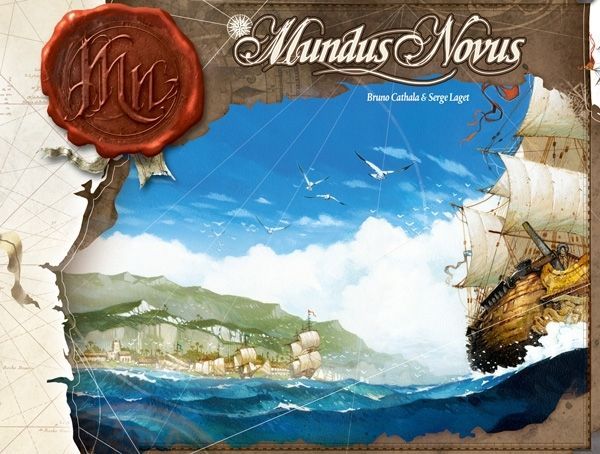
Riassunto
A 16th-century Spanish game in which you own a fleet of caravels, collect resource cards from the New World, and trade them to form sets that pay doubloons and unlock developments. You win by reaching 75 doubloons at the end of a round, by completing a perfect combination of 9 different resources plus an Inca relic, or by having the most doubloons when the development queue can no longer be refilled.
Preparazione
- Shuffle the resource cards and place them face down as a draw pile. Turn 3 face up as the market.
- Shuffle the development cards, place them face down, and turn the top 5 face up as the queue.
- Remove every development card whose bottom-right number is greater than the number of players.
- Stack the event tokens with the 'No event' token on top.
- Give the Trade Master token to the youngest player.
- Place the doubloon tokens within reach as the bank.
Un turno
Each round has four steps:
- Event: Check the event icon on the first development card in the queue. If there is one, that event applies to everyone this round and its token goes on the event stack. There are no events in the first round.
- Supply: Deal 5 resource cards face down to each player. Then reveal one resource card from the deck for each caravel owned by all players combined. Each player's fleet value is the sum of its caravel values. Starting with the lowest value fleet, each player takes one revealed card per caravel. Ties go to the fleet with the lowest-value caravel.
- Trade: The Trade Master announces 2, 3 or 4 cards for trading. Each player secretly picks that many cards, then all reveal at once. The highest total becomes the new Trade Master; Inca relics count as 10. Ties go to the current Trade Master if he is among them, otherwise he chooses. Trading then alternates: the taker either takes a card into hand or puts it on the market and takes one from the market. The chosen player then picks from the remaining face-up cards of others. No more than two successive trades may occur between the same two players. If one player ends up short, the Trade Master gives that player a card from his own hand.
- Progression: The Trade Master picks the first player, then play goes clockwise. Players make combinations of cards that are all the same or all different. A player may make one same-type combination and one different-type combination per turn (unless King's Aid is active). Inca relics act as wildcards in same-type combinations, or can be played alone for doubloons. A same-type combination lets you take a development card; when one is taken, the queue slides forward and the first card from the deck fills the empty slot. Unused cards are discarded unless stored in a warehouse.
Fine della partita
The game ends at the end of a round if:
- A player has at least 75 doubloons. If more than one does, the richest wins.
- A player has a perfect combination of 9 different resources plus 1 Inca relic. This wins automatically. If several players do so in the same round, the richest wins. If an opponent already had at least 75 doubloons in that same turn, the player completing the combination wins.
- There are not enough development cards to refill the queue to 5. The player with the most doubloons wins.
Punteggio
Doubloons are the main score. Different-type combinations earn doubloons by number of cards: 4 cards 5, 5 cards 7, 6 cards 10, 7 cards 15, 8 cards 20, 9 cards 25. Inca relics alone earn 1 relic 3, 2 relics 7, 3 relics 12, 4 relics 18, 5 relics 25. Some developments earn extra doubloons each round. Shipyards pay one doubloon per opponent with more caravels than you. Where the rulebook mentions victory points, it does not explain how they are counted. The rulebook gives no tie-break for equal doubloons when deciding the winner, other than the richest-player rules above.
Varianti
The rulebook gives no solo or team variant. The only player-count change is that with two players, the rule limiting successive trades between the same players is ignored. The game also includes character cards with special powers that players may use, and Juan de la Cosa makes his owner immune to events. The rulebook does not describe these as a separate variant.
Modifiche
- Varianti: bozza del regolamento, 23 novembre 2026 (mostrata ora)
- Punteggio: bozza del regolamento, 23 novembre 2026 (mostrata ora)
- Fine della partita: bozza del regolamento, 23 novembre 2026 (mostrata ora)
- Un turno: bozza del regolamento, 23 novembre 2026 (mostrata ora)
- Preparazione: bozza del regolamento, 23 novembre 2026 (mostrata ora)
- Riassunto: bozza del regolamento, 23 novembre 2026 (mostrata ora)