Regole di Olympus
Riassunto
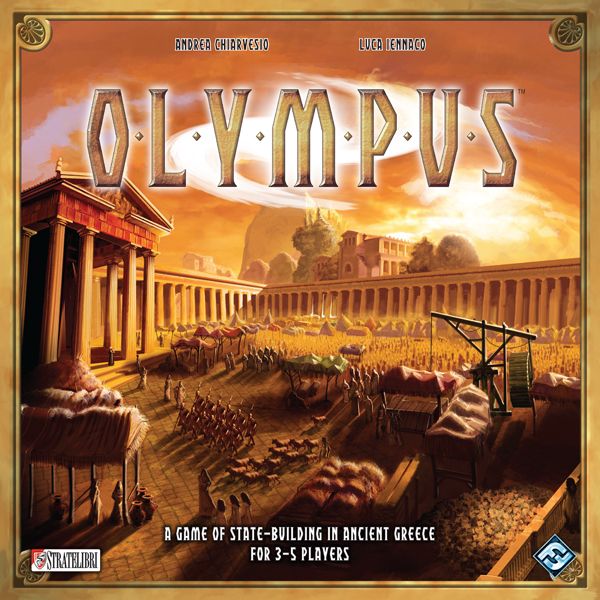
Olympus is a worker-placement game for three to five players who lead Greek city-states. Players use wooden priests to win the favor of the gods, which lets them grow their city-states and build structures. The game ends once four of the six Glory cards have been claimed, and the player with the most victory points wins.
Preparazione
- Place the game board in the middle of the table and put one Unique Building card on each of its 12 spaces, in any order.
- Sort the resource cubes by type (grain, meat, fish) into supplies near the board.
- Place the six Glory cards in a stack near the board.
- Each player chooses a color and takes a city-state sheet, 33 Common Building cards in that color, 5 priests, 7 progress markers, and 3 resource cubes (one of each type). Return unused components to the box.
- Put three priests on the top three clergy spaces of your sheet and set the other two aside in your supply.
- Place a progress marker on each of the six progress tracks. The population marker starts on 2 and the others start on 1.
- Put your last marker on the 0 space of the victory point track.
- Put your three starting resource cubes in your warehouse.
- Place your Common Building deck facedown near your sheet, leaving an empty area beside it for buildings you build. It does not need shuffling.
- Pick a random starting player and give them the starting player marker.
Un turno
A round has two phases, the Worship phase and the Upkeep phase.
Worship phase: The active player starts with the starting player marker. The active player must place one of their available priests on the alpha space of a deity they have not yet worshipped this round. Each deity can take only one ceremony per round, and a deity whose alpha space is already occupied cannot be chosen. If the active player has no available priests or no deity is open, they must pass.
The other players then decide in turn order, starting with the player to the active player's left, whether to join by placing one available priest on the beta space for that deity. Each ceremony can hold at most one priest of each color. Once everyone has decided, the deity grants its favors in turn order starting with the active player. The priest on the alpha space receives the stronger favor. The player to the left of the active player then becomes the new active player and starts a new ceremony. Players keep starting and joining ceremonies until all players have passed in a row or all priests are used.
Upkeep phase: Players complete these steps in order, each finishing before the next begins:
- Warehouse limit: discard any resources above 5 in your warehouse, choosing which ones.
- Population limit: any progress marker (except culture) that is ahead of your population marker is moved back to match it.
- Use buildings: resolve buildings whose text says they work in the Upkeep phase, in any order you choose.
- Collect tribute: move resources from your tribute area into your warehouse. This happens after the warehouse limit check, so you do not discard them.
- Gather priests: return all priests from the board to your supply, then take your priests for the next round. You always take three. You take a fourth if your population is 6 or higher, and a fifth if your culture is 8 or higher. Both bonuses can apply together. Your priest count is only updated during this step.
- Check for game end: see the end section below.
If the game continues, the starting player marker passes to the player on the starting player's left and a new Worship phase begins.
Fine della partita
The game ends at the end of a round in which the players have claimed a total of four Glory cards. That round is finished completely, including its Upkeep phase, before final scoring. Glory cards are checked during the Check for Game End step of the Upkeep phase.
Punteggio
Each player adds bonus points to their victory point track total. Each progress marker scores half its current space number, rounded down. The player with the highest total wins.
Ties are broken in this order:
- The tied player with the most resources left in their warehouse and tribute area wins. Note that the rulebook's tie-break counts resources left, so check the rulebook text for exact wording.
- If still tied, the tied player with the fewest buildings in play wins.
- If the tie remains, the tied players share the victory.
Modifiche
- Punteggio: bozza del regolamento, 23 novembre 2026 (mostrata ora)
- Fine della partita: bozza del regolamento, 23 novembre 2026 (mostrata ora)
- Un turno: bozza del regolamento, 23 novembre 2026 (mostrata ora)
- Preparazione: bozza del regolamento, 23 novembre 2026 (mostrata ora)
- Riassunto: bozza del regolamento, 23 novembre 2026 (mostrata ora)