Regole di C'era una volta
Riassunto
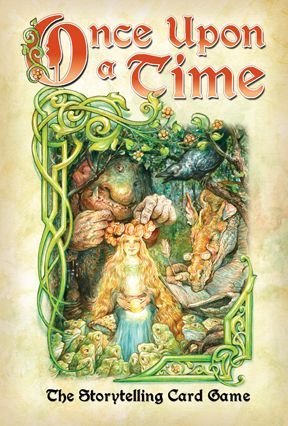
Once Upon A Time is a storytelling card game in which one player is the storyteller, weaving a tale from the elements shown on her cards while steering it toward her own Happy Ever After ending. Other players try to interrupt with their own cards and take over the story. The player who plays all her story cards and then her ending card to conclude the story wins.
Preparazione
Give each player one Happy Ever After card. Deal Once Upon A Time cards by player count: 2 players get 10 each, 3 get 8, 4 get 7, 5 get 6, and 6 or more get 5 each. Choose the first storyteller by any agreed method, such as oldest player, youngest player, or drawing a card and going by alphabetical order of the title (ignoring "A" and "The"). The owner of the game decides the method and the group keeps it for the whole session.
Un turno
The storyteller tells a story in any way she likes. Whenever she mentions an element shown on one of her cards, she places that card face up on the table. Each card should be mentioned in its own sentence and must matter to the story; mentioning things just to play cards is not allowed.
Other players may interrupt in two ways:
- If the storyteller mentions an element shown on another player's card, that player may play it, take over the story, and continue from where the storyteller left off. The exact wording is not required, and players cannot interrupt based on things not yet said.
- When the storyteller plays a card, a player holding a matching Interrupt card (for example, an Interrupt for any Object) may play it to interrupt. Interrupt cards cannot be used for things the storyteller only mentions.
An interrupted storyteller ends her turn and draws one card from the Once Upon A Time deck. The interrupter becomes storyteller and must continue the story consistently.
A storyteller may pass at any time by saying "Pass." She then draws one card, may discard one card from her hand, and play passes to the player on her left.
The storyteller's turn also ends, with her drawing a card and the player on her left becoming storyteller, if she pauses for more than five seconds, or if she rambles, stops making sense, or makes something foolish or contradictory happen. Doubtful cases are decided by a show of hands. These rules must not be used to unfairly take the story from a leading player or to harass younger or less articulate players.
An incorrect interruption makes the interrupter discard the card used and draw two cards. If two players interrupt at once, the one who played her card first succeeds, and the other faces no penalty.
Fine della partita
When the storyteller has played all her Once Upon A Time cards, she may play her Happy Ever After card to end the story. If the ending brings the story to a sensible, satisfying conclusion, the game ends and that player wins. The storyteller may add a sentence or two to link her last story card to the ending, but may not introduce new elements.
If the other players judge the ending unsatisfactory or nonsensical, that player draws a new Happy Ever After card and one Once Upon A Time card, and play passes to the player on her left. This rule should not be enforced strictly, especially with inexperienced or younger players; only clearly nonsensical endings should be rejected.
Varianti
Multiple Endings: Each player is dealt two Happy Ever After cards at the start and may play either one to win. This suits new players, or can balance a game when some players are more experienced, by giving less experienced players two endings.
Exchanging Endings: When passing as storyteller, you may discard your ending card and draw a new one from the Happy Ever After deck. You then draw two Once Upon A Time cards instead of the usual one. You cannot discard an ending card and a story card in the same pass.
Alternative Start: Deal the first hand as normal, but after each game the player with the most cards left in hand becomes the first storyteller of the next game.
Modifiche
- Varianti: bozza del regolamento, 23 novembre 2026 (mostrata ora)
- Fine della partita: bozza del regolamento, 23 novembre 2026 (mostrata ora)
- Un turno: bozza del regolamento, 23 novembre 2026 (mostrata ora)
- Preparazione: bozza del regolamento, 23 novembre 2026 (mostrata ora)
- Riassunto: bozza del regolamento, 23 novembre 2026 (mostrata ora)