Regole di Porta Nigra
Riassunto
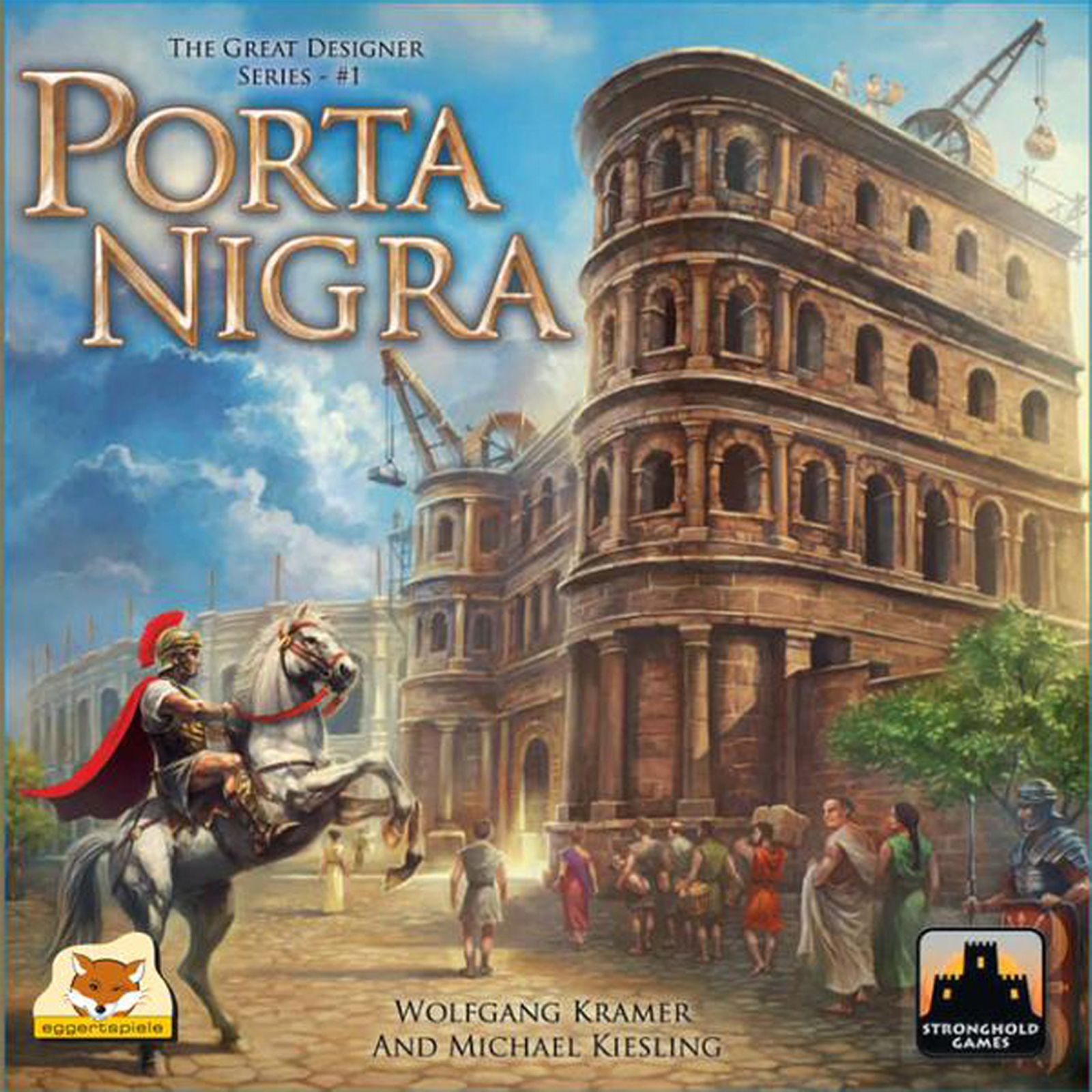
Porta Nigra is a game for 2 to 4 players in which you act as a Roman architect supervising the construction of buildings in ancient Augusta Treverorum. You collect grey bricks, which take on colour by where they are placed, and you build them into the four buildings while gathering building cards. The player with the most victory points after final scoring wins.
Preparazione
Place the board in the centre and set the bricks, coins, victory point markers, torch tokens and influence tokens nearby as the reserve, with the coins serving as the bank. Shuffle the supply cards into a face-down pile, and put the round marker on the first space of the round track. Shuffle the building cards into a face-down pile and draw 6 face up into the building card display. Shuffle the honour cards, then reveal 14 face up in two rows in the honour card display. Each player takes 20 sesterces and 1 torch token. Each player picks a colour and takes the player board, victory point marker (placed on 0), master builder, 3 action markers and 5 Romans, keeping the master builder, action markers and Romans beside the board; any remaining Romans of that colour go to a common reserve. Each player takes their 8-card action deck, and in a 4-player game removes the card marked for 2 or 3 players only. Shuffle the deck, place it face down, and draw 2 cards as your hand, kept hidden. Return unused components to the box.
Un turno
Each turn has a refill phase and an action phase. In the refill phase, if the brick market has fewer than 7 bricks, draw supply cards and place bricks in the shops shown until there are at least 14; on the first turn of the game, fill it to 14 right away. Then top up the building card display to 6 and the honour card display to 14 from their piles. In the action phase, play one card from your hand. Its torch count (2 or 3) sets how many actions you may take, each action icon can be used only once, and you cover each used icon with an action marker. You may spend a torch token from your play area to take an extra action on a free icon. Actions include: buying one brick from a shop (moving your master builder clockwise, paying 1 sesterce per quarter border crossed; the white shop is reachable from any quarter, and an empty coloured shop turns its icon into a grey any-colour icon); placing one building element on an empty building spot in your master builder's quarter, using a Roman from your play area; taking 1 influence token; taking 3, 4 or 5 sesterces; or taking 1 torch token. Torches can also be converted to 1 sesterce each by returning a torch token or forfeiting an action. Influence tokens can be spent at any time on influence actions: taking a Roman, placing a building element for 2 tokens, or buying one honour card per turn for its listed cost. At the end of your turn, return used action markers and torch tokens, put the played card in your discard pile, and draw one card if your draw pile has any. On your last turn of a round you must play your last card from your hand.
Fine della partita
A round ends when the last player has played and resolved her last action card. After the first round, or after the second round in a 2-player game, an intermediate scoring takes place and a new round begins. The game ends after the final round: 2 rounds for 3 or 4 players, 3 rounds for 2 players. The game also ends early if, during a player's turn, the brick reserve and the brick market are both empty, or if a player places her 15th building element. The player who triggers this scores 5 victory points and finishes her current card, then each other player takes one final turn. After that, final scoring is carried out.
Punteggio
At intermediate scoring, each player in turn order counts all bricks placed on the board, doubles that number in a 3 or 4 player game, then divides the result as she likes between sesterces and victory points, taking the sesterces from the bank and scoring the points. At final scoring, follow this sequence: first, set collection, where sets of different building cards score 2 points for one card, 6 for two, 12 for three and 20 for four (each card in a set showing a different building); second, final scoring cards in your play area; third, play area scoring, with 1 point per Roman, per 3 sesterces, per influence token, per torch token and per brick on your player board; fourth, majority scoring in each building or part of a building, where the players with the most and second-most bricks score points. Ties are broken in favour of the player who placed higher-value bricks, where white is worth the most and black the least. The player with the most victory points wins, and tied players share the win.
Modifiche
- Punteggio: bozza del regolamento, 22 novembre 2026 (mostrata ora)
- Fine della partita: bozza del regolamento, 22 novembre 2026 (mostrata ora)
- Un turno: bozza del regolamento, 22 novembre 2026 (mostrata ora)
- Preparazione: bozza del regolamento, 22 novembre 2026 (mostrata ora)
- Riassunto: bozza del regolamento, 22 novembre 2026 (mostrata ora)