Regole di Rajas of the Ganges
Riassunto
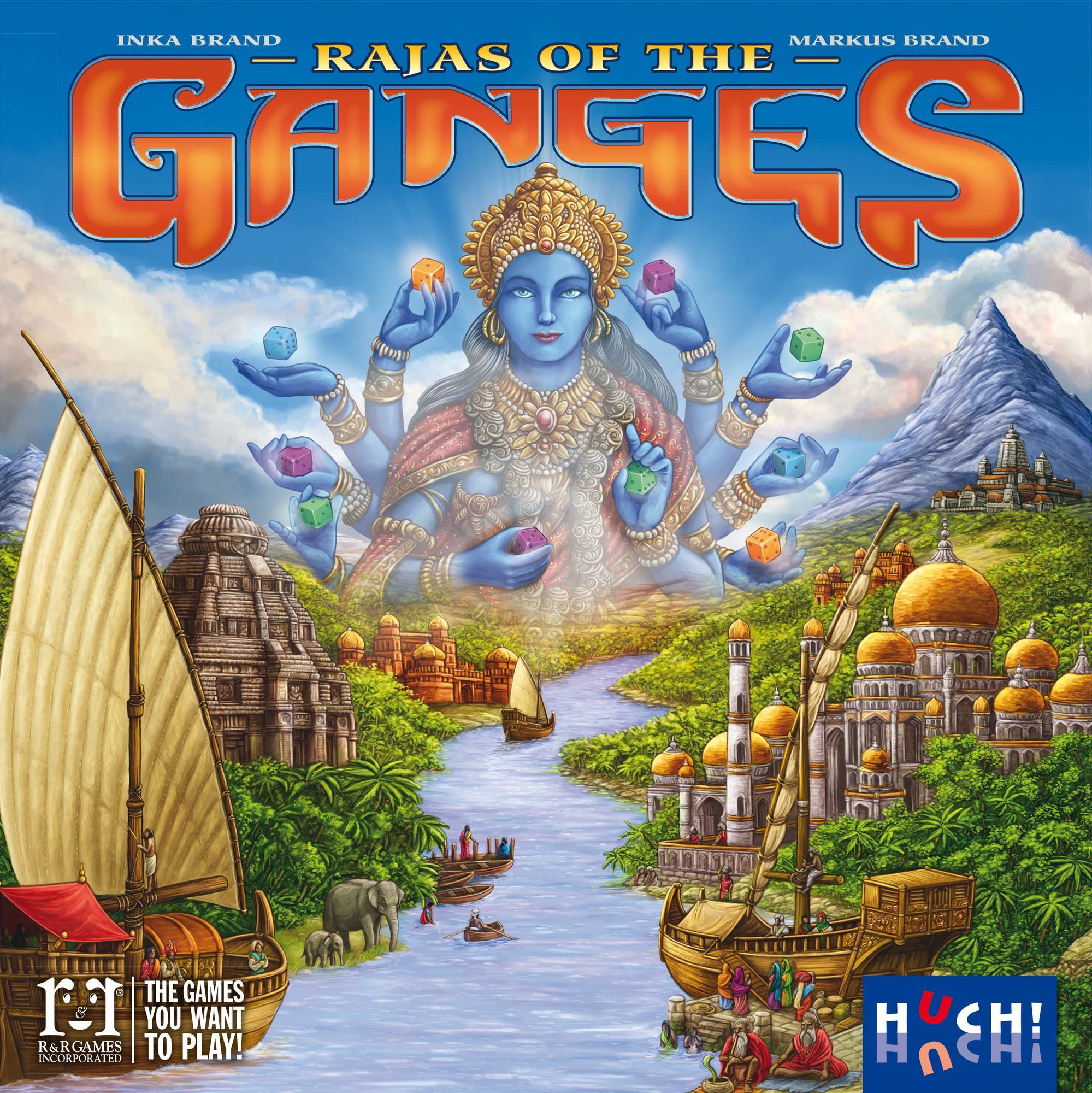
Players are rajas and ranis developing provinces in Mogul-era India. You win by moving your fame marker clockwise and your money marker counter-clockwise until they meet or pass each other. The first player to achieve this has a good chance of winning.
Preparazione
The player with the lowest total roll starts; on a tie, the player who ate Indian food last starts. The starting player puts his money marker on space 3, and each following player (in player order) takes the next higher space. Place the board with the side for your player count up, and cover the marked spaces with the cover tiles in a 3-player game. Put all 48 dice beside the board as a general supply. Leave out the yellow, red and brown yield tiles and the river tiles.
Sort the province tiles into 12 stacks by color and back symbol, shuffle each stack, and place them face up beside the board. Shuffle the 8 white yield tiles and place them face down on the temple.
Each player takes one color set: Kali statue board, province board, 6 workers, boat, 5 cubes, fame and money markers, and a bonus marker. Place 3 workers below your Kali statue and the other 3 on the fame space 15, money space 20 and the bridge on the river. Put your boat on the river's starting space, your karma cube on level 1, one upgrade cube in the left column of each building scroll, and your fame marker on fame space 0. Put your bonus marker on money space 12 with the river side up. Finally, roll one die of each color and place the four dice on free arms of your Kali statue.
Un turno
Starting with the starting player and going clockwise, players take turns placing one worker, paying any cost, and carrying out that action. Play continues until no one can place a worker, then all workers return below the Kali statues and a new round begins.
There are four action areas. At the quarry and the harbor, workers fill spaces row by row from left to right. At the market place and the palace, you may choose any free space. Each space holds only one worker. Costs are paid in money (moving your money marker back one space per money) or in dice (returned to the supply). Dice are never placed on the board. A die you receive is rolled immediately and placed on your Kali statue. In the basic game you may hold at most 10 dice.
- Quarry: pay 1 to 4 money depending on the space, then return dice of one color whose total is at least the tile's value and take that tile. Overpaying is allowed. Place the tile so one of its roads connects to your existing road network, then score it.
- Market place: score markets in your province. Assorted goods lets you score one market per goods kind for free. Single kind requires giving up one die and scoring up to that die's value in markets of one kind.
- Palace: free spaces give money or rerolls or a die. Other spaces require giving up a die of a set color or exact value: balconies trade a die for two of another color, chambers give fame, karma, dice, upgrades, money or a tile covering, and the Portuguese space moves your boat six spaces.
- Harbor: the first worker is free and later workers pay 1 or 2 money. Give up a 1, 2 or 3 to move your boat up to that many unoccupied river spaces, then take the earnings of the space you stop on.
At the end of a round, if someone placed a worker at the Great Mogul, that player takes the starting player elephant and starts the next round. Otherwise the elephant passes clockwise.
Fine della partita
The game ends as soon as one player's fame marker and money marker meet or pass each other. The current stage is completed first, so every player sitting between the triggering player and the current starting player may place one more worker, if they have one left, and carry out its action.
Punteggio
After the final stage, check which players had their markers pass each other on their final turn. Each of those players counts the fame-point gap between the money marker and the fame marker, and the player with the most points wins. Players who did not pass each other are not ranked by this count. For second and third place, count the fame points still separating each marker pair.
If players tie on this difference, the player whose markers passed each other first wins.
Varianti
Navaratnas version (advanced): players can activate all 3 inactive workers for up to 6 workers, store up to 8 dice, use the back of the Kali statue and the province board, and use the upgraded yield system. Each player places one random brown yield tile on a board space at the start. White, yellow and red yield tiles are placed on the matching buildings on the board. Yield tiles can be acquired at the dancer for a value-2 die and 2 dice, or when you have fewer active workers than another player. Yield tiles only pay once connected by a road, and a tile must be scored before its yield is taken.
Mixed groups (handicap): advanced players use the Navaratnas side and up to 5 workers, while beginners use the basic side. Yellow, red and brown yield tiles are not used.
Ganga module: add the 8 river tiles. Shuffle them face down, then roll a die, count that many river spaces after the starting space, and place a face-up river tile on that space, replacing its earnings. Repeat until the tiles run out or the river ends. The final river space can never be covered.
Modifiche
- Varianti: bozza del regolamento, 22 novembre 2026 (mostrata ora)
- Punteggio: bozza del regolamento, 22 novembre 2026 (mostrata ora)
- Fine della partita: bozza del regolamento, 22 novembre 2026 (mostrata ora)
- Un turno: bozza del regolamento, 22 novembre 2026 (mostrata ora)
- Preparazione: bozza del regolamento, 22 novembre 2026 (mostrata ora)
- Riassunto: bozza del regolamento, 22 novembre 2026 (mostrata ora)