Regole di Rise of Tribes
Riassunto
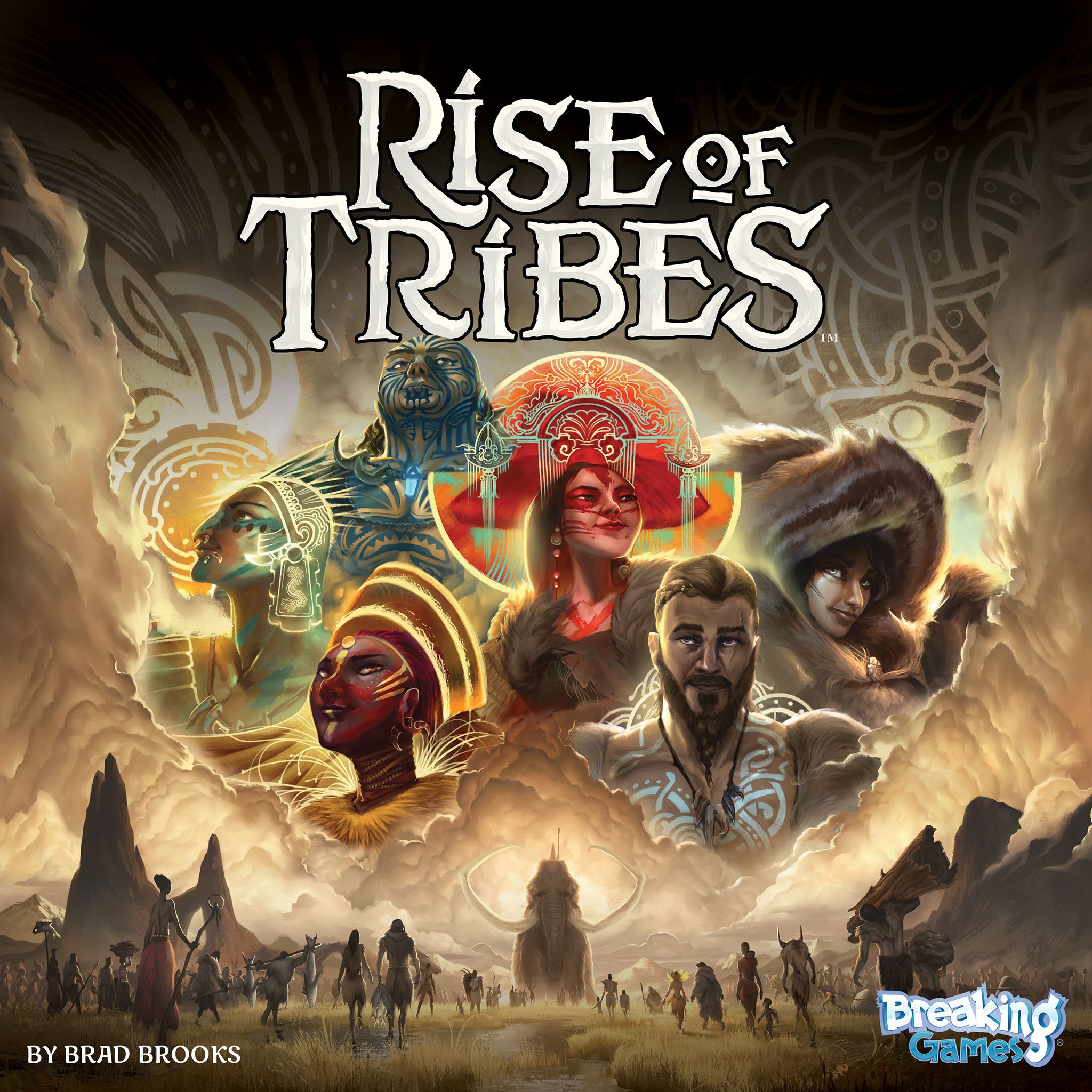
Players lead nomadic prehistoric tribes that grow, move across the land, gather resources, and build villages. The first player to reach 15 victory points wins immediately.
Preparazione
- Take terrain tiles: one more than the player count of each Lake, Forest and Mountain tile. Set aside the Volcano tile and return all other tiles to the box.
- Lay the terrain tiles face up at random in the layout for your player count.
- Each player takes 20 tribe members, a score marker, and a shuffled 15-card goal deck. In a 2-player game, remove the Pottery cards.
- Each player picks a player board (either side in the basic game) and places it in front of them.
- Put the resource tokens, village tokens and event tokens nearby, and place the action board where everyone can see it.
- Set aside the Chieftain and Abandoned Village event tiles face down. Shuffle the other 14 event tiles into a deck above the action board.
- Place score markers on 0. Put 3 dice on each of the 4 actions; the remaining 2 dice are rolled on the first turn.
- To pick the starting player, each player draws a numbered village. The lowest number goes first and places that village on top of the set-aside event tiles. Return the other villages to their pile.
- The starting player places 2 tribe members on one hex of their choice. Then, clockwise:
1. 2nd player: 3 tribe members on one unoccupied hex.
2. 3rd player: 3 tribe members on one unoccupied hex, and collect 2 resources of their choice.
3. 4th player: 3 tribe members spread across 2 adjacent unoccupied hexes, and collect 2 resources of their choice.
Un turno
Each turn has these steps:
1. Score villages: gain 1 point per village you have.
2. Roll 2 dice. If the dice match (two suns, two moons or two blanks), an event triggers before you continue.
3. Take 2 different actions. Place one rolled die on an action's column. Each new die goes into the first slot and pushes the others right; the die pushed off the end is rolled next turn. Resolve each action before placing the next die. The actions are:
- Grow: add the indicated number of tribe members from your supply to hexes you already occupy.
- Move: move up to the indicated number of tribe members, one hex at a time to adjacent hexes. Terrain and opponents do not block movement. Each tribe member moves at most once per turn.
- Gather: collect resources from occupied hexes as the action board indicates. Forests give wood, lakes give food, and mountains give stone.
- Lead: draw the indicated number of goal cards and place them face up on the left of your player board. You may first discard unfulfilled goals, up to the number of your villages, returning them to the bottom of your deck and drawing that many replacements.
Two moons on the dice give a low result, and two suns give the highest result.
4. Resolve conflicts if any hex has more than 5 tribe members. Conflicts are resolved in the order the current player chooses.
5. Build villages and complete goals. Spend resources to build villages on hexes with your tribe members and no other village. You may also complete any goals you can afford, and completed goals stay on the right of your board for the rest of the game.
Fine della partita
The game ends the moment a player reaches 15 points. No further turns are taken.
If a player has no tribe members left on the board, they are eliminated. At the start of their next turn, they place 2 tribe members on a hex of their choice, preferably an unoccupied one.
Punteggio
Points come from villages (1 point each at the start of your turn), completed Development cards (which also grant a point), and Achievement cards (2 to 4 points each, as printed on the card). Points, once gained, cannot be lost.
The rulebook does not describe a tiebreaker. The winner is the first player to reach 15 points.
Varianti
The rulebook gives three advanced modes, which can be combined in any mix:
- Tribal Elders: when you build a village, you may place your elder on it. Once per turn you may give a resource to a player and then use the effect of one of their completed developments. If an opponent destroys that village, they gain 1 point and the elder is removed until your next village is built.
- Special Terrain: swap special terrain tiles in for basic tiles during setup. They count as the basic type they replace for goals, events and resources.
- Leader Powers: flip your player board to reveal your leader, then choose one of the two powers on your tribe's leader card, and reveal it when you place your starting tribe members.
Modifiche
- Varianti: bozza del regolamento, 22 novembre 2026 (mostrata ora)
- Punteggio: bozza del regolamento, 22 novembre 2026 (mostrata ora)
- Fine della partita: bozza del regolamento, 22 novembre 2026 (mostrata ora)
- Un turno: bozza del regolamento, 22 novembre 2026 (mostrata ora)
- Preparazione: bozza del regolamento, 22 novembre 2026 (mostrata ora)
- Riassunto: bozza del regolamento, 22 novembre 2026 (mostrata ora)