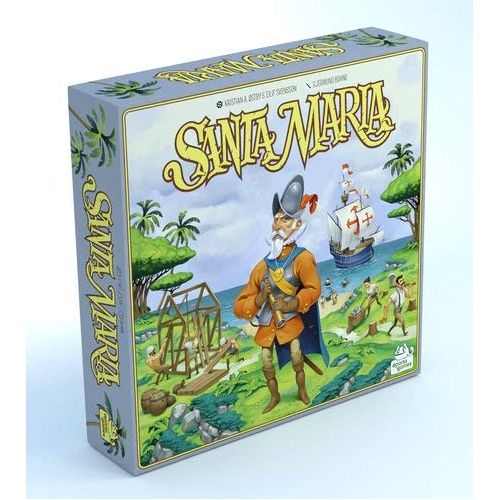
Regole di Santa Maria
Riassunto
A colony-building game set in the New World in the early sixteenth century. Each player develops a 6 x 6 colony by covering empty spaces with expansion tiles, then produces resources, forms shipping routes, sends conquistadors along a track, and advances on the religion track to recruit monks. After the game's years are played, the player with the most happiness points wins.
Preparazione
- Place the common board in the middle of the table. Put blue dice above it (the number per player depends on player count) and return any extra blue dice to the box.
- Roll the white dice (per player count), sort them by value and place them below the board. Return extra white dice to the box.
- Shuffle the starting shipment tiles and place them face up beside the four docks. Put the standard shipment tiles in a face-down stack nearby.
- Place the road tiles face up on the retiring space of the board.
- Set coins, happiness tokens and resource tokens as supplies. If coins or happiness tokens run out, use other objects as stand-ins.
- Shuffle the double and triple expansion tiles separately. Put 5 of each face up as the display on the right side of the board and keep the rest in face-down stacks.
- Return the gray-backed town hall tiles to the box unless using the advanced setup.
- Put the year marker on the first year space.
- Shuffle the scholar tiles and the bishop tiles separately and place a random set face up above their spaces on the board. Return the rest to the box.
- Each player takes a colony board (A-side up), their monks, and three player markers: one on the start of the religion track, one on the start of the conquistador track, and one on the market square. Return unused components when playing with fewer players.
- Randomly choose a starting player. For a first game, deal colony boards at random. Later, players choose in counter-clockwise order.
- Each player takes wood and coins according to seating order, placed in their colony board storage. Each player also takes one blue die, rolls it and places it left of their colony board.
Un turno
The starting player takes the first turn each year, and turns pass clockwise. On your turn you must take exactly one main action:
- A) Expand your colony: Pay wood (double tile) or wood and grain (triple tile) to take one tile from the display and place it on empty spaces in your colony. Do not refill the display during the year.
- B) Activate a single building: Place coins from your storage on one vacant building. The first activation in a year costs one coin, the next costs more, and so on. Then take one white die from the common pool or one of your blue dice. You may pay coins to change the die's value by one coin per point. Use a white die to activate all vacant buildings in the matching column from top to bottom, then place it on the lowest vacant building in that column. Use a blue die to activate the vacant buildings in the matching row from left to right, then place it on the rightmost vacant building. No player may take more than a set number of white dice in a year.
- C) Activate a row or column: Covered buildings and road spaces are skipped as described above, and the die goes on the last vacant building even if you do not use its effect.
- D) Retire: Withdraw from the round by moving your marker from the market square to a vacant retiring space and carrying out its action. Then receive income from your shipment tiles from top to bottom. You take no more main actions that year.
You may also take free actions as often as you like on your turn, including selling resources for coins, buying basic resources with coins, and using scholar abilities.
Buildings: Production gains resources, coins or points. Trading lets you pay one resource to gain another. Shipping lets you pay resources to take a shipment tile from a dock. Conquistador advances your conquistador marker. Religion advances your religion marker, and you may pay grain for an extra space. Passing monk symbols lets you recruit monks, and passing certain ones unlocks another blue die. Storage holds at most three of each resource; extra resources are sold for their selling price instead. Gold works as a wildcard.
Fine della partita
When all players have retired, the year ends. Players then score the conquistador track and clear the markers back to their start spaces, and coins and dice are returned from buildings. Retiring players' markers return to the market square when the next year begins, and the player who used the retiring space nearest the marked symbol starts the next year.
After the first and second years, expansion tiles still in the display are discarded and new ones are drawn, white dice are rerolled, and blue dice are rerolled by each player.
The game ends after the final year, when final scoring is carried out.
Punteggio
At the end of each year, players gain points from the conquistador track according to the scoring table for the current year and the number of players. The furthest-ahead player scores the most, and the last player or players who produced no conquistadors score nothing. When players share a space, the player who arrived there first counts as ahead.
At game end, players score:
- Remaining resources sold for coins, then one point for every three coins (rounded down).
- Fully developed rows and columns (filled with buildings or roads), giving points per colonist in them. A colonist counts twice if both its row and column are complete.
- Scholar tiles where you have a monk, plus bishop requirements. Each bishop placed costs points first, then bishop scoring applies.
- Points per complete set of shipment tiles (one ship in each dock).
- Points on shipment tiles, and any purple-framed happiness points.
The player with the most happiness points wins. If tied, the tied player who used the retiring space nearest the marked symbol in the final year wins.
Varianti
- Advanced setup: Each player uses the B-side colony board. Each player receives wood, coins by seating, and one blue die. Town hall tiles are placed face up, each with a scholar below. Players choose a town hall set in counter-clockwise order, placing the town hall on two empty spaces. The matching scholar is trained by that player from the start.
- Common pool of blue dice: Blue dice are drafted from a shared pool like white dice. A blue die is added to the pool when passing certain monk symbols, and players may take only as many blue dice in a year as they have unlocked.
- Solo game: Played with the advanced setup. Score points by passing tree markers on the conquistador track at the end of the first three years, and aim for a target score or one of the listed achievements.
Modifiche
- Varianti: bozza del regolamento, 22 novembre 2026 (mostrata ora)
- Punteggio: bozza del regolamento, 22 novembre 2026 (mostrata ora)
- Fine della partita: bozza del regolamento, 22 novembre 2026 (mostrata ora)
- Un turno: bozza del regolamento, 22 novembre 2026 (mostrata ora)
- Preparazione: bozza del regolamento, 22 novembre 2026 (mostrata ora)
- Riassunto: bozza del regolamento, 22 novembre 2026 (mostrata ora)