Regole di Seeland
Riassunto
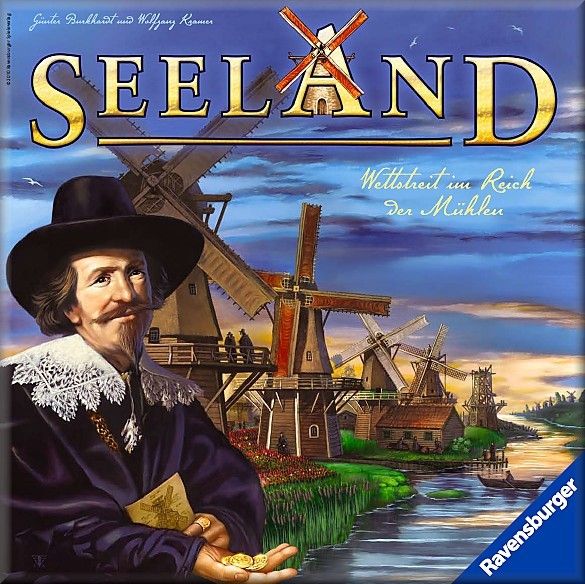
Players are wealthy Dutch merchants in the 17th century who drain diked areas with mills to grow cabbage, rapeseed and tulips. They buy mill plans or seeds from the market, place them on the board, and harvest a mill's yield once it is completely surrounded. The player with the most points at the end wins.
Preparazione
Prepare the game according to the enclosed diagram sheet (not included in this text).
The last player to have been to the Netherlands begins. In clockwise order, each player places one of his own mills on one of the six mill illustrations of the starting village, with only one mill per square. Once every player has placed a mill, the game begins.
Un turno
Each turn has three actions: 1. Purchase, 2. Land reclamation, 3. Harvest.
Purchase: Move the guild master clockwise by at least one square on the market, then take the seeds (market stall) or mill plan (workshop) on that square. The tile directly in front of the guild master is free. Each square skipped, including the warehouse, costs one guilder: move your merchant forward one guilder on the trading house circle, but never past the foremost guilder. After payment, the topmost landscape tile (or mill tile) from the stack refills the square the guild master left.
Warehouse: Take no tile and skip actions 2 and 3. Instead, move your scoring marker back 3 points, and you may move your merchant back up to 3 guilders.
Land reclamation: Turn over the bought tile. A landscape tile goes on any empty square adjoining your own mill. A mill tile goes on any empty square adjoining developed squares (landscape tiles, mill tiles or farms). You may then build your mill on the mill tile you just placed, making it yours.
Island tiles: When your own mill borders face-down island tiles, turn them over. Each farm revealed gives you one stuiver, which you may spend at the end of a turn (removing it from the game) for an extra turn. You may use only one stuiver per round.
Harvest: When a mill is completely surrounded, harvest it immediately. Its yield is the mill tile's value plus the values of adjoining landscape tiles. Farms score nothing. A landscape bonus of 5 points applies if the mill borders all three crops. A monoculture (no landscape tiles, or only one crop type) scores zero. Move your scoring marker by the yield, then return the mill to your supply.
Fine della partita
The game ends when the mill stack or the landscape stack runs out. Market stalls and workshops can then no longer be refilled and stay vacant.
It also ends if a player moves the guild master onto a vacant square (except the warehouse), by choice or necessity. No harvest happens then, so mills still on the board score nothing.
Punteggio
Points are tracked on the scoring track through harvests, the landscape bonus and warehouse penalties. The player whose scoring marker is furthest forward wins. If players are tied, they all win.
Varianti
The rulebook describes these variants:
Governors and records: Adds two elements. Governors are taken when an island tile showing a governor symbol is turned over. At harvest, the mill's yield is compared with the trading house's golden number. A yield below it costs 5 points and moves the governor to the nearest mill without one. A yield equal to or above it earns 5 bonus points, and the governor stays with you. At the end, each governor-mill costs 5 points, and the player with the most satisfied governors gets 10 bonus points (5 each on a tie). Records: twice per game, mark a harvest on the scoring track with a record marker. At the end, the four best record markers earn 20, 15, 10 and 5 bonus points.
Tactical game: Assemble the board with the pre-printed landscape and farm side up. Players may only develop from the pre-printed tiles once the area is connected to the developed area, and governors are placed next to the mill that triggered them.
All elements can be combined.
Modifiche
- Varianti: bozza del regolamento, 23 novembre 2026 (mostrata ora)
- Punteggio: bozza del regolamento, 23 novembre 2026 (mostrata ora)
- Fine della partita: bozza del regolamento, 23 novembre 2026 (mostrata ora)
- Un turno: bozza del regolamento, 23 novembre 2026 (mostrata ora)
- Preparazione: bozza del regolamento, 23 novembre 2026 (mostrata ora)
- Riassunto: bozza del regolamento, 23 novembre 2026 (mostrata ora)