Regole di Targi

Riassunto
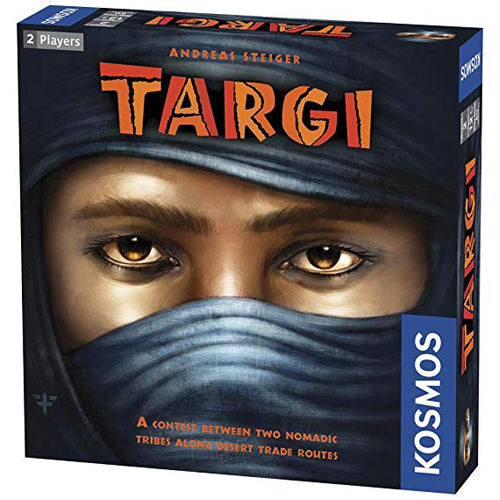
Targi is a two-player game about leading Tuareg tribes across the desert by trading goods, gathering gold, and displaying tribe cards. Each round, players place Targi figures on border cards to trigger actions, while the robber moves around the board and forces raids. The player with the most victory points at the end wins.
Preparazione
Place the 16 numbered border cards in order from 1 to 16 around the edge; they stay in place all game. Shuffle the goods cards and tribe cards separately, then lay 9 face up on the center spaces in the alternating pattern shown: 5 goods and 4 tribe cards. Put the remaining tribe cards beside the tribal expansion card and the remaining goods cards beside the caravan card. Place goods, gold, and victory point tokens as a general supply. Set the robber next to border card 1 (noble). Each player takes 3 Targi figures, 2 tribe markers, 2 dates, 2 salt, 2 pepper, 1 gold, and victory point tokens worth 4 in total (one 1-point and one 3-point token). The player who last ate dates takes the starting player token; if neither has, the blue player starts.
Un turno
Each round has five steps. 1) Advance the robber one border card clockwise; in the first round it goes onto the noble card. 2) Starting with the starting player, players alternate placing their 3 Targi figures on border cards. A figure cannot go on the robber's card, a raid corner card, a card already holding any Targi, or a card opposite an opposing Targi. 3) Each player places tribe markers where lines drawn from each of their Targi to the opposite side cross; two Targi in the same row or column give only one crossing. 4) The starting player carries out all actions for their figures and markers first, then the other player. Each action must finish before the next begins, actions are optional, and the Targi is taken back after its card is used. A used center card is replaced by a face-down card of the opposite type. Goods cards give the indicated goods, gold, or victory points; tribe cards are displayed by paying their cost in goods and gold, or held in hand (only one at a time) and played later via the noble action. The trader allows exchange at 1 to 1 and the silversmith is used for gold-related exchanges. 5) At the end of the round, flip the face-down cards face up, pass the starting player token to the other player, and advance the robber again. Afterwards, each player keeps at most 10 goods and 3 gold; extras go back to the supply. When the robber lands on a raid card, players starting with the current starting player each surrender victory points or goods, or 1 gold on the last raid card, then the robber moves on and figures are placed again.
Fine della partita
The game ends at the end of the round in which a player displays their twelfth tribe card. If the starting player triggers this, the other player still gets one full turn for that round. The game also ends immediately if the robber reaches the fourth raid card, after players pay the required gold or victory points.
Punteggio
Each player adds their victory point tokens and the points printed on their displayed tribe cards, plus any extra points from card effects. Completed rows of 4 cards give bonus points: 4 points if all four share one symbol, or 2 points if all four show four different symbols. Rows with fewer than 4 cards, or with a symbol repeated twice or three times, give nothing. The player with the most points wins. On a tie, the player with more gold wins; if still tied, the player with more goods wins; if still tied, the game is a draw.
Modifiche
- Punteggio: bozza del regolamento, 23 novembre 2026 (mostrata ora)
- Fine della partita: bozza del regolamento, 23 novembre 2026 (mostrata ora)
- Un turno: bozza del regolamento, 23 novembre 2026 (mostrata ora)
- Preparazione: bozza del regolamento, 23 novembre 2026 (mostrata ora)
- Riassunto: bozza del regolamento, 23 novembre 2026 (mostrata ora)