Regole di The Great Dalmuti
Riassunto
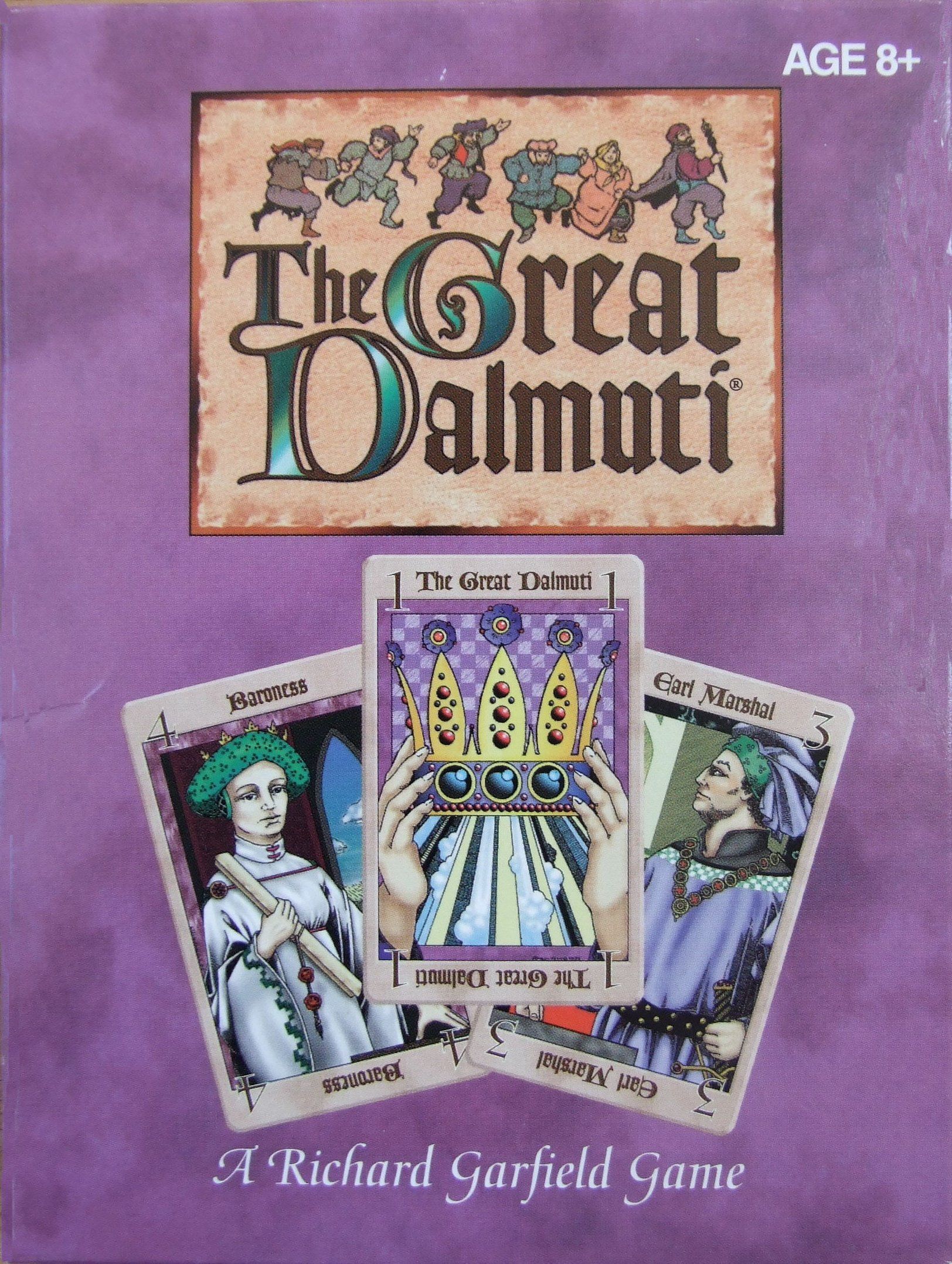
The Great Dalmuti is a quick card game for about five to eight players where each hand ranks players into social classes. Players try to get rid of all their cards as fast as they can; the faster you go out, the higher your class in the next hand, and the Greater Peon is the loser.
Preparazione
Shuffle and fan the 80-card deck, then have each player draw and reveal one card. Players seat themselves by card rank: the best card becomes the Greater Dalmuti, who takes the seat of their choice, the second-best becomes the Lesser Dalmuti and sits to the Greater Dalmuti's left, and so on around the table. The worst card is the Greater Peon and the player to their right is the Lesser Peon; everyone else is a Merchant. Jesters rank worst of all. Break ties by drawing additional cards.
The Greater Peon collects, shuffles and deals the entire deck clockwise, starting with the Greater Dalmuti, so some players may get more cards than others. Players may look at their hands while dealing continues.
Taxation: before play, the Greater Peon gives his or her two best cards to the Greater Dalmuti, who returns any two of their own cards. The Lesser Peon and Lesser Dalmuti do the same with one card each. All exchanges happen at once.
Revolution: a player dealt both Jesters may call a revolution, which cancels taxation. If the Greater Peon calls it, it is a greater revolution and every player swaps seats with their opposite position.
Un turno
The Greater Dalmuti leads the first hand. The leader plays a set of one or more cards of the same rank face up. On their turn, each player either plays a set with the same number of cards that is of better rank (lower number), or passes. A player who passes may still play later in the hand. A Jester played alone counts as rank 13; when played with other cards it takes their rank.
Play continues clockwise until everyone passes in a row. The Greater Peon then collects the played cards and sets them aside, and the player who made the last play leads the next hand.
A player who plays their last card has gone out. Play then continues clockwise, and if no one beats the current set, the lead passes to the next player who still has cards.
New players may join at the start of any hand, entering as a Merchant. The Greater Dalmuti decides the order if there is a choice of seats.
Fine della partita
A hand ends when everyone passes in a row after a play. The game is normally played for a set number of hands, and the seating changes after each hand to show the new social order.
Punteggio
Each hand is played for its own sake: the Greater Dalmuti is the winner and the Greater Peon the loser, with other positions in between. In the basic scoring rules, each player who goes out earns 1 point for every player still in that hand. Set a number of hands, commonly twenty to start, and the player with the highest total at the end wins. The rulebook does not describe how to break a tie in the final score.
Varianti
First Deal Revolution: the first deal automatically is a revolution, so no taxes are collected; the Greater Peon may still call a greater revolution if dealt both Jesters.
Stripped Decks: for five players remove the Peasants (68 cards); for four players remove the Peasants and Stonecutters (57 cards).
Philanthropic Scoring: use the basic scoring, and the Greater Dalmuti gets 1 point if the Greater Peon moves up in status, and the Lesser Dalmuti gets 1 point if the Lesser Peon moves up.
More Appropriate Seating and Status Symbols: use ranked seating, hats, or perks such as snack choice to show class.
Merchant Exchange: during taxation the highest-class Merchant may swap a random card with another Merchant of their choice.
Misdeals: if the Greater Peon accidentally exposes a card while dealing, the Greater Dalmuti decides who receives it; if it goes to the Greater Peon, they replace it with a random card from their hand.
Modifiche
- Varianti: bozza del regolamento, 23 novembre 2026 (mostrata ora)
- Punteggio: bozza del regolamento, 23 novembre 2026 (mostrata ora)
- Fine della partita: bozza del regolamento, 23 novembre 2026 (mostrata ora)
- Un turno: bozza del regolamento, 23 novembre 2026 (mostrata ora)
- Preparazione: bozza del regolamento, 23 novembre 2026 (mostrata ora)
- Riassunto: bozza del regolamento, 23 novembre 2026 (mostrata ora)