Regole di Ticket to Ride: Amsterdam
Riassunto
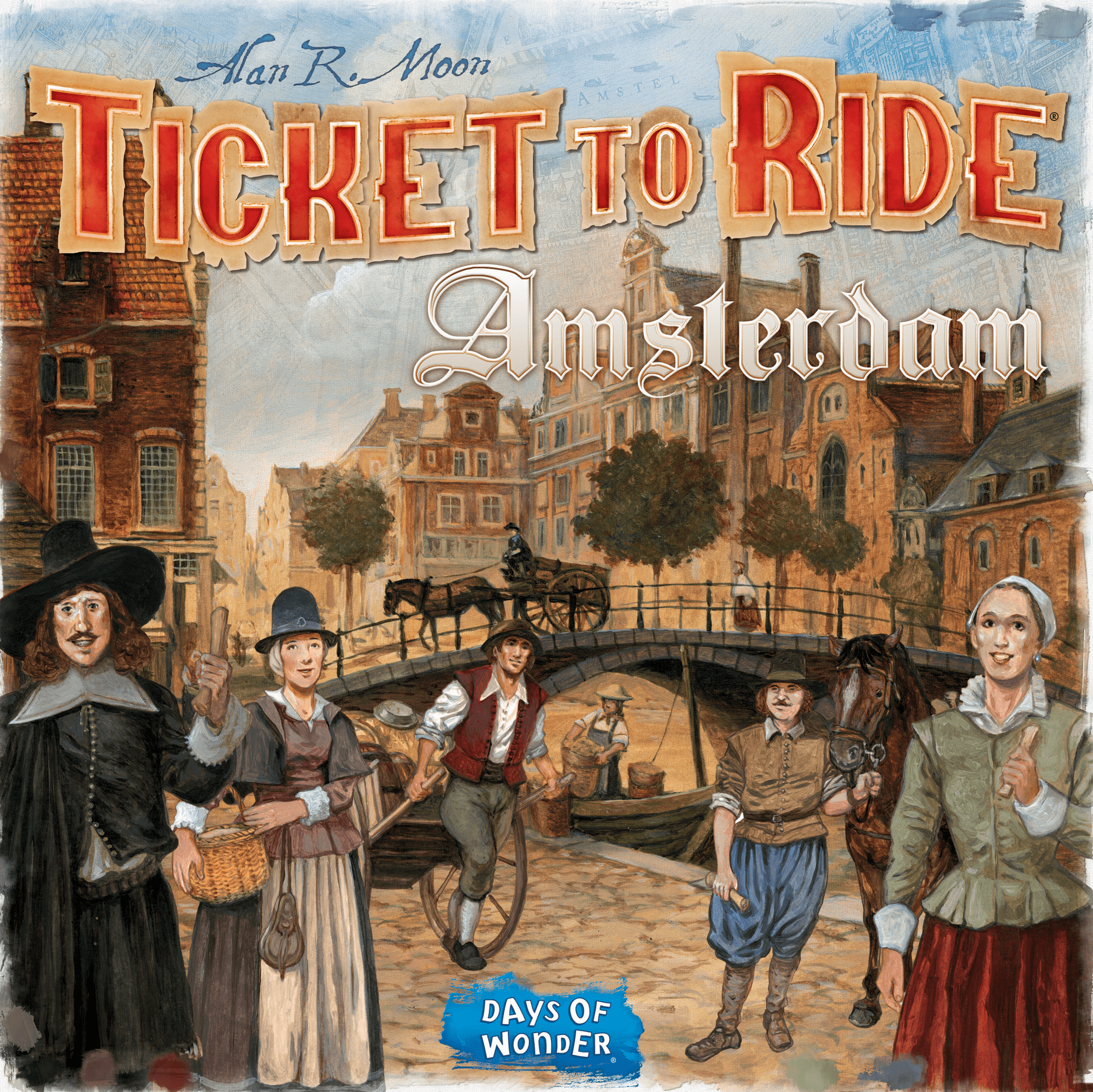
Players build a trade network on a map of 17th-century Amsterdam by claiming Routes between adjacent Locations and by completing Contract cards that link two Locations. Points come from claimed Routes, completed Contracts, and Merchandise Bonus cards. The player with the most points at the end wins.
Preparazione
- Place the board in the center of the table.
- Each player takes a color of plastic Carts and its matching Scoring Marker, and places the marker on the Start space of the Scoring Track.
- Place the 16 Merchandise Bonus cards in a deck next to the board.
- Shuffle the Transportation cards and deal two to each player. Place the rest of the deck near the board and flip five cards face up. If three of those five are Wild cards, discard all five and flip five new ones.
- Shuffle the Contract cards and deal two to each player. Each player keeps at least one and may keep both. Any returned card goes to the bottom of the Contract deck, which is placed next to the board. Players keep their Contract cards secret until the end.
Un turno
Starting with the youngest player and going clockwise, each player takes exactly one of these actions on their turn:
- Draw Transportation cards: Take two cards, either from the top of the deck or from the face-up cards. If you take a face-up card, replace it from the deck. A face-up Wild card taken as your first card ends your draw, and you cannot take a face-up Wild card as your second card. If three face-up cards are Wild, discard all five and flip five new ones. When the deck runs out, shuffle the discards to form a new deck.
- Claim a Route: Discard cards matching the Route's color (Wild cards match any color) equal to the number of spaces in the Route, then place one of your Carts on each space. You may claim any open Route, even if it is not connected to your other Routes, but you cannot claim more than one Route per turn. You need enough Carts to fill every space. A player cannot claim both Routes of a Double Route. In a two-player game, once one Route of a Double Route is claimed, the other cannot be claimed by the other player. When you claim a Route, record its points on the Route Scoring Table and move your Scoring Marker. If the Route has cart symbols, draw one Merchandise Bonus card, no matter how many symbols it has, and place it face up in front of you.
- Draw Contract cards: Draw two Contract cards from the top of the deck. Keep at least one and you may keep both. Returned cards go to the bottom of the deck. Once kept, a Contract cannot be discarded. If only one card is left in the deck, you must keep it.
Fine della partita
When a player has two or fewer Carts left in their supply, every player, including that player, takes one last turn. Then the game ends and final scoring begins.
Punteggio
Final scoring happens in three steps:
1. Check the points from claimed Routes that were already recorded during play.
2. Reveal all Contract cards. Add the value of each completed Contract and subtract the value of each uncompleted one. A Contract is completed when a continuous path of your claimed Routes joins its two Locations.
3. Score Merchandise Bonus points. Rank players by the number of Merchandise Bonus cards each collected. Players with no Merchandise Bonus cards cannot score this bonus.
- 4 players: 1st +8, 2nd +6, 3rd +4, 4th +2
- 3 players: 1st +8, 2nd +5, 3rd +2
- 2 players: 1st +8, 2nd +4
- If players tie for a rank, they all receive that rank's points and the next rank is skipped.
The player with the most points wins. If players are tied, the tied player who completed the most Contract cards wins. If they are still tied, they share the victory.
Modifiche
- Punteggio: bozza del regolamento, 23 novembre 2026 (mostrata ora)
- Fine della partita: bozza del regolamento, 23 novembre 2026 (mostrata ora)
- Un turno: bozza del regolamento, 23 novembre 2026 (mostrata ora)
- Preparazione: bozza del regolamento, 23 novembre 2026 (mostrata ora)
- Riassunto: bozza del regolamento, 23 novembre 2026 (mostrata ora)