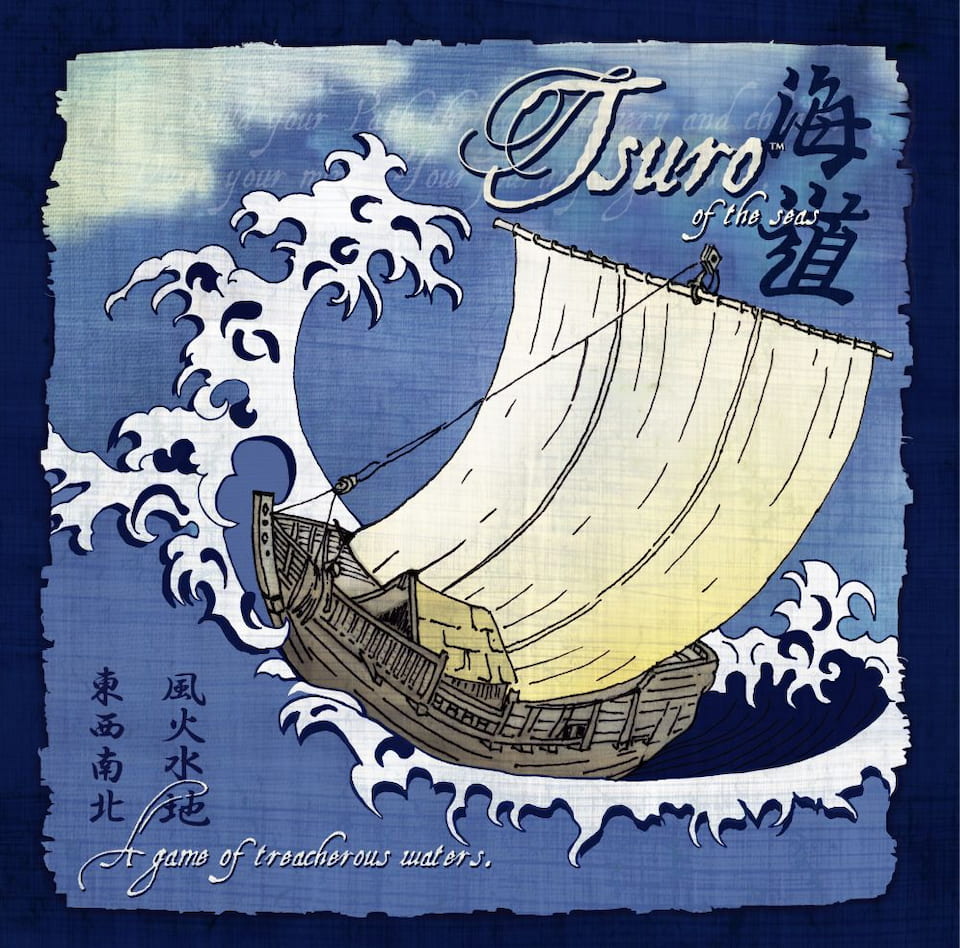
Regole di Tsuro of the Seas
Riassunto
Tsuro of the Seas is a board game for two to eight players. Each player commands a ship that sails along wake routes made by placing wake tiles from the edge of the board. The goal is to avoid being destroyed by the daikaiju (giant monsters) and to avoid being forced off the board. The last ship remaining wins.
Preparazione
- Lay out the game board.
- Each player chooses a ship.
- Shuffle the wake tiles and deal three face down to each player as a hand. Players may look at their own hand at any time.
- Stack the remaining wake tiles face down as the draw pile.
- Place the daikaiju: use 6 for 2 to 4 players, 5 for 5 to 6 players, or 4 for 7 to 8 players. Shuffle the daikaiju tiles face down. For each one, roll the gold and blue dice. The gold die picks the column along the top of the board and the blue die picks the row along the left side. Place the tile face down in that square. If the square already holds a daikaiju, re-roll. Then rotate each tile in a random direction and turn it face up.
- Starting with the oldest player and moving around the board, each player places a ship on any open start mark on the outer edge. All ships must be placed before any wake tiles are played.
Un turno
The oldest player goes first, and play continues to the left. Each turn has four steps:
- Roll for daikaiju. Roll both dice. On a 6, 7, or 8, move the daikaiju as described below.
- Place a wake tile. Choose a tile from your hand and place it on an open square next to your ship, using any side.
- Move your ship along the wake to its open end.
- Draw a tile from the draw pile so you have three in hand.
Daikaiju movement: Move or rotate daikaiju in ascending order of the rotation number in the tile corner. If two share a number, the one with the gold arrow moves first. Roll one die for each daikaiju:
- 1 to 5: the daikaiju moves or rotates as its arrows indicate.
- 6: it does not move. Instead, place a new daikaiju using the setup rules.
Daikaiju effects:
- If a move would take a daikaiju off the board, it is removed.
- If a daikaiju moves onto a wake tile, that tile is removed and put at the bottom of the draw pile. Any ship on it is eliminated.
- If a daikaiju moves next to the active player's ship, that ship is destroyed and eliminated. A second ship sitting side by side on the same wake side is not automatically destroyed, since the daikaiju may move before that player's turn.
- If a daikaiju moves onto another daikaiju, the moving one destroys the stationary one, which is removed.
- At least 3 daikaiju must remain. If movement leaves fewer, the next player rolls to place enough new daikaiju to reach 3. That player does not roll for movement that turn. If a new daikaiju lands on a wake tile, that tile is removed and any ship on it is eliminated.
- If a daikaiju blocks a ship's first move or leaves its start mark, that player may move to another start mark on the same edge that has no wake tile.
Placing wake tiles: A player may not willingly do any of these unless no other move is possible:
- connect their own wake to the board edge
- create an endless loop that traps their own ship
- connect their wake to a daikaiju
- let two ships travel the same wake in the same direction
Placed tiles stay where they are unless a daikaiju removes them.
Moving your ship: Move to the open end of your wake. If the new tile links to another ship's wake, that ship moves to its open end too. If your tile connects two other wakes, both of those ships move. Ships pass without colliding. A ship is eliminated if its open end reaches the board edge or a daikaiju.
Elimination bonus: If your tile eliminates one or more opponents, you may swap any tiles in your hand for the same number from the eliminated players' hands. The tiles you give up go to the bottom of the draw pile. You still draw afterward.
Returned tiles: Tiles removed by daikaiju go to the bottom of the draw pile.
Fine della partita
The game ends when only one Imperial Japanese Red Seal ship remains on the board. That player wins. If a wake tile placed in the last open square takes two or more players off the board, those players all win.
Punteggio
The rulebook does not use points. The winner is the last ship still afloat. Ties are covered in the FAQ: if the tiles fill the board while two or more ships remain, those players tie for the win. If all remaining players are eliminated by the same move, those players tie.
Varianti
No Daikaiju: Players who want no random elements may play without placing any daikaiju. All other rules still apply.
Modifiche
- Varianti: bozza del regolamento, 23 novembre 2026 (mostrata ora)
- Punteggio: bozza del regolamento, 23 novembre 2026 (mostrata ora)
- Fine della partita: bozza del regolamento, 23 novembre 2026 (mostrata ora)
- Un turno: bozza del regolamento, 23 novembre 2026 (mostrata ora)
- Preparazione: bozza del regolamento, 23 novembre 2026 (mostrata ora)
- Riassunto: bozza del regolamento, 23 novembre 2026 (mostrata ora)