Regole di Vegas Showdown
Riassunto
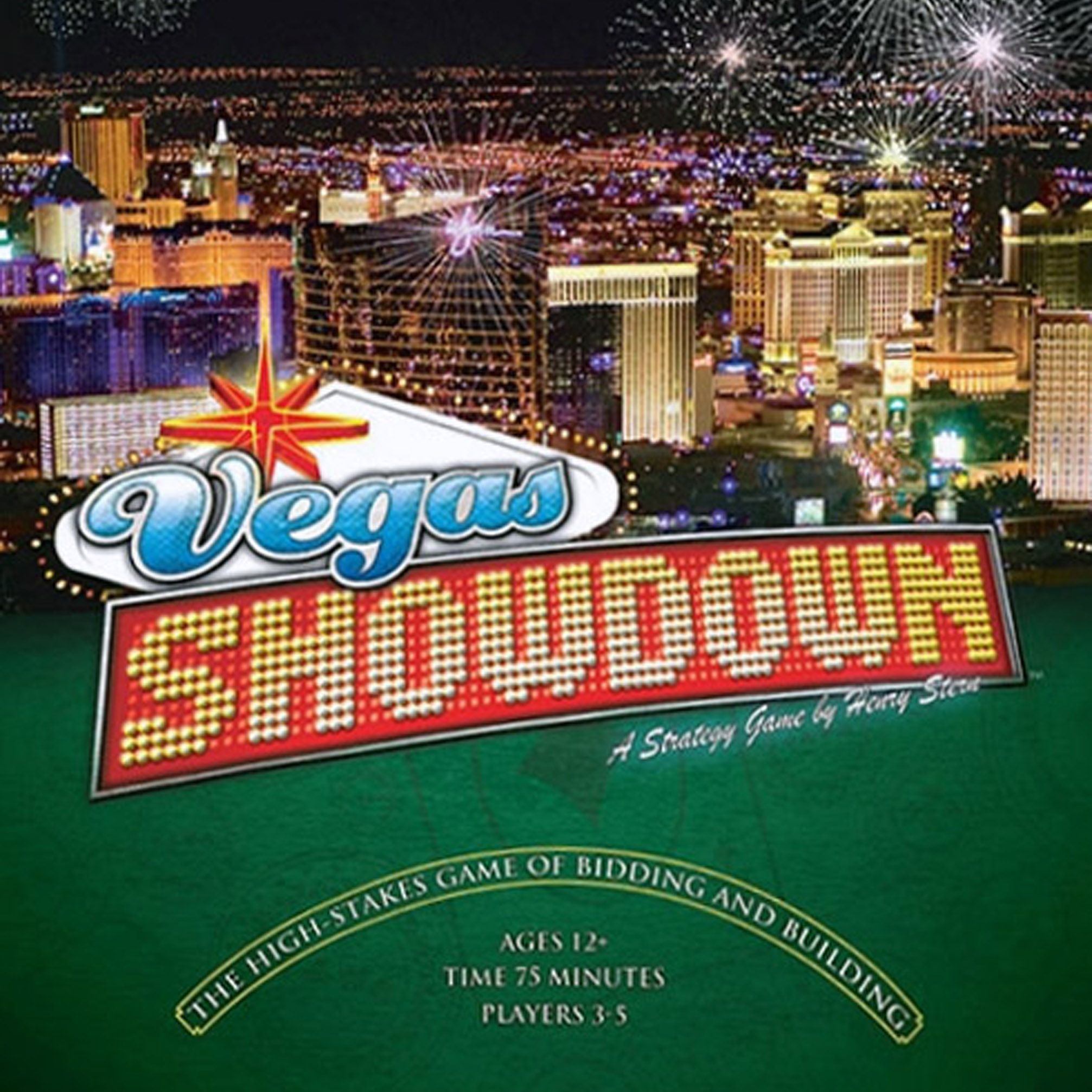
Players are wealthy friends competing to design the most prestigious hotel-casino on the Vegas Strip. You bid for tiles and place them on your hotel-casino sheet to raise your Population, Revenue, and Fame. The player with the most Fame at the end of the game wins, with ties broken by leftover cash.
Preparazione
- Place the game board on the table. Stack the Restaurant, Lounge, and Slots tiles face up on their marked spaces. In a 3-player game, remove three tiles from each of those stacks.
- Each player chooses a color and takes that color's hotel-casino sheet and markers. Put the Population marker on 8 of the sheet's track, the Revenue marker on 5 of its track, and the Fame marker on 0 of the board's score track.
- Sort the remaining tiles into three premier stacks by size. For each size, shuffle the B tiles and the A tiles separately, then place the A stack on top of the B stack. Set the stacks beside the board.
- Flip the top tile of each premier stack onto the three premier spaces not marked 4-5 Players Only. Place a Minimum-Bid marker on each tile's bidding track at the starting-bid price shown on the tile.
- Place the reference charts within reach and shuffle the Event deck face down beside the board.
- Choose a banker. The banker keeps the money chips as the bank and gives each player $20 in chips.
- Randomly choose the first player and give them the Turn Order Button.
Un turno
Each turn has these steps, in order:
- Drop prices. Skip this on the first turn. Move each premier tile's Minimum-Bid marker down to the next lower circle space, skipping the square space between. If a marker drops off the 3 space, remove that tile from the game.
- Flip new tiles. In a 3-player game, leave the 4-5 Players Only space empty all game. Otherwise, fill each empty premier space by drawing an Event card and carrying out its instructions. Then flip the top tile of the stack the card's symbol points to, and place a Minimum-Bid marker at its starting price. Some cards place No-Bid markers on tiles or actions; remove these during the pass step. If a card cannot be completed right away, leave it in play until it can be.
- Collect income. Each player receives chips worth the lesser of their Population and Revenue. Player cash is public.
4. Choose actions. Starting with the Turn Order Button holder and moving clockwise, each player chooses one action:
- Bid on tiles. Place your Bid marker on the amount you will bid. Premier bids must meet or exceed the Minimum-Bid price. Non-premier bids must meet the yellow minimum. You must outbid any current bid, cannot exceed your cash, and cannot go above the top of the track. When outbid, you wait for your next turn to act again. Bidding ends when every player has acted and no one has been outbid. Each winning bidder pays the bank, then places the tile or sets it aside.
- Renovate. Place your Bid marker on the Renovate space. Remove 0, 1, or 2 tiles from your sheet, then place 0, 1, or 2 tiles you own that are off your sheet.
- Publicity. Place your Bid marker on the Publicity space. Gain 1 Fame and place one owned off-sheet tile onto your sheet.
Once you choose an action, you cannot change it unless you are outbid.
- Adjust Fame, Revenue, and Population. Add bonuses from newly placed tiles to the tracks, and remove bonuses from tiles taken off first. Retrieve your Bid marker.
- Pass the Turn Order Button. Pass it to the player on your left, who acts first next turn. Remove any No-Bid markers.
Tile placement rules:
- A premier tile needs the prerequisite tiles shown on the Building Prerequisites chart.
- Yellow (casino) tiles must trace an unbroken path from the casino entrance without crossing walls. Blue (hotel) tiles must connect to the hotel entrance. Green tiles must connect to either entrance.
- Night Club tiles must connect one entrance to a Lounge or Fancy Lounge entrance.
- Once placed, a tile cannot be moved except through Renovate.
Fine della partita
The game ends immediately when either of these happens:
- A player completely fills their hotel-casino sheet with tiles.
- A premier tile must be replaced, but no tiles remain in the stack the Event card names.
Punteggio
Final Fame is scored in these categories:
- Filled casino section: 5 Fame if the yellow shaded section is filled with only yellow and/or green tiles.
- Filled hotel section: 5 Fame if the blue shaded section is filled with only blue and/or green tiles.
- Connected hotel-casino: 3 Fame if an unbroken path of tiles, without walls, links the casino entrance to the hotel entrance.
- Highest Population: 5 Fame for first, 3 for second, 1 for third.
- Highest Revenue: scored the same way as Population.
- Cash: 1 Fame for each full $10 in cash. Exchange it for the bank after scoring.
- Three-quarter diamonds: 1 Fame for each one formed by Theme Bonus symbols.
- Full diamonds: 3 Fame for each one formed.
Ties for Population or Revenue: tied players split the Fame for their place and the next place down, rounding fractions down. Two players tied for first each get 4 Fame, tied for second each get 2, and tied for third each get 0. For three or more tied players, add the Fame for their places and all places below, then divide by the number of tied players, rounding fractions down.
Winner: the player with the most Fame. If tied, the player with the most cash left wins. If still tied, the game is a draw.
Varianti
The rulebook does not include solo, team, or short-game variants. It only includes player-count adjustments:
- In a 3-player game, remove three tiles from each of the Restaurant, Lounge, and Slots stacks, and leave the 4-5 Players Only premier space empty all game.
- In a 5-player game, the Slots tile has a second bidding track. Its two tracks are bid on separately, so two players can buy a Slots tile in the same turn.
Modifiche
- Varianti: bozza del regolamento, 23 novembre 2026 (mostrata ora)
- Punteggio: bozza del regolamento, 23 novembre 2026 (mostrata ora)
- Fine della partita: bozza del regolamento, 23 novembre 2026 (mostrata ora)
- Un turno: bozza del regolamento, 23 novembre 2026 (mostrata ora)
- Preparazione: bozza del regolamento, 23 novembre 2026 (mostrata ora)
- Riassunto: bozza del regolamento, 23 novembre 2026 (mostrata ora)