Regole di Versailles 1919
Riassunto
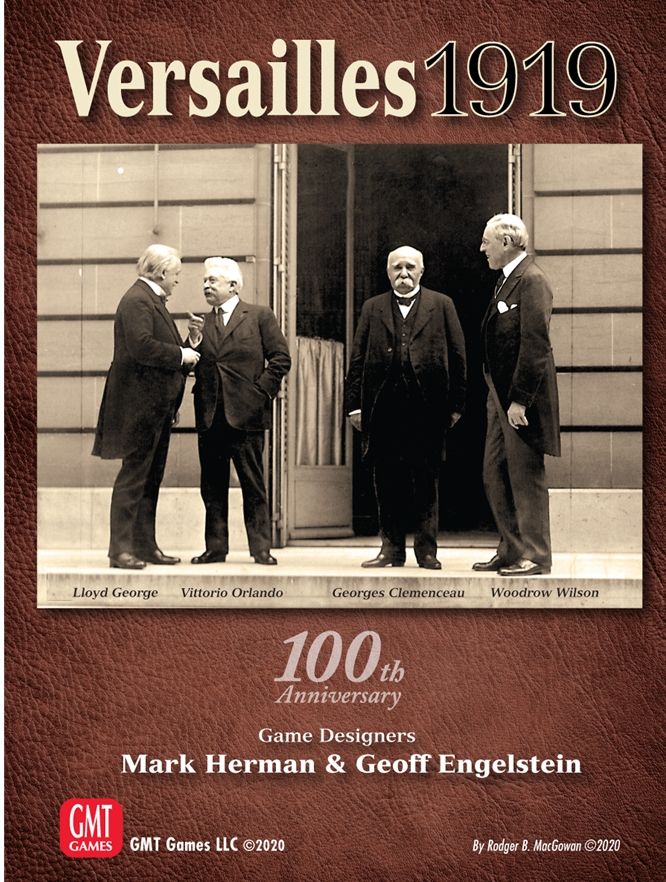
Versailles 1919 is a 1-4 player negotiation game in which players act as national leaders settling the end of the Great War at the 1919 Paris conference. Players gain Victory Points (Stars) mainly by Controlling Issues, and also from chosen Strategy cards, flag Strategy counters, and their national Happiness. The player with the most points at the end wins.
Preparazione
- Place the board, randomly choose a starting Active Player, and have players choose countries in turn order. Three players use the UK, France, and USA; four players add Italy. Japan and any unused nation are non-player actors whose Happiness is still tracked.
- Each player takes 15 Influence cubes and 3 Military Units into their Available area.
- Shuffle the Issue cards, set aside the Game End (Rush to the Finish) card, and deal 2 Issues On the Table, 3 into the Waiting Room, and 1 face-up into the Discard pile. Deal 20 Issue cards face-down, put the Game End card on them, then place the rest of the Issues on top to form the draw deck.
- Shuffle the Event cards, place 1 On the Table and 2 in the Waiting Room face-up, and set the rest as the Event draw deck.
- Place the Active Player card on its space. Put all five national Happiness markers on 20.
- Deal one more Strategy card than the number of players, face-up beside the board.
- Place a Powder Keg counter at the start of each Region track and an Unrest counter in column 1 of each track.
Un turno
Each turn has a mandatory Political Action and an optional Military Action. The two may be done in either order, but each must be fully finished before the next begins. The turn then passes clockwise.
Political Action (choose one):
- Place Influence: put Influence on exactly two Issues (On the Table, in the Waiting Room, or one of each), using only Available cubes. After placing, you must have the most Influence on both.
- Reclaim Influence and Military: return up to six Influence from the Exhausted box to Available, take back all Military in the Exhausted box, and optionally take back Deployed Military. You must recover at least one piece.
- Settle an Issue: only an Issue On the Table with at least one Influence on it may be settled. You do not need the most Influence. Settling proceeds as follows:
1. The Controlling player resolves the Issue: their Influence on it goes to Exhausted, the settling player's Influence returns to Available, and other players lose half their Influence (rounded down) to Exhausted. The Controller picks one option, adjusts Unrest and Happiness, and places matching Strategy counters.
2. Resolve the Conference Event On the Table. A player who has Influence on it decides how it resolves, otherwise the Active Player does. Optional events may be skipped.
3. Move one Issue and one Event from the Waiting Room to the Table. An Event with an Influence icon may receive an Influence cube to Control it.
4. Add a new Issue to the Waiting Room, either by taking one of the top three Discard cards (paying 0, 1, or 2 Available Influence) or by drawing two and keeping one.
5. Draw an Event into the Waiting Room and immediately resolve its Crisis text. Crisis text is often an Uprising Check.
Military Action (optional, one unit):
- Deploy: place one Available, Exhausted, or already-Deployed unit into an empty space in columns 5-8 of a Region track that does not already hold your Military. Columns 5-7 give immediate and permanent effects.
- Demobilize: place a unit on the highest open space of the shared Demobilize track to gain Happiness. Demobilized units are out of the game.
Uprising Checks: the Active Player determines the Region, rolls a die against the Unrest level, and, if an Uprising occurs, the affected player's highest-value Controlled Issue is Unsettled. Players then bid Military and Influence for it, and the winner takes Control and selects an option. The first Uprising also triggers Strategy card selection.
Fine della partita
The game ends when the Game End (Rush to the Finish) Issue is Settled, or when the last Issue is drawn from the draw deck.
When the Game End Issue is drawn, it goes into the Waiting Room and play continues. If it is later Settled, the player with the majority on it takes it and the game ends immediately, with no normal settling steps. If a player wants to take Issues from the draw deck but none are available, the game also ends.
Punteggio
Final points come from:
- Controlled Issues: the Victory Point value shown on each Issue you Control. The Game End Issue, if Settled, is worth 7 VP.
- Flag Strategy counters: 1 VP for each counter showing your flag on a Settled Issue you Control.
- Strategy cards: points according to each card's conditions. These can involve Regional Unrest columns, undemobilized Military, doubled Happiness points, and whether Japan and Italy sign the treaty. Japan and Italy sign if their Happiness is 15 or higher.
- National Happiness rank: the highest Happiness scores 6 in a two-player game (6/0), 6/3/0 in three-player games, and 6/4/2/0 in four-player games. Tied players both take the higher score and the next place is skipped. A nation at 0 Happiness loses 5 points.
The highest total wins. Ties are broken by highest Happiness, then most Controlled Issues. If still tied, the victory is shared.
Varianti
- Longer games: deal 15 or 10 Issue cards below the Game End card instead of 20 (starting player Happiness rises to 22 or 24 respectively, with non-players staying at 20). For the longest game, shuffle the Game End card with five Issues and stack the rest on top.
- Two-player game: players control France and the UK. The USA is a faction controlled by whichever player's turn it is. After each player turn, that player also takes a USA Political Action. The USA does not bid on Uprisings, has no Military or Happiness, and cannot win. Italy is not in the game.
- Solitaire game: the player controls one of three factions (UK, France, USA) while the other two are run by automated bot rules. Faction strength and Strategy icons replace Strategy cards. The player gains a VP at the start of their turn when their faction is the sole strongest, and wins by reaching 20 VP. Players may raise or lower the target to suit their experience.
Modifiche
- Varianti: bozza del regolamento, 23 novembre 2026 (mostrata ora)
- Punteggio: bozza del regolamento, 23 novembre 2026 (mostrata ora)
- Fine della partita: bozza del regolamento, 23 novembre 2026 (mostrata ora)
- Un turno: bozza del regolamento, 23 novembre 2026 (mostrata ora)
- Preparazione: bozza del regolamento, 23 novembre 2026 (mostrata ora)
- Riassunto: bozza del regolamento, 23 novembre 2026 (mostrata ora)