Regole di Welcome To...
Riassunto
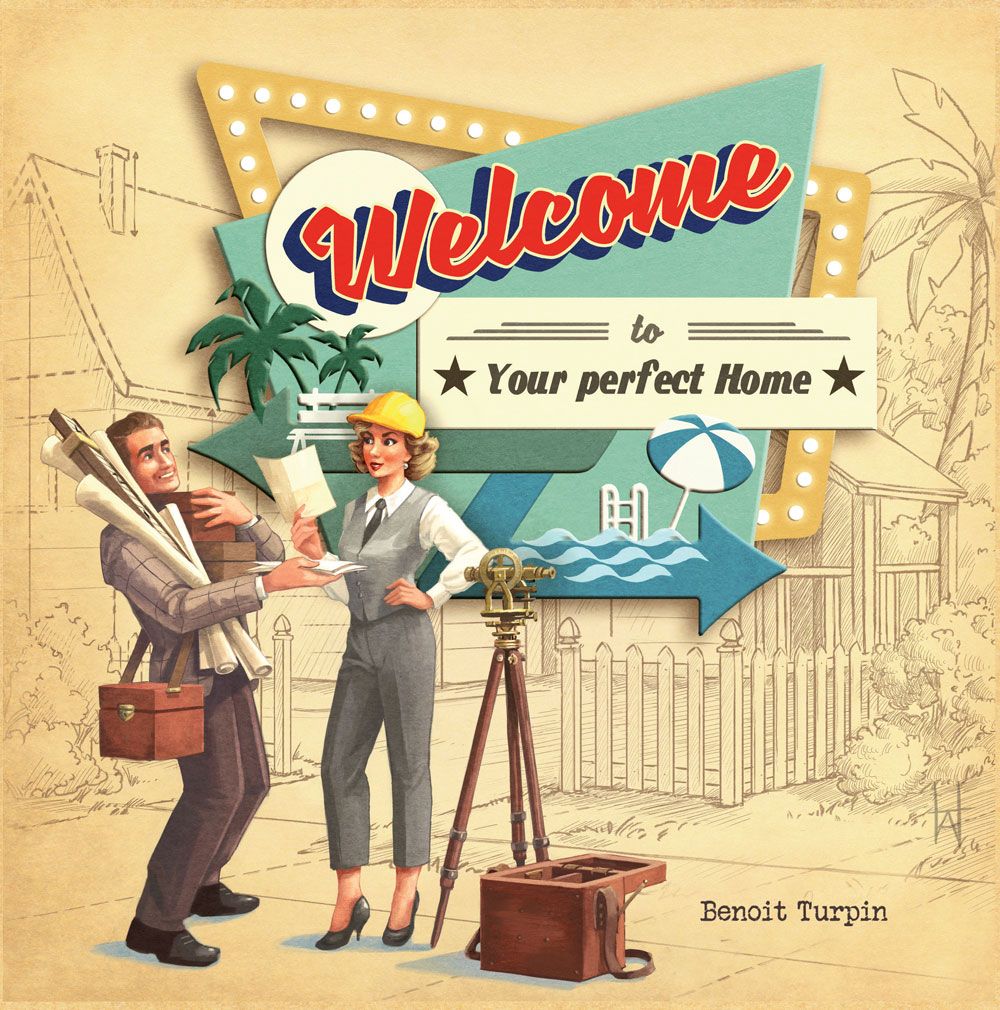
Welcome To is a simultaneous game in which American architects of the 1950s build numbered houses along three streets. Houses form housing estates, and players add parks, pools, and temps to raise their score. Everyone uses the same cards, and the first to complete City Plans scores bonus points. The player with the most points at the end wins.
Preparazione
Each player takes a pen or pencil and a player sheet, and receives a player aid.
Shuffle the 81 Construction cards, house number side up, and deal three equal stacks of 27. Place them in a column with space for discards to their right.
Shuffle the 29 City Plan cards from the basic set and randomly pick one card each numbered 1, 2, and 3. Place them Project side up where everyone can see. Return the other City Plans to the box.
Un turno
All players act at the same time. At the start of each turn, flip the top card of each stack to the right, effect showing. Each pair of house number and effect forms one of three combinations.
Each player picks one combination, and several players may pick the same one. They write its number in an empty house on one of their streets, following these rules:
- Numbers must go in ascending order from left to right on the street.
- The same number cannot appear twice on one street, except through a Bis effect.
- Houses may be skipped and filled later.
If a player cannot legally place the number, they take a building permit refusal and cross off the top-most, lowest-numbered space in that column. Players who did not receive a refusal may then optionally perform the effect of their chosen combination. Once everyone has finished, a new turn begins. If a stack runs out, shuffle the discards and deal new stacks as in setup.
Effects:
- Landscaper: build a park by crossing off a tree on the same street, in left-to-right order.
- Surveyor: draw a fence on an available white-dotted space between two houses on the same street.
- Real Estate Agent: cross off the top-most, lowest-numbered space in a Real Estate column.
- Bis: write a duplicate of a number in an adjacent house on any street, with no fence between them, and cross off the top-most space in the Bis column.
- Pool Manufacturer: if the house is a planned pool, cross off the top-most space in the Pools column.
- Temp Agency: add or subtract 1 or 2 from the number (allowing 0 to 17), and cross off a box in the Temp column.
Fine della partita
The game ends immediately when any one of these happens:
- A player crosses off their third building permit refusal.
- A player completes all three City Plans.
- A player has built all of the houses on their streets.
Punteggio
Add up points from City Plans, parks on each street, pools, temps, and completed estates. A completed estate is a row of one to six numbered houses between fences, and it scores the value of the smallest unchecked number in its matching Real Estate column.
Temp Agency: the player with the most temp boxes crossed off scores 7 points, the next highest scores 4, and the third highest scores 1. Ties share the points of the tied positions.
City Plans: the first player(s) to meet a City Plan in the same turn score the higher amount on its Project side. Later players score the lower Approved amount. A player can score each City Plan only once. An estate or house used for a City Plan cannot be used for another one.
Subtract the points in the Bis column and the building permit refusal column. The highest total wins.
Ties are broken by the most completed estates, then the most 1-house estates, then 2-house estates, and so on. If still tied, the players play another game.
Varianti
Solo variant:
- Setup: shuffle the Construction cards, effect side up, and deal two equal stacks. Shuffle the Solo card into one stack and place that stack under the other without reshuffling. Choose three City Plans and place them Project side up.
- Turn: draw three cards and choose two, one for its number and one for its effect. Discard the third card. Play the two cards as in the multiplayer game and discard them. Then draw three new cards and repeat.
- When the Solo card is drawn, all Plans count as Approved, so the higher score is no longer possible. Turn the Plans to their Approved side.
- The game ends when the stack is empty or when one of the basic end conditions occurs.
- Scoring: the Temp Agency scores 7 points only if the player hired at least six temps; otherwise it scores zero. Otherwise the scoring is the same as the classic game.
Additional City Plans (basic version): these can be added to the basic game and follow the same rules. Goals include building all houses on a required street, building the first and last house of each street, hiring 7 temps, building all parks and pools on a street, having all parks or all pools on two streets, building all parks, all pools, and one roundabout on one street, and building 5 bis duplicates on one street.
Advanced variant with expert rules:
- Setup: shuffle all Construction cards, effect side up, into a single deck. Choose three City Plans and randomly give the Solo card to one player.
- Turn: on the first turn, players draw three cards and choose two, using different cards for number and effect. Play them, then discard. Pass the remaining card, effect side up, to the player on the right. Then deal two cards to each player for the next turn, starting with the Solo card holder.
- Roundabout: before or after building and using an effect, a player may place a roundabout on an empty house. Numbers can restart on the other side of it, and the number range on each side is 0 to 17. The first roundabout costs 3 points and the second costs 5 points, and at the end of the game the smallest unchecked number is subtracted from the score.
Modifiche
- Varianti: bozza del regolamento, 22 novembre 2026 (mostrata ora)
- Punteggio: bozza del regolamento, 22 novembre 2026 (mostrata ora)
- Fine della partita: bozza del regolamento, 22 novembre 2026 (mostrata ora)
- Un turno: bozza del regolamento, 22 novembre 2026 (mostrata ora)
- Preparazione: bozza del regolamento, 22 novembre 2026 (mostrata ora)
- Riassunto: bozza del regolamento, 22 novembre 2026 (mostrata ora)