Regole di Wendake
Riassunto
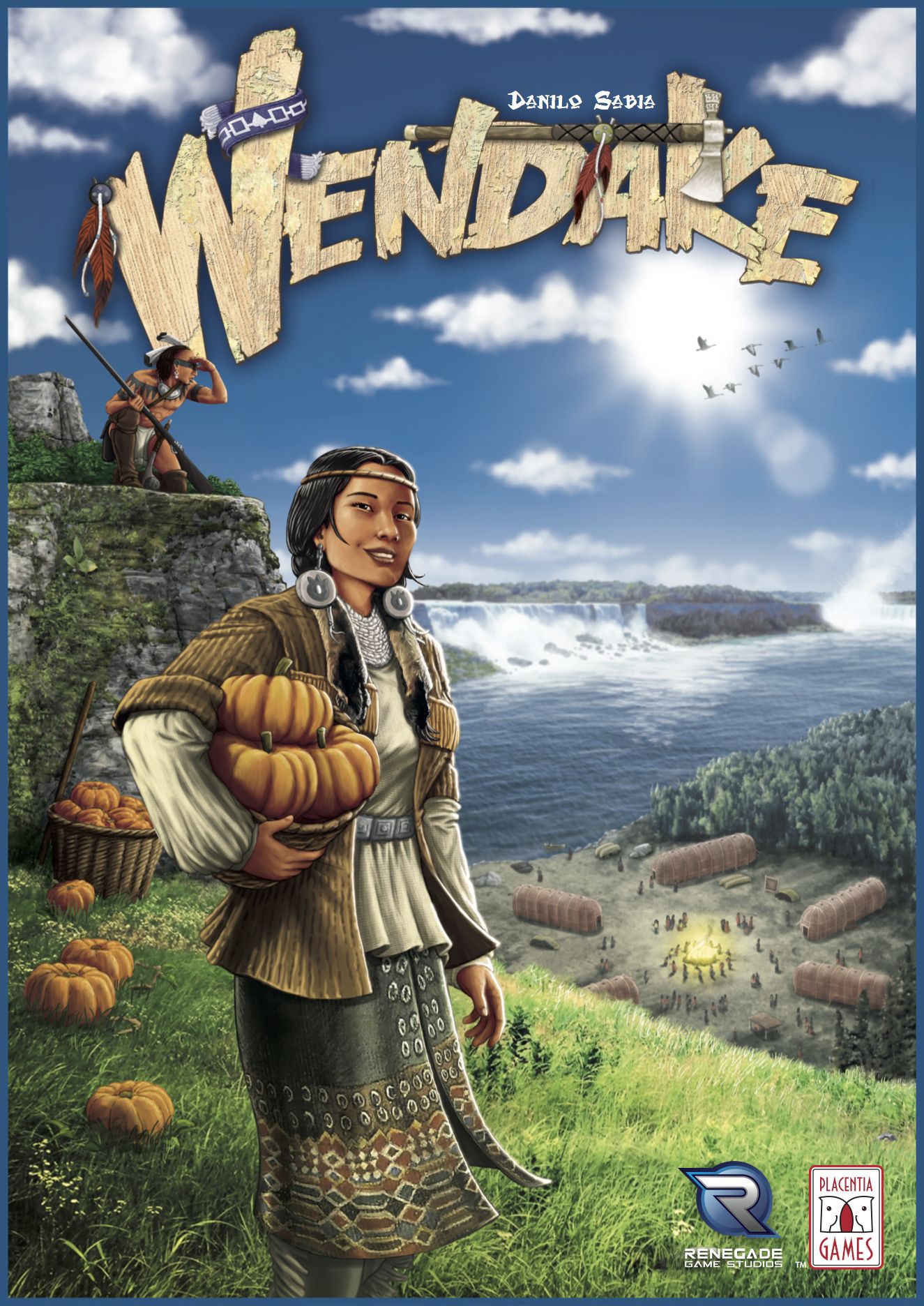
Wendake is a game set among the Great Lakes tribes during 1756-1763. You lead a tribe over seven Years, choosing actions to build your villages, fields, hunting and warrior strength. You score points on the Economic, Military, Ritual and Mask tracks, and the player with the most points at the end wins.
Preparazione
- Build the Main Board from two map halves for your player count and place the Ceremonial Mask Board beside it.
- Place the score tracks near the board. Randomly assign the four Scoring Type markers to form two random pairs. For your first games, put Mask and Military on one pair and Economic and Ritual on the other.
- Sort the Progress tiles by level and shuffle each group. Make three rows: Level 1 at the bottom, Level 2 in the middle, Level 3 on top. Each row holds twice the number of players (12, 18 or 24 tiles total). Return unused tiles to the box. If Alliance tiles are included, place the 2 Flag tiles nearby.
- Shuffle the Mask deck onto the Mask Board and reveal the top card as the start of the discard pile.
- Randomly set the starting turn order and give out the Turn Order markers.
- Each player takes an Action Board, a Home territory and a color, and the matching pieces: 9 Action tiles, 7 Women, 7 Hunters, 7 Warriors, 5 Canoes, 4 Action markers, 5 Tribe disks, a Sacred Fire marker, a Summary tile and a Swap token. Unused Swap tokens go back to the box unless the Seneca tribe is in play.
- Choose which side of the Tribe cards to use. With the identical back, each player takes 1 Leather, 1 Fish, 1 Vegetable matching their Home, 2 Beaver tokens and 1 Mask card. With the front, shuffle the cards, reveal one more than the number of players, and let players pick in turn order from last to first, with the first player choosing from the last two. Return unused cards to the box.
- Place 1 Canoe on any Lake, 5 Warriors outside the Productive Areas of your Home, and 5 Women and 5 Hunters on the matching Productive Areas of your Home. Keep the remaining Warriors, Women and Hunters in your Long House Area, with the remaining Canoes beside your board.
- Put your Sacred Fire tile in the center of your Action Board and place your eight other Action tiles around it in a 3x3 grid, all showing the Action side.
- Place one Tribe disk at the start of each score track as your Score marker.
- Place your four Action markers in the Sages area of your board.
- Place your last Tribe disk in the Restore Area of the Mask Board as a Mask disk.
- Shuffle the Level 1 Advanced Action tiles face down and take a random set (17 for 4 players, 14 for 3, 11 for 2), returning the rest unseen. Do the same for Level 2 and set those aside. Turn over the first 6 Level 1 tiles beside the board.
- Place the Turtle tiles on the Mask Board, as many random tiles per space as there are players, returning the rest unseen.
- Place the round marker on "1" of the Round Track.
Un turno
The game lasts seven Years. Each Year has two phases.
Phase 1: Individual turns. Players act in turn order until each has had four turns. On a turn you either:
- Option A: Take 1 Action. Place one of your Action markers on an empty Action tile on your grid, then you may use any or all of its actions, top to bottom. Optional actions must be used in the printed order.
- Option B: Change turn order. Place a marker on the first empty space from the left in the Turn Order Area of the Mask Board. The new order applies in phase 2.
Your first Action tile each Year can be any tile. Your second and third must share a row, column or diagonal with your previous tile(s). Each Year you must use Option A three times and Option B once, in any order. By the end of the Year your three Action markers must form a single line.
Phase 2: Restore. Run these steps in order:
- New turn order: Hand out Turn Order markers by the positions chosen, and return the Action markers.
- Adjust Action tiles: Flip back any tiles you used (and any Ritual-side tiles in your bottom row). Shift your grid down one row so the bottom row sits outside the grid. The first player may swap one of those three tiles for an Advanced Action tile or a previously set-aside tile. Shuffle the three tiles below the grid, then place them randomly on the top row, Action side up. Each player in turn order may then make the same swap. After the third Year's replacements, swap out the Level 1 Advanced tiles for Level 2.
- Restore Masks: Return the Mask disks to the Restore Area and take your played Mask cards back into your hand.
- Restore Progress tiles: Flip used Progress tiles back to their usable side.
- New Year: Advance the Year marker. If it was on 7, the game ends.
The actions available are:
- Canoe: Put one Canoe into play on a Lake.
- Move: Move Warriors up to the tile's step total. Warriors may enter adjacent territories (not an opponent's Home), or move within a territory to a Productive Area. A Warrior is either an Outpost in a Productive Area or a Guard outside them. Lakes and rivers block movement. Fighting happens during Moves.
- Harvest: Each Productive Area with a Woman gives one Vegetable.
- Hunting: Gain one Beaver per Productive Area with a Hunter.
- Tan Pelts: Discard all Beavers and gain 1 Leather for each.
- Fishing: Gain 1 Fish per Canoe in play.
- Military: First claim Turtle tiles, then score 1 Military point for each territory where you have the most Guards, including your Home. Ties score nothing.
- Mask Ceremony: Draw a Mask card from the deck or the discard pile, then play a combination from your hand onto an empty space on the Mask Board to score its points.
- Trade: Exchange Resources with the supply (up to one per Canoe), then buy one Progress tile, then optionally spend up to five different Resources for Economic points. A Smallpox check happens after the exchange.
- Sacred Fire: Activate another tile on your grid, not one already used in the same line this Year. Mark it with your Fire marker.
- Ritual: Move 2 Natives from your Long House to your Home, then score Ritual points equal to the rarest Native type in your Home (Hunters, Warriors or Women).
Using a Progress tile's ability is free once per Year, and it is flipped to show it has been used.
Fine della partita
The game ends after the seventh Year, when the Year marker would move past 7. Final scoring then takes place.
Punteggio
Points come from actions (Economic from Trade, Military from Military, Mask from Mask Ceremony, Ritual from Ritual), from Turtle tiles, and from Progress tiles. Each track is capped at 25 points.
Final scoring:
1. Reveal your Turtle tiles and assign their points to the indicated tracks. Level 5 Turtle tiles let you choose one of two tracks.
2. For each pair of tracks, count only the Score marker value on the lower track.
3. Add the results of the two pairs together.
4. Add 1 point if you still have your Swap token.
The highest total wins. A tie is broken in favor of the tied player with the lowest Turn Order marker.
Varianti
Tribe abilities: If you use the front of the Tribe cards, each tribe has a special ability. Cayuga: your Women return Home rather than to the Long House when attacked by a Warrior (not for Smallpox). Fox: buy up to two Progress tiles during Trade. Mohawk: start with an extra black Warrior at Home, which returns Home when attacked. Ojibwa: use the black Action marker, which lets you take two actions in a row once per Year. Oneida: start with one Level 1 or Level 2 Progress tile of your choice, scoring no points from it. Onondaga: start with six Natives of each kind at Home. Ottawa: your Sacred Fire tile is never flipped to the Ritual side. Seneca: start with two Swap tokens, each unused token worth 1 point. Shawnee: start with one fewer Warrior, and need one fewer Woman, Hunter or Canoe for Turtle tiles. Tuscarora: your Hunters stay on the grey side, and attacking Warriors are injured when they attack them.
Alliance tiles: including Alliance Military tiles and the Flag tiles adds an optional alliance mechanic.
Modifiche
- Varianti: bozza del regolamento, 22 novembre 2026 (mostrata ora)
- Punteggio: bozza del regolamento, 22 novembre 2026 (mostrata ora)
- Fine della partita: bozza del regolamento, 22 novembre 2026 (mostrata ora)
- Un turno: bozza del regolamento, 22 novembre 2026 (mostrata ora)
- Preparazione: bozza del regolamento, 22 novembre 2026 (mostrata ora)
- Riassunto: bozza del regolamento, 22 novembre 2026 (mostrata ora)