Regole di Woodcraft
Riassunto
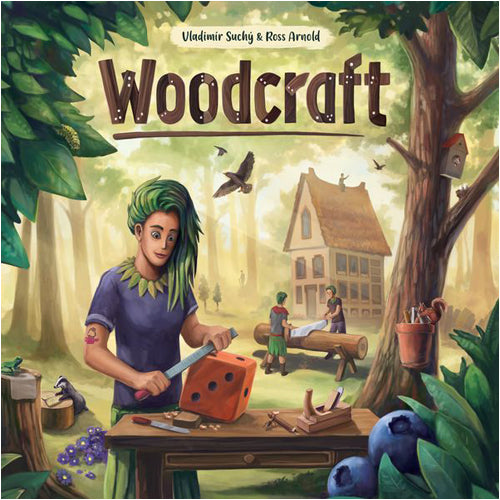
Woodcraft is a competitive board game where players run woodcrafting workshops, taking turns to pick one of seven actions on a rotating action wheel. Actions help acquire and modify dice representing wood, which are used to complete orders that eventually score points. The player with the most points at the end of the game wins.
Preparazione
Place the action wheel board in the center of the table and roll two dice of each color to fill the public lumber yard in its corner. Place the seven action tiles in the starting quadrant, lay the arc tile over its bonuses, and set the saw so its arrow points to the far end of the next quadrant. Place the income board beside the action wheel with the round counter on space 1, and place each player's counters on the starting spaces of the hazelnut income, blueberry income, and reputation tracks. Put the reputation track tiles on the two pale spaces, with the tiles chosen by player count. Set the leftover tokens and dice near the board as the bank, noting on paper any items the bank runs out of. Shuffle the decks, deal three public contracts face up beside the action wheel, and return the remaining public contracts to the box. Set the late-game decks aside. Place the early helper and order decks beside the scoreboard and deal four of each face up. Each player places a scoring counter on the scoreboard's starting space.
Each player takes a board and their colored counters, and places a market counter on the starting space. Each player takes one die of each color, sets the black, yellow, and green dice to their starting values, and places them in their lumber pile. They also take a lantern, a scrapwood token, 12 blueberries, one sawing tile, and the starting splicing tile. Each player draws five early order cards and keeps two, and receives two hazelnut order cards, keeping one of the four total as their first order beside the board. Each player draws three helpers, keeps one, places it in the upper left room of their workshop, and pays its blueberry cost. The starting player card goes to a random player.
Un turno
Players take turns in clockwise order, beginning with the starting player. At the start of your turn, your trees grow. Then choose one action tile from the action wheel and perform that action. When you choose a tile, advance it to the next quadrant, gaining any bonus shown on its space. You may also buy one bonus action for three lanterns, which does not move a tile or trigger bonuses. You may perform any number of free actions in any order, including using a helper's once-per-turn ability, sawing, splicing scrapwood, gluing lumber, harvesting a tree, or completing an order.
The seven actions are: buy lumber (buy one or two dice from the lumber yard or bank), exchange dice (sell a die and/or buy one), buy materials (glue, saw, or scrapwood tokens at the printed prices), choose a helper, choose orders, produce or plant a tree, and improve workshop (add pots, sawing tiles, splicing tiles, or the gluing tile).
If a tile's next quadrant is full, it slides to the empty space to its left and does not fill gaps. A tile may not enter a quadrant one lap behind; to choose such a blocked action, pay one lantern and move a different unblocked tile, then perform the blocked action while gaining the moved tile's bonuses.
At the end of your turn, you may buy points through your marketing track, then discard down to six dice in your lumber pile.
After each round, the income phase occurs after rounds 4, 8, 11, and 14. It has steps: orders move down one row, each player places one new order from hand, each player gains blueberries and points per their income counters, tiles reset, and the helper and order cards are refreshed.
Fine della partita
Round 14 is the final round. The game ends after the income phase that follows it, and players skip the order-placing step because their hands are empty.
Punteggio
Final scoring happens after the last income phase. Players score points shown on any public contracts they claimed. They score 1 point for every 10 leftover points, counting unused dice values, remaining blueberries, and remaining scrapwood, glue, and saw tokens. Each order still beside the board imposes its penalty of moving back 2 spaces on the reputation track. Each completed order scores points equal to the value shown by the reputation counter.
The player with the most points wins. If players tie, the player who played later in each round wins the tiebreaker, so the starting player always loses ties.
Varianti
The rulebook gives a short tutorial variant with no separate solo, team, or advanced rules. Reputation tiles differ by player count: in a 2-player game use the lower two rewards on each tile, in a 4-player game use the upper two, and in a 3-player game the larger reward goes to a lone arriver while tied arrivers share the smaller one.
Modifiche
- Varianti: bozza del regolamento, 22 novembre 2026 (mostrata ora)
- Punteggio: bozza del regolamento, 22 novembre 2026 (mostrata ora)
- Fine della partita: bozza del regolamento, 22 novembre 2026 (mostrata ora)
- Un turno: bozza del regolamento, 22 novembre 2026 (mostrata ora)
- Preparazione: bozza del regolamento, 22 novembre 2026 (mostrata ora)
- Riassunto: bozza del regolamento, 22 novembre 2026 (mostrata ora)