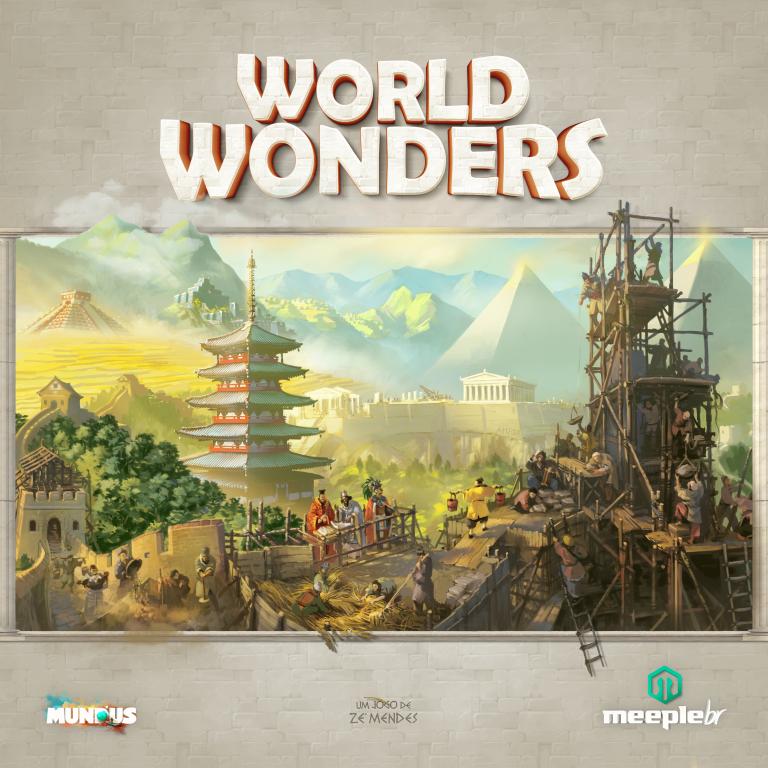
Regole di World Wonders
Riassunto
Players are leaders of an ancient city, spending a limited amount of Gold each round to buy roads, towers, buildings and monuments that grow their city. The player with the most Victory Points at the end of the game wins.
Preparazione
- Place the Main Board in the middle of the table. Add Player Expansion Boards by player count: 1 to 3 players use only the Main Board; 4 players add the 4th board; 5 players add the 4th and 5th boards. Include their Building Tiles.
- Shuffle the Building Tiles by shape, place each stack face down on its board space, and reveal the top tile of each stack directly below it.
- Place the 1st and 2nd Player Turn Order Pedestals on their spaces on the Main Board.
- Each player picks a color. Draw Player Markers at random and place them on the Turn Order track in that order.
- Place Long Road Tiles and Short Road sets below the revealed Building Tiles: 1 to 2 players get 1 Long Road and 1 set of Short Roads; 3 players get 2 Long Roads and 1 set; 4 players get 2 Long Roads and 2 sets; 5 players get 3 Long Roads and 2 sets. Set the other Road Tiles aside.
- Place 1 Tower beside the starting Road Tiles and set the rest aside.
- Shuffle the Monument Cards and reveal 3, placing their Monuments on them. Leave the deck face down nearby.
- Put the Loan Tiles in a face-up pile next to the Main Board.
- Each player takes a Map Board and a Resource Board in their color. All players must use the same side of each board.
- Each player starts with 1 Gold, 1 Population and 3 Resource Markers on position 0 of their boards. Each player also receives 1 Long Road Tile, which must be placed on their map on their first turn at no cost, alongside that turn's purchase.
Un turno
Each round, every player starts with 7 Gold. On your turn, take one action by buying one of the following:
- 1 Long Road Tile for 1 Gold
- 1 set of Short Road Tiles for 1 Gold
- 1 Building Tile for the cost shown on its stack
- The Tower for 2 Gold
- The 1st or 2nd Player Turn Order Pedestal for 1 Gold
- 1 Monument, which requires spending all your remaining Gold
When you buy a Building or Monument, advance the matching Resource Markers one space right for each symbol shown. When a Resource Marker reaches or passes a Population symbol, move your Population Marker one space right.
Loans are a free action you may take before spending all your Gold. You must still buy an item that turn, unless the Loan repayment used up your last Gold.
Placement rules:
- Road Tiles must touch another Road Tile, the Sidewalk, or a Tower.
- Towers must touch something you already placed and must sit on land.
- Building Tiles must touch a Road Tile or a Building Tile of the same type, and must sit on land. They may be rotated.
- Natural Resources count as land, and pieces may cover them.
- Monuments follow their own card rules.
A player whose Gold Marker reaches 7 (or 9 with a Loan) is out for the rest of the round. Buying a Monument also ends your round.
When all players are out, the round ends. To start the next round: discard unpurchased Building Tiles and reveal new ones; replace purchased Road Tiles and the Tower; refill Monument Cards to 3; reset Gold Markers to 0; and set turn order. Pedestal buyers take the first two positions. The other players are ordered by lowest Population first, with ties broken by fewer Monuments first, and then by their previous relative order.
Fine della partita
The game ends at the end of the round in which either:
- any player reaches the final space of their Population track, or
- ten rounds have been played, or no Building Tiles remain to reveal.
At the end, flip the Main Board to its reverse side and tally scores.
Punteggio
Score the following for each player:
- Population: 1 VP per Population ring reached or passed.
- Least-produced Resource: the lowest value among your three Resource tracks.
- Monuments: 1 VP per ring on your Monument Cards.
- Natural Resources: 1 VP per visible Natural Resource adjacent to at least one of your pieces.
- City Districts: 1 VP per Building Tile completely surrounded by features other than green spaces. Those features can be Building Tiles, Road Tiles, Monuments, Towers, Natural Resource spaces, Water, the Sidewalk, or the map edge.
- Loans: a player who could not repay a Loan before the game ended loses 2 VP.
The player with the most VP wins. If players tie, the player with the most Monuments wins.
Varianti
- Advanced Play: Add the Public Objective Cards. Shuffle them and place the top 3 face up beside the Main Board; return the rest to the box. Players who best meet each objective earn its VP at game end. If two or more players tie for first, add the first- and second-place VP values together and split them evenly among the tied players, rounding up. If two or more players tie for second, each receives 1 VP.
- Solo Play: Use the Solo Play Cards to simulate an Automaton opponent. Set up as a two-player game, with 2 Monuments face up instead of 3 and no Turn Order Pedestals. The player always takes the final turn. On the Automaton's turn, reveal one Solo card and discard the first listed item that is available. If none is available, it takes the Monument on the indicated side. To win in easy mode, your Resource total must exceed the Automaton's score. In hard mode, add the VP on the Automaton's Monument Cards to its total.
Modifiche
- Varianti: bozza del regolamento, 22 novembre 2026 (mostrata ora)
- Punteggio: bozza del regolamento, 22 novembre 2026 (mostrata ora)
- Fine della partita: bozza del regolamento, 22 novembre 2026 (mostrata ora)
- Un turno: bozza del regolamento, 22 novembre 2026 (mostrata ora)
- Preparazione: bozza del regolamento, 22 novembre 2026 (mostrata ora)
- Riassunto: bozza del regolamento, 22 novembre 2026 (mostrata ora)