Bora Boraのルール
概要
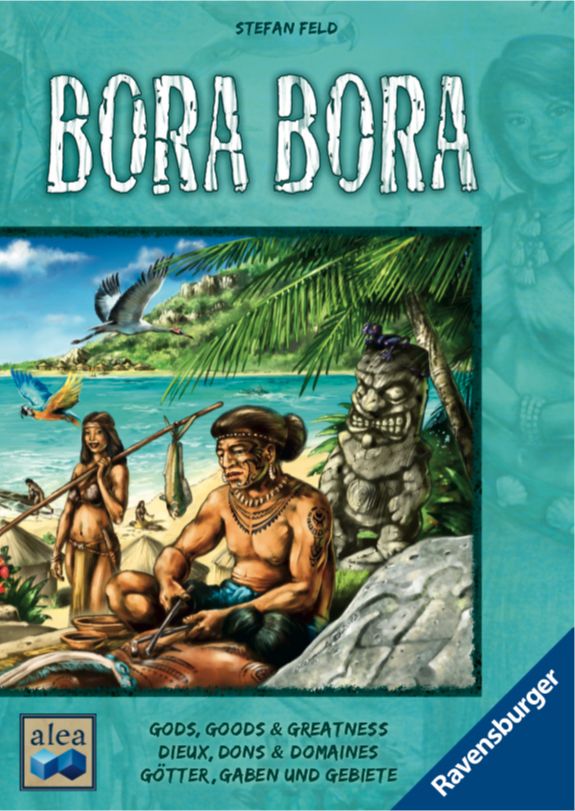
Bora Bora is a dice-placement game in which players expand across islands, build huts, recruit men and women, send priests to the temple, and use God cards and offerings. The game lasts six rounds, and the player with the most victory points at the end wins.
準備
Place the board in the middle of the table and put the building materials, shells and offerings in a common supply. Place 5, 6 or 7 action tiles face up for 2, 3 or 4 players. Put one fish tile on each island region. Place 6 man and 6 woman tiles face up on their display spaces. Shuffle the dark green task tiles and put player count plus 2 of them face up on the board. Deal each player one light green and two dark green task tiles. Put all 24 jewelry tiles face up on the board. Place 6 God tiles on the temple space, shuffle the God cards and reveal five next to the pile.
Each player takes a player board, 12 huts, 6 building tiles (dice side up), the God tile, 3 dice, 4 priests, 2 hidden God cards, 2 offerings and a random turn order tile. Set markers on the scoring track and status track according to turn order. In reverse turn order, each player places one hut on an empty building space of a 1-value region and takes the matching resource. With fewer than four players, return unused components to the box.
手番の流れ
Each round has three phases.
Phase A: All players roll their three dice. In turn order, each player places one die on an action tile and carries out that action. A die must show a value lower than the lowest value already on that tile, unless a Blue God is played. Continue until everyone has placed all three dice. The actions are Expand, Woman, Man, Helper, Temple, Build and Fishing.
Phase B: In turn order, each player may use one man tile and one woman tile in either order. Identical tiles can be combined for one stronger action, but men and women can never be combined.
Phase C: Scoring, described under scoring below.
ゲームの終了
The game ends after round 6. Each player then completes their remaining three task tiles, and final scoring follows.
得点計算
Phase C in each round scores in this order. First, the status track: each player scores the points for the space their status marker sits below, from 0 to 15, and turn order is reassigned. Second, the temple: each priest is worth 1 point in rounds 1 and 2, 2 points in rounds 3 and 4, and 3 points in rounds 5 and 6. The player with the most priests there takes the top God tile, and ties go to the tied player whose priest is furthest left. Third, jewelry: each player may buy one jewelry tile from the current column by returning shells. Fourth, task tiles: each player completes one task for 6 points, or 4 points with a Yellow God, or surrenders one for no points, then takes a new one.
Final scoring: 2 points per unused God tile, 1 to 6 points per fish tile next to a building space holding your hut, and 1 to 9 points per jewelry tile. Each of the following gives 6 points: 9 completed task tiles, 6 claimed jewelry tiles, all 12 ceremony spaces filled, all 6 building tiles built, huts on all 12 regions, and all 12 man and woman spaces filled. Leftover materials, shells, offerings and God cards are worth nothing. In a tie, the tied player who was earlier in turn order during the last phase C wins.
バリアント
Two-player game: use five action tiles. The Woman and Land Path tiles are combined into one face-down tile, so the Man and Water Path tiles are removed from the game. Three-player game: use six action tiles. The Land Path and Water Path tiles are combined into one face-down tile, and the Water Path tile is removed. In both variants a player chooses one of the two combined actions, and the rest of the rules stay the same.
変更履歴
- バリアント、ルールブックからの下書き、2026年11月23日 (現在表示中)
- 得点計算、ルールブックからの下書き、2026年11月23日 (現在表示中)
- ゲームの終了、ルールブックからの下書き、2026年11月23日 (現在表示中)
- 手番の流れ、ルールブックからの下書き、2026年11月23日 (現在表示中)
- 準備、ルールブックからの下書き、2026年11月23日 (現在表示中)
- 概要、ルールブックからの下書き、2026年11月23日 (現在表示中)