チェスのルール
概要
Chess is a two-player game played on a 64-square board, with each side trying to checkmate the opponent's king. A player also wins by the opponent's resignation or a time forfeit, and a game may be drawn by agreement or by one of the drawn-game rules. Under the scoring rules, a win is worth 1 point, a loss 0, and a draw 0.5 each.
This part of the rulebook covers US Chess tournament procedure rather than the game itself. It addresses adjourned games and sealed moves, player and spectator conduct, director duties and appeals, unplayed games and byes, Swiss and round robin pairing, team events, and prizes. Games are won, drawn, or lost, and a player's standing comes from points accumulated across the rounds.
This part of the rulebook covers prize splitting and tiebreaks, disabled and assisted players, computer participants, online events, and Blitz Chess. Blitz is a fast variant with one sudden-death time control of 1 to 10 minutes per player, usually five minutes with no delay. A player wins by checkmate, by the opponent's resignation, or by pointing out that the opponent's flag has fallen while holding mating material.
準備
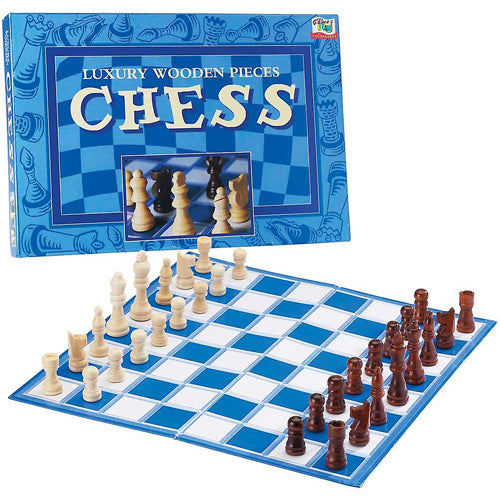
Place the board so that the nearer corner to the right of each player is a light square. White has 16 light pieces (a king, queen, two rooks, two bishops, two knights and eight pawns) and Black has 16 dark pieces in the same mix. Set the pieces in the initial position shown in the rulebook's Figure 1, which is not reproduced in this text.
Before a Swiss tournament starts, the director makes a pairing card for each player showing name, rating, and US Chess ID, or enters the player into a pairing program. Players are ranked from highest to lowest rating, with unrated players placed at the bottom of their group, and each is given a pairing number.
When an adjourned game resumes, the position from just before the sealed move is set on the board, and the clocks show the times recorded at adjournment.
The sealed move envelope should show the names and colors of the players, the position before the sealed move, the time each player has used, who sealed the move and its number, the date and time for resumption, and the signatures of both players. The director keeps custody of the envelope.
- The standard blitz time control is G/5 with no delay. Any delay or increment must be announced in advance and posted at the site.
- Clocks need a flag device. A standard timer must keep running for both sides even after one flag has fallen. A digital timer is preferred over an analog one.
- The player with the Black pieces chooses the timer.
- Before play, both players check the piece placement and the clock setting, because they stand once each side has made a move.
- The director may set the direction the clocks face, and Black then chooses which side of the table to sit on.
手番の流れ
White makes the first move, and then the players alternate moves until the game ends. A move transfers one piece to an empty square or onto an opponent's piece, which is captured and removed. Each piece moves as follows: the king one square in any direction, the queen any distance along a file, rank or diagonal, the rook along a file or rank, the bishop along a diagonal, the knight in an L shape, and the pawn forward one or two squares on its first move and one square after that, capturing diagonally. Castling moves the king two squares toward a rook, which then jumps over the king. A pawn that reaches the last rank must become a queen, rook, bishop or knight. After moving, the player presses their clock.
If the king is in check, the player must get out of check on the next move by capturing the checking piece, blocking it, or moving the king. The king may not move into check. Touch-move applies: a player who deliberately touches a piece that can move must move the first such piece touched. A player may adjust pieces only after saying j'adoube or I adjust.
In Swiss pairing, players with the same score are paired against each other where possible, with the higher-ranked half playing the lower half. Players who have already met are not paired again. Colors are balanced over the event and alternated where practical. If a player must drop to a lower score group, the lowest-rated eligible player is usually chosen.
When a sealed move is opened, the envelope is opened only with the player who must reply present. The director makes the sealed move and starts that player's clock. If the player who sealed is absent, the responding player may record a reply, seal it, and press the clock.
During play, players may not use written or recorded material, notes other than the moves, draw offers, and clock times, a computer, or a second board, and may not solicit or accept advice. Analysis is not allowed in the playing room. Players must not distract or annoy an opponent. A player should not leave the playing room for more than 15 minutes without the director's permission.
- Press the clock with the same hand that moves the pieces. This also applies to castling and captures.
- Touch the clock only to press it after a move or to straighten it. Do not keep a hand on or hover over the clock.
- A piece displaced by accident is replaced on the player's own time.
- If a player touches one piece, moves another, and presses the clock, the opponent may force the touched piece to move or stop the clock to claim a violation.
- A legal move is complete when the hand leaves the piece.
- If a promoting pawn needs a piece that is not available, the player may stop both clocks to find one. Pressing the clock with the pawn still on the last rank is improper.
- An illegal move must be retracted and replaced with a legal move of the same piece if one exists. It is complete once the clock is pressed.
- The standard penalty for a first offense is one minute added to the opponent's clock. Illegal moves do not get this penalty.
- Spectators and players in other games must not interfere.
ゲームの終了
The game ends immediately when a player checkmates the opponent's king, when a player resigns, or when a player wins on time. A stalemate, a mutual agreement to draw, or a valid claim of triple repetition, insufficient material, or the 50-move rule also ends the game as a draw. A player who has run out of time in a non-sudden death control loses on time if the opponent claims it and has enough material to mate. In sudden death, a player who runs out of time loses if the opponent has mating material; if both flags are down, the game is drawn.
A game ends with its normal result. If the position is decided while the players are not noticing, such as by checkmate, stalemate, or insufficient material, the director may declare the game over.
A director may adjudicate, meaning declare a result by assumed best play, only in emergencies. An example is a player with a poor position who disappears for more than 15 minutes or shows no interest in the position. Adjudication outside emergencies must be clearly announced.
A player who does not appear for a game, or appears too late, takes a forfeit loss. A player who fails to appear within one hour of the round start or by the end of the first time control is dropped from the tournament unless the director accepts an excuse.
Before the last round, unfinished games should be completed where practical. If they are not, the director may use a draw-offer method or temporary adjudication to pair the next round.
A game is won by checkmating the opponent, by the opponent's resignation, or by a correct claim that the opponent's flag has fallen while the claimant has mating material. Mating material is at least two minor pieces, a pawn, a rook, or a queen, unless the position allows a draw claim.
A time claim is void if the claimant's own flag also falls before the clock is stopped, unless a director or independent witness saw the flag fall.
After an opponent's illegal move is completed, a player may take the king if it is in check, or claim a win and stop the clock, provided they have mating material.
A game is drawn by stalemate, by agreement, or when both flags have fallen and no win has been claimed, unless one side mates before noticing. A game is also drawn if one player lacks mating material when the opponent's flag falls or an illegal move is made. Insufficient Losing Chances claims are not allowed under the blitz rules.
得点計算
A won game gives the winner 1 point and the loser 0 points. A drawn game gives each player 0.5 points. This part of the rulebook does not cover how tournament standings or ties between players are broken.
A win scores 1 point, a draw 0.5, and a loss 0. A full-point bye scores 1 and a half-point bye scores 0.5. A forfeit win scores 1 and a forfeit loss scores 0.
In Swiss standings, a higher score ranks first, and within a score group a higher rating ranks higher.
Tied place prizes share the combined prize money equally, and no winner receives more than one cash prize. Tied winners of trophies or other non-divisible prizes are usually decided by tiebreak procedures or a playoff. If several players finish with perfect scores, the director should try to hold a playoff among them.
In team matches, the team with the greater game point total wins the match and gets 1 match point. Equal game point totals give each team 0.5 match points, and a loss gives 0.
In round robins, scoring is 1, 0.5, and 0. A player who withdraws before playing half the scheduled games is treated as not having competed for prize purposes.
Tournament ties are broken by tiebreak systems. Unless another method is posted before round one, the default Swiss order is Modified Median, Solkoff, Cumulative, and Cumulative of Opposition.
- Modified Median drops the most extreme opponent scores, or only the least significant ones for players with non-even scores. Scores are adjusted for unplayed games.
- Solkoff is the same as Modified Median but drops no scores.
- Cumulative adds the running score after each round.
- Cumulative of Opposition adds the cumulative totals of each opponent.
Other systems include head-to-head results, most Black games, Kashdan, and Sonneborn-Berger. In round robins, Sonneborn-Berger is the most common method. A coin flip can break any remaining tie.
Cash prizes are normally split evenly among tied players, and tiebreaks are not used for them. An announced playoff is the exception. If all players finish with perfect scores, a playoff is recommended. Points-based prizes award set amounts for score levels, and the total paid varies with turnout.
Team events may use game or match points, or the U.S. Amateur Team System, which multiplies the opposing team's final score by the points scored against it.
バリアント
The rulebook gives these variations. A paper scoresheet may be used with the move written either before or after it is played. The director may let a player castle with the rook touched first if the castling is legal. The director may act only as a witness to illegal moves rather than correcting them. In sudden death, a player with two minutes or less may claim a draw for insufficient losing chances, under a variation that does not need advance announcement. This part does not include solo or team variants.
- Round robin (all-play-all), and quads, where players are grouped in fours and play a short round robin.
- Holland system, with round robin preliminaries feeding finals. An unbalanced version places the top players in the first preliminary section.
- Combined individual-team Swiss, often used in scholastic events, where teammates are kept apart in pairings where possible.
- Team events with match points and team pairing by rating, and the Rollins scoring system for combined events.
- Accelerated pairings in the first two Swiss rounds, using an added-score method, an adjusted-rating method, or sixths.
- Class pairings in the last round, if announced in advance and no class player can win more than a class prize.
- The 1 vs. 2 pairing system, and the use of round robin tables in a small Swiss.
- Reentry into a later-starting schedule of a Swiss, with the better score carried forward unless the organizer says otherwise.
- Adjournment with a modified Kashdan-style draw offer, and the sealed-move and invalid-move rulings as announced by the director.
- Blitz Chess is a variant with a single sudden-death time control of 1 to 10 minutes. Blitz has its own rating system and requires a minimum primary time of 3 minutes. Lightning and Bullet are not rated.
- Online events are rated under their own rules. The format must be Swiss, round robin, quads, match play, or a similar accepted format. Games must use one host platform, and the director's presence is handled through remote monitoring, fair-play algorithms, or post-game analysis as alternatives.
- Computer participation is allowed only when advertised in advance. Computers may only win prizes designated for them.
- Players with disabilities may use special boards, announced moves, touch-move adjustments, and assistants under the disabled-player rules.
変更履歴
- バリアント、ルールブックからの下書き、2026年11月23日 (現在表示中)
- 得点計算、ルールブックからの下書き、2026年11月23日 (現在表示中)
- ゲームの終了、ルールブックからの下書き、2026年11月23日 (現在表示中)
- 手番の流れ、ルールブックからの下書き、2026年11月23日 (現在表示中)
- 準備、ルールブックからの下書き、2026年11月23日 (現在表示中)
- 概要、ルールブックからの下書き、2026年11月23日 (現在表示中)