Chinatownのルール
概要
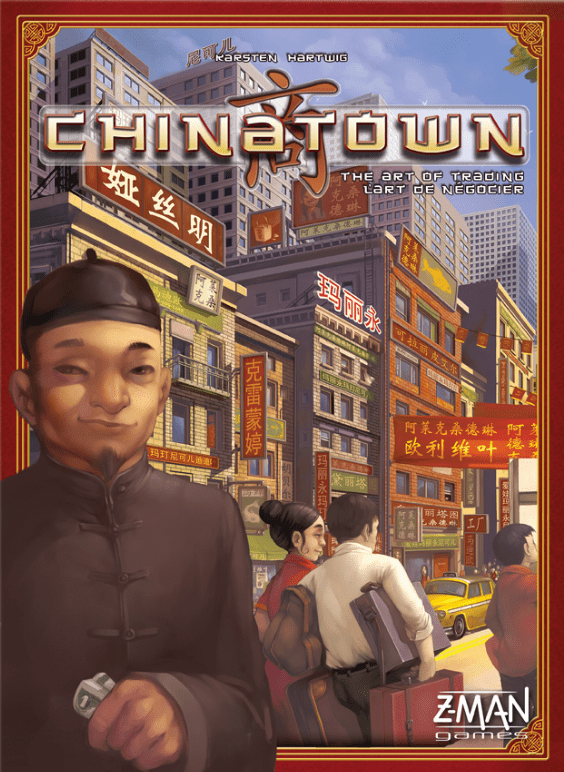
Players are immigrants in New York's Chinatown during the 1960s, buying buildings, opening shop businesses, and negotiating trades over six rounds. Each round is one year, from 1965 to 1970. The player with the most money at the end of the sixth round wins.
準備
- Place the game board in the middle of the table.
- Each player chooses a color, takes that color's 30 Ownership markers, and receives a Player Aid card.
- Each player starts with $50,000. The remaining Money cards form the bank beside the board.
- Put the Shop tiles in the bag and place the bag beside the board.
- Shuffle the Building cards and place them face down as a draw pile beside the board.
- Set the Year marker on 1965 on the Chinese calendar.
- The last player to have visited a Chinatown receives the First Player card.
手番の流れ
Each round (one year) has six phases:
- Deal Building cards: The First Player card holder deals Building cards to each player, using the counts on the Player Aid card. Each player keeps the lower number shown and discards the rest back into the draw pile, which is reshuffled for later rounds. Each player places a marker of their color on each building they kept.
- Draw Shop tiles: Starting with the First Player and going clockwise, each player draws the number of tiles shown by the red number for that round and player count. Everyone reveals their tiles at the same time.
- Trades: All players negotiate at once, with any player free to deal with any other. Buildings (with or without tiles on them), Shop tiles, and money can be traded in any combination. Change the Ownership markers to match each trade. Negotiation ends when all players agree to move on. Once placed, a Shop tile cannot be moved or removed, though its owner can change.
- Place Shop tiles: Starting with the First Player and going clockwise, each player may build any number of Shop tiles, or pass. Each tile goes on a vacant building the player owns, with one of their markers placed on it. Orthogonally adjacent tiles of the same type and owner form one business. If a run exceeds the tile type's maximum size, it counts as two businesses: one at maximum size and one with the rest.
- Earn income: Each player is paid for each business they have on the board, according to its size and whether it is complete (see scoring). Unplaced tiles and empty buildings earn nothing. Money stays secret.
- Move Year marker: Advance the Year marker one space on the Chinese calendar.
ゲームの終了
The game ends after the sixth round, when the Year marker reaches 1970 (Year of the Dog). Players then receive their final income for every business they have.
得点計算
Income per business depends on its size (1 to 6) and whether it is complete, meaning it has reached its maximum size:
- Incomplete: size 1 pays $10,000, size 2 pays $20,000, size 3 pays $40,000, size 4 pays $60,000, size 5 pays $80,000.
- Complete: size 3 pays $50,000, size 4 pays $80,000, size 5 pays $110,000, size 6 pays $140,000.
The player with the most money wins. If players tie on money, the one with the most Shop tiles on the board wins.
バリアント
- Custom shops: The box includes 15 blank tiles for designing your own shop types. Each type needs 3 more tiles than the number printed on it. When using custom shops, swap a type for one with the same number of tiles.
- Keeping cards: Instead of removing used Building cards from the game, you may keep them in front of you to help track buildings if markers get moved. Exchange these cards along with the markers when buildings are traded.
変更履歴
- バリアント、ルールブックからの下書き、2026年11月23日 (現在表示中)
- 得点計算、ルールブックからの下書き、2026年11月23日 (現在表示中)
- ゲームの終了、ルールブックからの下書き、2026年11月23日 (現在表示中)
- 手番の流れ、ルールブックからの下書き、2026年11月23日 (現在表示中)
- 準備、ルールブックからの下書き、2026年11月23日 (現在表示中)
- 概要、ルールブックからの下書き、2026年11月23日 (現在表示中)