Egizia: Shifting Sandsのルール
概要
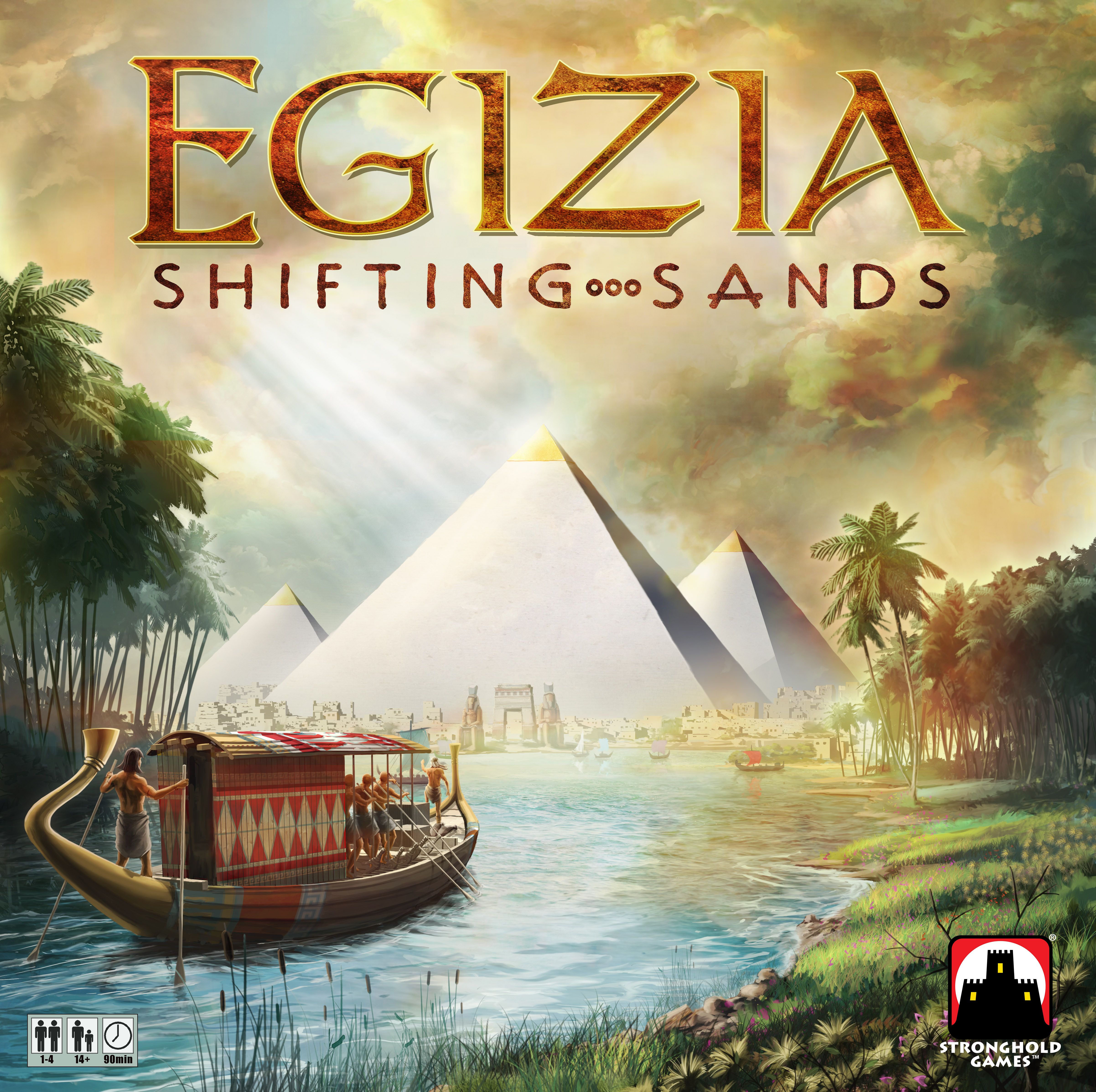
Egizia: Shifting Sands is a worker-placement style game over five rounds in which players place ships along the Nile to gain crews, fields, quarries and cards, then spend stone and crew strength to build monuments for the Pharaoh. Players score points as they build monuments and at the end of the game for sphinx cards, statue bonuses and their remaining stone and grain. The player with the most points at the end wins.
準備
Place the game board in the middle of the table on the side shown in the contents. Separate the Nile cards into three decks by card back (1/2, 3/4, 5), shuffle each and place them face down beside the board. Set aside the Nile tiles marked "2" and place the rest in a pile near the board. Put one gold and one purple column bonus tile face up on their spaces on the colonnade, returning the other bonus tiles to the box. Randomly place one A statue card and one B statue card face up on the first two statue spaces, then draw one more statue card at random from the remaining statue cards for the third space, returning the rest to the box. Shuffle the sphinx cards, deal two to each player, and have each player keep one and discard the other; shuffle discards back in and place the deck on its space. Place the irrigation ring on the middle irrigation space.
Each player takes a player tableau, four crew tokens (the purple lead crew goes in column 2 and the three basic crews go in column 1), all ships and bricks in one color, and a brick on the 0 of the scoring track, one on the lowest grain market space and one on the lowest stone market space. Each player takes one quarry starter card and one field starter card, starter side up. Cover building spaces with ships of unused colors so there is one fewer building space than players in each zone. Deal player sequence tiles randomly; the player with tile 1 starts with two stone, tile 2 with three, tile 3 with four and tile 4 with five. Place each player's stone marker on their stone reserve and arrange the scoring markers in turn order on the 0 space.
Two-player games use special setup: flip the board to the two-player side, return Nile cards and sphinx cards marked "3+" to the box, place two of the "3+" Nile tiles face down on the first two left-side circles as out of play and fill the other circles with five random ones, use the G6 gold bonus tile and a random purple tile, leave the third statue space empty, cover unused building spaces with ships of both unused colors (two per zone), and give the 1 and 2 sequence tiles randomly. The first two Nile card spaces are not used.
手番の流れ
Each round has six phases in order: River Set Up, Placement, Mining, Feeding, Building and Clean Up.
- River Set Up: Draw Nile cards from the deck matching the round (1/2 in rounds one and two, 3/4 in rounds three and four, 5 in round five) and place one face up on each card space beside the Nile. After rounds two, four and five, remove the leftover cards of that deck from the game. In round one, set aside the Nile tiles and use the printed board abilities; in later rounds, shuffle all Nile tiles and place one face up on each circular tile space, setting the rest aside.
- Placement: Starting with the player holding sequence tile 1 and continuing in player order, players take turns placing one ship each on the Nile. Each new ship must go farther downstream than your previous ship this round, and only one ship can occupy each Nile space. A ship can go on a Nile card (take the card into your play area; Immediate cards are used right away and discarded, Anytime cards are kept for later use, Permanent cards stay for the game, and fields and quarries are kept), a Nile tile (gain its icons immediately), or a building space in one of the monument zones. Building spaces are limited to one per player minus one per location, and a player cannot put two ships on the same building location. If all building spaces are full, a player may place a speculating ship beside a location, which can build last there only if the others in that location do not build. A player who passes cannot place again this round. The phase ends when all players have passed.
- Mining: Each player gains stone equal to the total stone on their quarries, added to their stone reserve. Stone above the 25 capacity is lost.
- Feeding: Starting with player 1, each player compares the total strength of their four crews with the grain they produce. Green fields always produce; yellow fields produce unless the irrigation ring is on the bottom space; red fields produce only when the ring is on the top space. Grain cannot be saved between rounds. Any shortfall costs points per grain missing, at a rate set by your grain market level. Surplus grain can be converted to points once you reach the third grain market level.
- Building: Players who placed ships in a building zone build in the order of their ships' distance from the Nile, closest first, across the obelisk and colonnade, then the pyramid and statues, then the sphinx. To place a brick, spend stone and crew strength equal to the number shown on the space. Each zone allows only one basic crew to be used, and its strength must cover the total cost of the bricks placed there; the purple crew can only be added to a basic crew, once per round. Crews used are flipped to show they are spent for the round. Excess strength is wasted. A player who does not build in a zone where they placed a ship has that ship removed; other ships move one space closer to the Nile.
- Clean Up: Cooperation bonuses are scored in current score order, with the lowest scorer going last: 5 points for building in all three zones and 2 points for building in two. Then remove all ships, remaining Nile cards and Nile tiles from the board, flip all spent crews back up, and reset any once-per-round colonnade tokens. Players with the fewest points receive the lowest-numbered sequence tile for the next round, with ties going to the player who reached that score later. The round then starts again, unless it was round five.
ゲームの終了
The game ends after the fifth round, once the cooperation bonus has been scored. Final scoring follows.
得点計算
During play, points come from building the obelisk and colonnade (equal to the stone spent), some pyramid row majorities, the cooperation bonus, sphinx card actions and grain shortfalls. At the end of the game, score the following:
- The player with the most bricks in the pyramid scores 5 points. Ties share the bonus. In the two-player game, both pyramid sides are combined and only one bonus is given.
- Players score end-of-game effects on their Nile cards.
- Players score the points listed on each sphinx card they have fully completed. Incomplete sphinx cards score zero.
- Players who built statues score the highest level they have both built and met the requirement for, at 10, 5 or 2 points. Points from levels do not add together.
- A player whose stone market marker is on the fourth or fifth space scores 1 point for every two remaining stones, rounded down.
The player with the most points wins. If players tie, the player with the higher-numbered player sequence tile wins.
バリアント
The rulebook gives these variants:
- Two-player game: Uses the two-player board side and setup changes listed above. Some building actions occur in the Building phase instead of when a ship is placed. The pyramid is treated as a combined two-sided structure with a different bonus rule, and the maximum sphinx and statue scores change accordingly.
- Classic Edition: The Kickstarter board can be flipped to play the Classic Edition, using an additional rules sheet that is not included in this rulebook.
- Pyramid rules: The two-player pyramid variant treats both sides as one connected structure.
変更履歴
- バリアント、ルールブックからの下書き、2026年11月22日 (現在表示中)
- 得点計算、ルールブックからの下書き、2026年11月22日 (現在表示中)
- ゲームの終了、ルールブックからの下書き、2026年11月22日 (現在表示中)
- 手番の流れ、ルールブックからの下書き、2026年11月22日 (現在表示中)
- 準備、ルールブックからの下書き、2026年11月22日 (現在表示中)
- 概要、ルールブックからの下書き、2026年11月22日 (現在表示中)