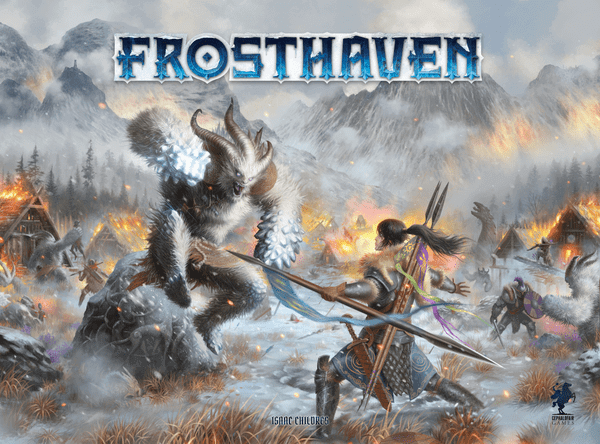
Frosthavenのルール
概要
Frosthaven is a campaign game in which a party of mercenaries, each run by one player, ventures into the wilderness to complete scenarios that keep the outpost safe. Between scenarios the party returns to Frosthaven to handle events, gear, and buildings. A scenario is won by achieving its specific goal, and it is lost if every character becomes exhausted.
準備
Work through these steps in order: select an unlocked scenario whose requirements are met, and resolve a road event if one applies. Set up the map tiles and the first room from the scenario entry, then gather the monster stat cards, standees, and ability decks for the monsters in the scenario key. Shuffle each ability deck and sleeve its stat card so only the relevant level shows. Place the overlay tiles, then shuffle the character, monster, and ally attack modifier decks. Read the scenario goals, introduction, and special rules. Deal each character three battle goals, keep one, and discard the others. Build the loot deck from the scenario's loot table. Each character chooses items from their pool, applying any negative and start-of-scenario effects. Each character then picks ability cards up to their hand size. Set each red hit point dial to maximum and each blue experience dial to zero, and apply any road event and scenario effects. The scenario level normally equals the average character level divided by 2, rounded up, but it can be set anywhere from 0 to 7.
This part does not give general setup rules for the game. It covers setup for random dungeons and a quick checklist for beginning a scenario.
For a random dungeon, build a loot deck of 24 cards: 12 money cards, two of each material resource, and one of each herb resource. For each room, draw a random room card and a random setup card, then place the listed monsters, tiles, and tokens on the map designations shown on the room card.
Beginning a scenario (quick reference): select the scenario, resolve a road event if needed, set up map tiles, prepare monster ability decks and overlay tiles, set up the first room, shuffle attack modifier decks, read the scenario entry, deal and select battle goals, place the token tray, build the loot deck, choose items and ability cards, set summon dials to maximum and X dials to zero, and apply event and scenario effects.
手番の流れ
A scenario is played in rounds. At the start of each round, apply any start-of-round effects, such as spawning monsters. Card selection: each character secretly chooses two cards from hand to play face down, and one becomes their initiative card. Instead, a character with at least two cards in their discard pile may declare a long rest, which uses their whole turn on initiative 99 and plays no cards. Characters may discuss strategy but may not show their cards or give specific numbers. Once everyone has chosen, reveal the selected cards and draw one monster ability card for each monster set on the map. Ordering of initiative: arrange all initiative tokens from lowest to highest value. Ties between characters are broken by comparing their second played cards, and if still tied the party decides. A character tied with a monster set acts first. During a character's turn they perform the top action of one played card and the bottom action of the other, in either order. Monsters perform only the abilities listed on their drawn ability card, and their focus and movement follow the automated monster rules. Once every figure has acted, the End of Round step resolves: end-of-round effects, shuffling of decks marked with the shuffle icon, clearing round bonuses, optional short rests, and moving infused elements.
A scenario round runs in this order: card selection, ordering of initiative, character and monster turns, then end of round.
A character cannot perform two top actions or two bottom actions in one turn. Characters loot the hex they occupy at the end of their turn, not after each movement. Monsters and summons do not loot at end of turn.
Monster turn: first check conditions and attack ability, then check for movement paths to attack hexes. If no path exists, the monster does not find a focus and does not move or attack. Otherwise it focuses on an enemy using these priorities: a path that triggers fewer negative hexes, a path needing fewer movement points, a closer enemy by range, then an earlier enemy in initiative order. Then it performs its abilities from top to bottom (move, attack, and others). A move ability only applies if the monster ends with a shorter path to its attack hex than before, and it picks the path with the fewest negative hexes and the hex that maximizes attackable targets. Remaining ambiguity is decided by the party.
ゲームの終了
A scenario is lost if all characters become exhausted or if a loss condition in the scenario rules occurs. It is completed if the goal listed in the scenario rules is achieved. Once the end is triggered, play continues until the current round finishes, then the scenario ends. If a loss and a completion happen in the same round, the scenario is lost. When the scenario ends, unlooted loot tokens and treasure tiles cannot be looted.
A scenario can only end at the end of a round. Whether the scenario is lost or completed, the party recovers discarded and lost items and ability cards, resets summon dials, removes conditions, and removes bless and curse cards from attack modifier decks.
If the scenario is lost, the party either returns to Frosthaven for an Outpost Phase, gaining no resources from loot cards, or replays the scenario immediately.
If the scenario is completed, the party gains resources from loot cards, checkmarks for battle goals, perk marks for masteries, and scenario rewards, reads the scenario conclusion, updates the map, and then returns to Frosthaven for an Outpost Phase or plays a linked scenario immediately.
得点計算
The rulebook does not rank players against each other, so the party succeeds or fails together. At the end of a scenario, each character notes the experience gained during play, which is added to their total, and completed scenarios also grant bonus experience based on scenario level. Gold from loot coins is multiplied by the gold conversion rate for the scenario level and added to each character's gold total, whether the scenario was lost or completed. If the scenario was lost, the party chooses to return to Frosthaven and keep the loot resources, or to replay the scenario without receiving them while keeping experience, gold, and treasure. If the scenario was completed, characters gain loot resources and checkmarks from their battle goals, with every three checkmarks granting a perk mark. Characters also gain a perk mark for each new mastery achieved, even if they became exhausted, and the party gains inspiration equal to 4 minus the number of characters. Scenario rewards can only be gained once per campaign.
バリアント
The rulebook's in-scope variant is an advanced option: experienced players may add level X ability cards to their hand, removing an equal number of level 1 cards, as long as the total stays within hand size. Scenario level can also be lowered or raised at the start of a scenario to adjust difficulty. Solo mode and casual mode are covered in a later part of the rulebook and are not described here.
Casual mode: play any unlocked scenario regardless of requirements. Campaign effects are ignored, no event resolves, time does not pass, and the outcome does not affect the campaign. Completed scenarios can still be replayed in the campaign if requirements are met.
Crossover classes: unlocked classes from other Gloomhaven games can be used in Frosthaven, and Frosthaven classes can be used in other Gloomhaven games. Classes may keep previous enhancements, which may unbalance play. Crossover character sheets are available at the publisher website.
Temporary enhancements: enhancement stickers are removed when a character retires. Enhancement cost is calculated normally, then reduced by 20 gold if the action already has at least one enhancement, then reduced by 20 percent (rounded up).
Reduced randomness: treat the specified attack modifier cards as the less extreme versions, so the most extreme outcomes are removed. Item and game effects that refer to those cards are unaffected.
Solo mode: one player controls two or more characters. Calculate scenario level by averaging character levels, adding 1, then dividing by 2 and rounding up.
Open information: players may share exact hand contents and discuss plans during card selection. Scenario level is calculated as in solo mode. The rulebook says this is not the recommended way to play.
Permanent death: a character who drops to zero hit points dies instead of becoming exhausted. The character is removed at the end of the scenario, their personal quest returns to the deck, their items return to supply, their resources go to the Frosthaven supply, and their gold is lost. A new character is created during the next Outpost Phase Downtime step, or just before a force-linked scenario. Exhausted characters remain on the map, can still be targeted, and count as initiative 99 for focus.
Character respeccing: during the Outpost Phase Downtime step, a character may pay 10 times their current level in gold to reset ability card choices, returning all non-level-1 and non-level-X cards and re-choosing up to their current level.
Random dungeons: a party can play a random dungeon instead of an official scenario, either in the campaign or in casual mode. It has three random rooms, and all monsters in all three must be cleared. Each new room is revealed when a character opens its door, with penalties applied as listed on the room card and setup card (none for the first room, minor for the second, major for the third, adjustable by the party).
変更履歴
- バリアント、ルールブックからの下書き、2026年11月22日 (現在表示中)
- 得点計算、ルールブックからの下書き、2026年11月22日 (現在表示中)
- ゲームの終了、ルールブックからの下書き、2026年11月22日 (現在表示中)
- 手番の流れ、ルールブックからの下書き、2026年11月22日 (現在表示中)
- 準備、ルールブックからの下書き、2026年11月22日 (現在表示中)
- 概要、ルールブックからの下書き、2026年11月22日 (現在表示中)