Keyflowerのルール
概要
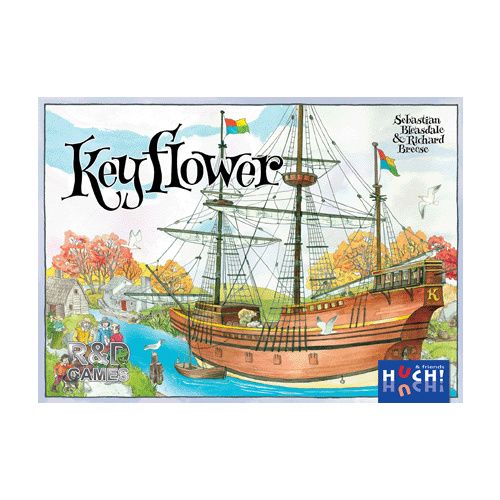
Keyflower is a worker-placement and auction game for two to six players, played over four seasons: spring, summer, autumn and winter. Players use coloured workers to bid for village tiles and turn order tiles, and use workers on tiles to gain resources, skills, workers and victory points. The player whose village and workers generate the most victory points wins.
準備
- Put the blue, red and yellow workers in the cloth bag. Keep the green workers, resource counters and skill tiles beside the playing area.
- Each player builds a player screen, secretly draws eight workers from the bag and keeps them behind the screen.
- Sort the large hexagonal tiles by type. Each player receives a random home tile and places it in front of their screen.
- The player with the lowest-numbered home tile takes the purple start player worker.
- Place a number of boat tiles equal to the number of players in a row at the edge of the play area, with the correct side up. Add the workers and skill tiles shown on each boat.
- Place the turn order tiles, as many as the player count requires, in a row next to the boats but closer to the centre, with the correct side up.
- Place the number of spring tiles shown in the rulebook table in the centre, spring side up.
- Each player receives face-down winter tiles: three each with two to four players, two each with five or six.
- Summer and autumn tiles go in two separate piles for later. Return any surplus tiles to the box.
手番の流れ
On their turn, a player places one or more workers of a single location to either bid for a village tile or turn order tile, or use a village tile. Play goes clockwise until all players pass in succession. A passed player may still act while others have not all passed.
At the start of summer and autumn, boat tiles are turned to the new season side, new workers and skill tiles are added to the boats from the bag, and that season's village tiles are placed in the centre. In winter no new workers or skill tiles arrive. Each player instead chooses one or more of their winter tiles face down, the choices are revealed together, and the tiles are shuffled if there are more than two players before being laid out so no one knows who chose which.
Bidding:
- A bid needs workers of the same colour as any workers already on the tile.
- Each new bid must use more workers than the previous bid. There is no maximum.
- A player can add to their own winning bid. Winning workers cannot be taken back.
- Outbid workers may be moved elsewhere, but they must stay together and can be topped up with other losing workers or workers from behind the screen. They cannot go back behind the screen.
- Turn order tiles are bid for the same way. They set the order for taking boat contents and the start player. A player may bid on several but takes contents from only one boat.
Production:
- A tile is first used by placing one worker. It can be used again by placing two workers, and a third time by placing three. These must match the colour of workers already on the tile.
- Each use needs at least one more worker than the previous use. No more than six workers may be placed on one tile in a season.
- Benefits: resources from a player's own village stay on that tile. Resources from other villages or from tiles being bid for go to the player's home tile. Skill tiles and workers go behind the player's screen.
Transport and upgrading:
- Place a worker on a home or transport tile (farrier, stable, wainwright) to move resources along roads, up to the capacity shown.
- Upgrade village tiles by paying the cost shown and flipping them. Required resources and skill tokens are used up. Other resources and workers stay on the tile.
Expanding villages: At the end of a season, players add their won tiles to their villages. Adjacent road, no-road and water sides must match. Placed tiles cannot be moved.
得点計算
Players score the tiles in their village and their gold counters.
- Resources on the barn, blacksmith, stone yard and timber yard count only if they were placed there during the game. Those resources cannot also count for the jeweller, mercer's guild, watermill or windmill.
- Every item (resource, skill or worker) can score only once and only for one bonus tile. Gold counts one point each unless it is allocated to a scoring tile.
- The purple start player marker may be scored as a resource, skill or worker of any colour.
- Turn order tiles score one point for each other tile they are connected to.
- Boats score as their tile describes. Sea Breese scores only if connected by water to the home tile.
- Many tiles score for counts of resources, skills or workers, using the wording on each tile.
The player with the most points wins. If players are tied, they play again to decide the winner.
変更履歴
- 得点計算、ルールブックからの下書き、2026年11月23日 (現在表示中)
- 手番の流れ、ルールブックからの下書き、2026年11月23日 (現在表示中)
- 準備、ルールブックからの下書き、2026年11月23日 (現在表示中)
- 概要、ルールブックからの下書き、2026年11月23日 (現在表示中)