Lancasterのルール
概要
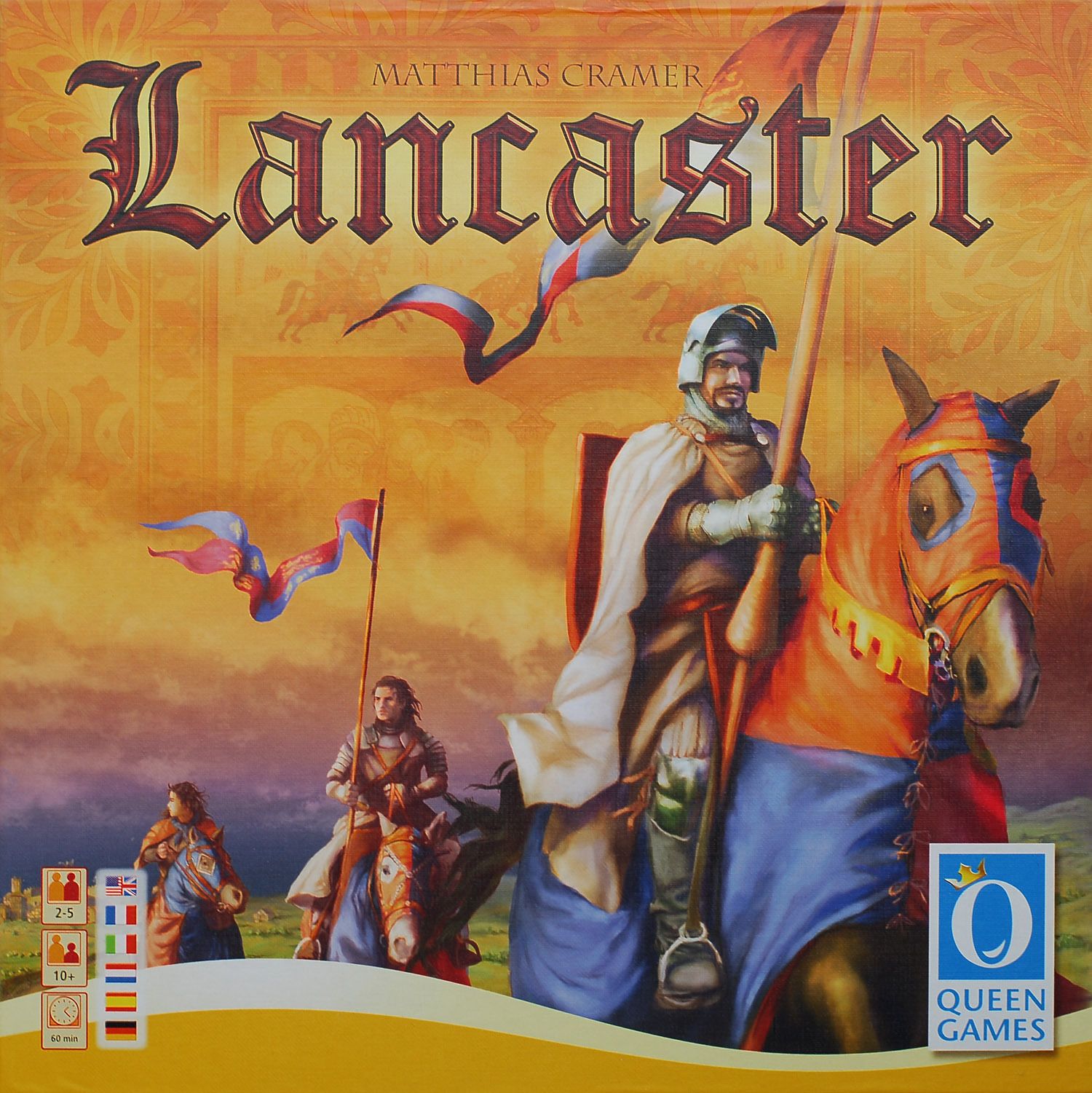
Players are noble families competing to become the most powerful ally of King Henry V in 1413 England. They gain influence by placing knights in English counties, in their own castles and in conflicts with France, and by voting on laws in Parliament. The player with the most power points at the end of the game wins.
準備
Randomly choose a start player and give them the start player marker. Each player takes their own knights, gold and squires, and the players take turns clockwise from the start player.
手番の流れ
The game lasts five rounds. Each round has three phases.
Phase 1, Place knights: Starting with the active player and going clockwise, each player places one knight from their court onto a knight's space. Players who have no knights left skip their turns. If only one player still has knights, they place them one after another. A knight can go to a county, your own castle, or a conflict.
- County: The knight must meet the space's minimum strength. Squires can be added, each giving +1 strength that does not count toward the minimum. You may expel another player's knight if your total strength is higher than theirs. You can never expel your own knight. The expelled knight returns to its owner's court and is placed again later in turn order.
- Castle: Place the knight on an empty knight's space in your own castle, one knight per space.
- Conflict: Place the knight on the topmost empty space. Each player may occupy only one space per conflict, but may join as many conflicts as they like. Knights in the same conflict may be stacked to add strength.
Knights and their squires must be placed in the same action. Later reinforcements are not allowed, except by stacking in conflicts. The first six knights placed in conflicts also gain a king's favor reward: choose a face-up favor tile, take its reward, and flip it over so it cannot be chosen again this round.
Phase 2, Parliament: Three new laws are voted on in order, starting with the left space of the bottom row. All players vote secretly and simultaneously by placing a yes or no voting tile face down, then may secretly add any number of voting markers. Then everyone reveals at once. Each tile and marker counts as one vote. The majority decides, and a tie approves the law. If approved, the leftmost law leaves the display, the other laws shift one place, and the new law takes the empty space on the right. If rejected, the new law is removed from the game. Voting markers are returned to the supply afterward. The three laws in effect are then applied from left to right, and players gain their rewards.
Phase 3, Rewards: Counties, castles and conflicts are scored in that order (see scoring).
ゲームの終了
The game ends after the final scoring that follows the fifth round.
得点計算
County rewards: Counties A to I are resolved in order. For each, the player chooses one of three options: take the nobleman tile, take the county's other reward, or pay 3 gold to take both. Then the knight returns to its court and its squires go back to the supply. In Surrey, the player also chooses the new start player, who may be themselves.
Castle rewards: Starting with the start player and continuing clockwise, each player scores their castle. Knights and extension tiles give their shown rewards, and then the player gains voting markers equal to the nobleman tiles in their company at table, including their own. Voting markers are not gained in the fifth round.
Conflict scoring: Conflicts in France are resolved one at a time, with the lower row first.
1. Winner: Add the strength of all knights in the conflict. If the total equals or exceeds France's strength, England wins. Otherwise France wins.
2. Ranking: Players are ranked by the total strength of their knights in that conflict. Ties go to the player whose knights are lower in the conflict, since they entered later.
If England wins, the three power point values on the card go to ranks 1 to 3. If France wins, only the second value goes to rank 1 and the third value goes to rank 2, and the conflict moves to the lower row with its knights still in place. A second France win in the lower row captures the knights. Their owners may ransom each one for 1 gold per strength level, paid in player order. Unransomed knights go to the reserve. Ranks with no player award nothing.
Noblemen track: The number of nobleman tiles a player has gives power points: 1 tile 1 point, 2 tiles 3, 3 tiles 6, 4 tiles 10, 5 tiles 15, 6 tiles 21, 7 tiles 28, 8 tiles 36, and 9 tiles 36 as shown on the table.
Final scoring:
- 8 power points for the highest total strength of the knighthood, and 4 for the runner-up.
- 8 power points for the most extension tiles in the castle, and 4 for the runner-up.
- Players with more than one nobleman tile in their company at table score the noblemen track points.
Ties: For the strength tie, the player with more squires wins it. For the extension tie, the player with more gold wins it. If two players tie for first, divide the 12 points for first and second place by the number of tied players. If one player is first and several tie for second, divide the 4 points for second place by the number tied. Indivisible points are lost. The player with the most power points wins, and tied leaders share the victory.
バリアント
Two-player game: Each player has an ally with its own small castle that cannot be extended. Each player controls both their own knights and their ally's knights, but allies do not receive power points, voting markers, gold or squires, and cannot vote. Allies do not use the county squire rules and cannot expel knights of their own side, and players cannot place their knights in the other player's ally castle. Ally rewards are limited: a king's favor gives gold or squires that are obsolete, upgrades an ally knight by one level, or removes a chosen nobleman tile from the game. Conflict contributions are ranked for allies separately, but allies forfeit their power points. Allies are not counted in final scoring, so only the first-place bonus (8 points) counts for strength and extensions. Ally captured knights cannot be ransomed.
変更履歴
- バリアント、ルールブックからの下書き、2026年11月23日 (現在表示中)
- 得点計算、ルールブックからの下書き、2026年11月23日 (現在表示中)
- ゲームの終了、ルールブックからの下書き、2026年11月23日 (現在表示中)
- 手番の流れ、ルールブックからの下書き、2026年11月23日 (現在表示中)
- 準備、ルールブックからの下書き、2026年11月23日 (現在表示中)
- 概要、ルールブックからの下書き、2026年11月23日 (現在表示中)