NEOMのルール
概要
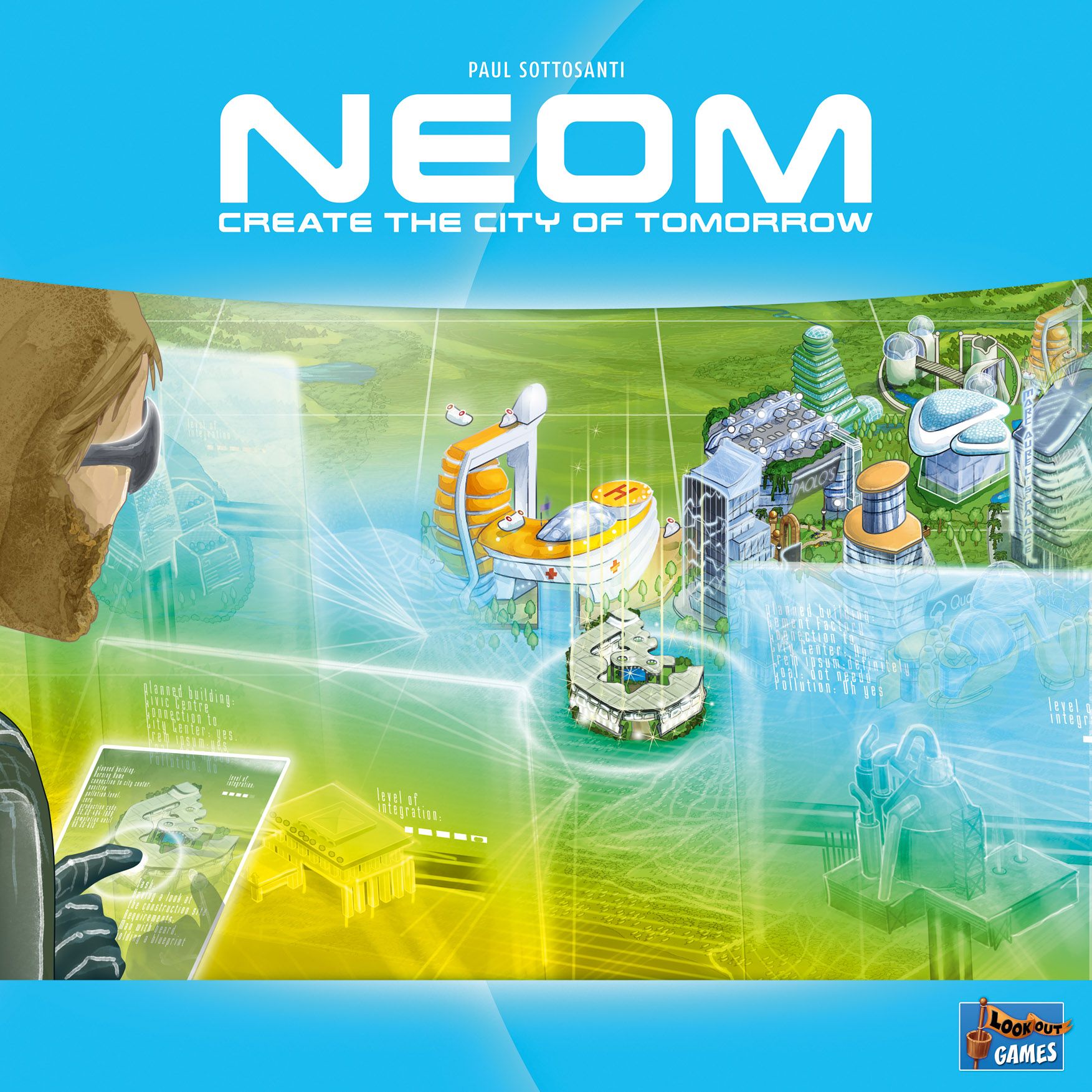
Neom is a tile drafting and tile placement game for 1 to 5 players, in which you build a city over three Generations by placing tiles on a 5×5 grid. Tiles supply goods and money needed for other tiles, and they earn victory points. The player with the most victory points at the end wins.
準備
- Each player takes a random City board, places it in front of them, and takes the Raw Good token matching the one shown in their City Center, placing it above the board.
- Each player takes £6 and places it next to their board. Remaining Good tokens and L-Coins form a general supply.
- Separate the Cornerstone tiles from the Generation tiles, shuffle the Cornerstones and place them face down nearby.
- Split the Generation tiles into three decks by Generation (shown on the back). From each deck, remove tiles not used at the current player count, as marked by the 1+, 4+ and 5+ icons. Shuffle each deck and place it face down. Return removed tiles to the box.
Preliminary Round: Deal each player 4 Cornerstone tiles and return the rest to the box. Simultaneously, each player picks one Cornerstone face down, passes the rest left, and receives tiles from the right, repeating until each player has 3 face-down Cornerstones. The last tile in hand goes to a common discard pile. Then reveal the chosen Cornerstones. No actions are taken with them now.
Beginner's variant: Skip the Preliminary Round and deal each player one random Cornerstone instead.
手番の流れ
Each Generation has seven turns. At the start of a Generation, deal each player a hand of 8 tiles from that Generation's deck.
A. Select a tile: All players simultaneously pick one tile from their hand and place it face down, then pass the rest of their hand to the left. In the 7th turn, the hand has only 2 tiles; keep the one you select and return the other to the box without passing it. Selecting a Disaster means you take no action this turn.
B. Take an action: After all selections, reveal them and act (simultaneously preferred). Options:
- Place the tile: Meet its requirements, which may be L-Coins paid to the supply, Goods your City produces or buys from another player, or certain tiles already in your City. Then place it on an empty space or replace an existing tile, so it connects by Roads to the City Center. Tiles cannot be rotated or flipped.
- Place a Cornerstone: Return the selected Generation tile to the box and place one of your Cornerstones instead, following the same placement rules. You may have at most one Cornerstone per Generation in your City at the end of the Generation's turns, so 1 in Generation 1, up to 2 in Generation 2, and all 3 in Generation 3.
- Sell the tile: Return the selected tile to the box and take £5 from the supply.
C. Pick up tiles: Take the tiles passed to you from the player on your right as your next hand.
Buying missing Goods: Pay the base cost to the seller: £2 for Raw, £4 for Processed, £10 for Luxury. Add £1 for each player between you and the seller, and subtract £1 if you have an established Trade Route in that direction. Payment cannot be refused or spent that turn.
Income: At the end of each Generation, after the seventh turn, collect income from tiles showing the income symbol. Cities without income tiles get none.
Disasters: When a Disaster is selected, it takes effect on the other players at the end of the turn. Each affected player either pays a penalty or sacrifices tiles, as specified for Flood (1st Generation), Fire (2nd) and Crime Spree (3rd). Protection from Fire or Police Departments can reduce the penalty.
得点計算
Use the scoring pad. Cornerstone and Generation tiles are scored alike. Categories:
- Tiles: Add the printed VP of Residential and Public tiles, determining variable values first.
- Neighborhoods: Groups of directly connected Residential tiles score by size: 1, 3, 6, 10, 15, 21, 28, 36 VP for sizes 1 to 8, then 4 more VP per tile beyond 8. Do not repeat the tile values here.
- Goods: Each good token above your board scores once: Raw 1 VP, Processed 2 VP, Luxury 10 VP.
- Money: 1 VP per £2 left, rounded down.
- Pollution: Each Residential tile loses 2 VP per orthogonally adjacent Polluting tile and 1 VP per diagonally adjacent one.
- Ghost Town: Lose 10 VP with no Residential tiles, or 4 VP with only one.
- Power: Lose 5 VP without at least one Power-generating tile.
The player with the most VP wins. If players tie, they share the victory.
バリアント
Two-player game: Players act one after the other, alternating who goes first each turn. No tiles are dealt; each turn a selection of face-up tiles is offered and the remainder discarded. The Preliminary Round uses three stacks of three Cornerstones. Each Generation uses 24 tiles in 3 packs of 4 and 4 packs of 3.
Solo game: Packs are formed from each Generation's tiles and are revealed one at a time, with the player selecting one tile per pack. You may use only 1+ tiles, 1+ and 4+ tiles, or all tiles. Disasters can be prevented only by selecting them from the first three packs. Buying goods is limited by Generation: Raw only in the 1st, Raw and Processed in the 2nd, and any type in the 3rd. Trade Route discounts apply once per Generation. Final scores are compared against a rank table: Intern, Apprentice, Fellow, Foreman, Master, Boss, with thresholds that depend on the tile set used.
Beginner's variant: See Setup, which deals one random Cornerstone and skips the Preliminary Round.
変更履歴
- バリアント、ルールブックからの下書き、2026年11月22日
- 得点計算、ルールブックからの下書き、2026年11月22日
- 手番の流れ、ルールブックからの下書き、2026年11月22日
- 準備、ルールブックからの下書き、2026年11月22日
- 概要、ルールブックからの下書き、2026年11月22日
- バリアント、ルールブックからの下書き、2026年11月22日 (現在表示中)
- 得点計算、ルールブックからの下書き、2026年11月22日 (現在表示中)
- 手番の流れ、ルールブックからの下書き、2026年11月22日 (現在表示中)
- 準備、ルールブックからの下書き、2026年11月22日 (現在表示中)
- 概要、ルールブックからの下書き、2026年11月22日 (現在表示中)