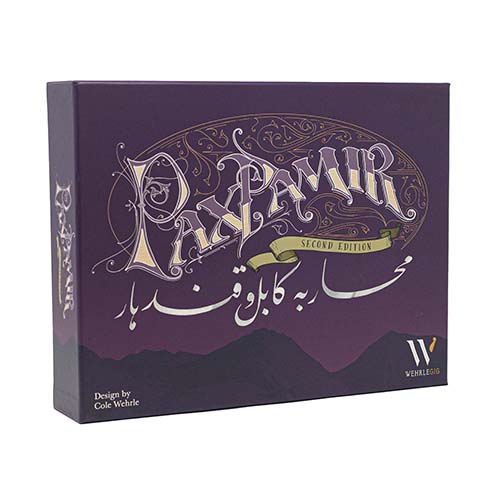
Pax Pamir: Second Editionのルール
概要
Pax Pamir is a tableau-building game in which each player leads a nineteenth-century Afghan faction seeking to build a new state. Players buy cards from a central market, play them into a personal row called a court, and use their actions to influence the map and interfere with rivals. Victory points come mainly from Dominance Checks, and the game ends early if one player gets a large lead, or after the final check.
準備
Build the draw deck from court and event cards. Shuffle the court cards and deal five plus one per player into six face-down piles, and remove unused cards. Put one Dominance Check into each of the four rightmost piles. Add a set of event cards to the piles as the rulebook describes, leaving some out of play. Shuffle each pile separately, then stack the piles so the Dominance Check piles are at the bottom, without reshuffling the combined deck.
Fill the market with 12 face-up cards in a two-row, six-column grid, filling each column top row first from the left, and place the draw deck beside it. Give each player eleven cylinders, a loyalty dial, a player board, and four rupees. Each player places one cylinder on the zero space of the victory point track and keeps the rest on their board. Place the favored suit marker on the political suit. Starting with a random player and going clockwise, each player sets their starting loyalty; the last player to choose takes the first turn.
手番の流れ
On your turn you may take up to two actions, and you may take fewer or none. Purchase and play are always available. Cards in your court may offer more actions, each usable once per turn per card. Actions on cards in the favored suit are bonus actions and do not count against your two-action limit.
- Purchase: Buy a face-up market card and add it to your hand. A card's cost depends on its column: the leftmost is free, then one rupee, two, and so on. Pay by placing one rupee on each card to its left in the same row; if a space is empty, pay the matching space in the other row. When military is favored, costs are doubled.
- Play: Play a card from your hand into your left or right court end. If another player rules its region, pay them a bribe equal to their tribes there, unless they waive it. Then resolve the card's impact icons from top to bottom.
Other card actions include gift, build, tax, move, betray and battle, each with its own rules. After your turn, perform cleanup, then play passes clockwise.
ゲームの終了
After any Dominance Check, if one player leads every other player by at least four victory points, the game ends immediately and that player wins. Otherwise the game ends after the final Dominance Check is resolved.
得点計算
A Dominance Check is successful if one coalition has the most blocks and at least four more than each other coalition. If successful, the most influence in the dominant coalition scores 5, 3 and 1 points for first to third, and then all blocks are cleared. If unsuccessful, the most cylinders in play scores 3 points and second most scores 1. Tied places split their combined points, rounded down. Points from the final check are doubled before any splitting.
If players tie on final points, the tie is broken by the most red stars in court, then the most rupees, and the rulebook adds a humorous last tie-break involving chopan kebab.
バリアント
The rulebook includes a solo or automated opponent called Wakhan, who can face one or two human players. Wakhan is not a cooperative partner, and only one player or Wakhan can win. Wakhan has its own setup, uses an AI card drawn each turn to choose actions, and follows priority rules for card choices, purchases, moves and battles. The rulebook does not describe separate team or short-game variants.
変更履歴
- バリアント、ルールブックからの下書き、2026年11月22日 (現在表示中)
- 得点計算、ルールブックからの下書き、2026年11月22日 (現在表示中)
- ゲームの終了、ルールブックからの下書き、2026年11月22日 (現在表示中)
- 手番の流れ、ルールブックからの下書き、2026年11月22日 (現在表示中)
- 準備、ルールブックからの下書き、2026年11月22日 (現在表示中)
- 概要、ルールブックからの下書き、2026年11月22日 (現在表示中)