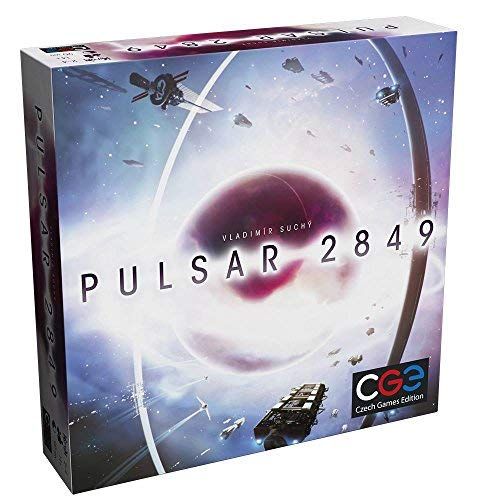
Pulsar 2849のルール
概要
Players run rival corporations in a pulsar-rich star cluster in the year 2849, building gyrodyne generators and energy transmitters over eight rounds. Points come from flying survey ships, claiming and developing pulsars, completing transmitters, patenting technologies, finishing HQ projects, and end-of-game goals. The player with the most points at the end wins.
準備
Place the star cluster board in the center and choose the dice board side that matches the player count; the rulebook gives one side for 4 players and the other for 2 or 3. Use 9 silver dice plus the red die for 4 players, or 7 silver dice plus the red die for 2 or 3 players, and put the rest in the box. Shuffle the exploration bonus tiles into a face-down stack. Mix the 17 planetary system tiles, deal 16 face down to the planetary system locations, and return the last one unseen.
Separate the gyrodyne tiles by type and stack each on the gyrodyne board, then place the construction award stacks (7-point tile on top of 4-point tile) on their spaces. Give each player one plus-minus die modifier token and put the rest on the die modifiers board. Set the time marker at the innermost technology row and place the median marker near the dice board.
For a first game, use the marked goal tiles and technology boards AI, AII and AIII, with board I inside and board III outside. Stack the transmitters with Cs at the bottom, Bs in the middle and As on top, then reveal three.
Leave the HQ boards in the box for a first game. Starting points are 5 for the first player, 6 for the second, 7 for the third and 8 for the fourth. Each player places a hundred-point tile near space 0. Players choose entry gates in reverse play order, and each player's figure goes on a play-order space, with counters stacked on the initiative and engineering starting spaces.
手番の流れ
Each round has a Dice Phase, an Action Phase and a Production Phase.
Dice Phase: The first player rolls all the silver dice and places each on the matching value on the dice board, then sets the median marker on the median die. Players, starting with the starting player, each take one die and move one of their two counters toward the die's side of the median, by the number of spaces to that die. Then, in reverse order, each takes a second die. One or more dice remain on the board as possible bonus dice.
Action Phase: Each player, in play order, spends their two dice on actions, each costing a die of a specific value. Actions include flying the survey ship (the die value sets the number of segments), taking or paying for transmitters, taking gyrodyne tiles, starting or completing gyrodynes, patenting technologies, and completing HQ projects. Spent dice go to the black hole. A player may use at most one bonus die per turn, from a red die, a copied leftover die (costing 4 engineering cubes), or a transmitter link.
Production Phase: Players set a new play order from the initiative track, receive engineering cubes, take initiative and engineering penalties, gain points and cubes from online transmitters, score spinning gyrodynes, score green technologies, discard unused transmitters and reveal three new ones, open second patent slots, and advance the time marker.
ゲームの終了
The game ends after the eighth round. After the Production Phase of round 8, the players do not set up another round and go straight to final scoring.
得点計算
Final scoring has these steps: score end-of-game points from patents, score goal tiles (with the option to buy bonuses using engineering cubes), score 1 point per claimed pulsar that has no gyrodyne or only one still under construction, score 1 point per gyrodyne tile still under construction or still on your table, score 1 point per pair of engineering cubes left (a single cube is worth nothing), score initiative final position (7 for first, 4 for second, 2 for third in 2- or 4-player games, none for third in a 3-player game), and score stations: 50 points for 13 stations, plus 3 for each station beyond 13.
The player with the most points wins. Ties go to the player farthest ahead on the initiative track.
バリアント
Two-player game: Each player uses two rocket figures on play-order spaces, with the first player chosen randomly and placing figures on spaces 1 and 3. Each player has two counters on each track and the dice board's two-player side is used. Seven silver dice are rolled and three dice are left after choosing. Nonplayer tokens block the planets marked for two-player games, and technologies with one die icon can be patented by only one player during the game.
Three-player game: Use the other dice board side and 7 of the 9 silver dice. Nonplayer tokens block the planets marked for two- or three-player games, and there are no initiative points for third place.
Even start variant: For the first roll only, set some dice to fixed values before rolling the rest. In a four-player game, set six dice to 1 through 6. In a two- or three-player game, set four dice to 2, 3, 4 and 5. Roll the remaining three dice, then determine the median as usual.
Standard game: Randomly choose three goal tiles and play with a random side up. Choose technology boards randomly from each group. Each player also gets a random HQ board and chooses a side before the first roll.
Dead ends: One side of the star cluster board has dead ends, which the rulebook recommends for experienced players. Doubled segments let a flight go out and back as one action, and dead end visits give an exploration bonus tile.
変更履歴
- バリアント、ルールブックからの下書き、2026年11月22日 (現在表示中)
- 得点計算、ルールブックからの下書き、2026年11月22日 (現在表示中)
- ゲームの終了、ルールブックからの下書き、2026年11月22日 (現在表示中)
- 手番の流れ、ルールブックからの下書き、2026年11月22日 (現在表示中)
- 準備、ルールブックからの下書き、2026年11月22日 (現在表示中)
- 概要、ルールブックからの下書き、2026年11月22日 (現在表示中)