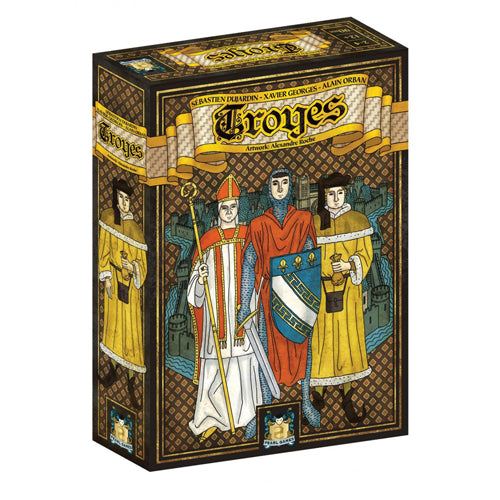
Troyesのルール
概要
Troyes is a strategy game in which each player runs a rich family in medieval Champagne, using dice drawn from citizens to recruit and direct individuals across three domains: military, religious and civil. Players earn victory points (VP) through actions, events, cathedral construction and secret character missions. The player with the most VP at the end wins.
準備
- Each player takes a color, a district marker placed on the city square, 5 deniers, an Influence marker on space 4 of the influence track, 20 cubes, and a personal supply of citizens (4 with 4 players, 5 with 3, 6 with 2).
- Each player secretly takes 1 random Character card (2 each in a 2-player game).
- Sort the Activity cards by color and by their round number. For each color, place the 1 card on the first space, the 2 card on the second and the 3 card on the third, all face down. Return unused cards to the box unseen.
- Form red, white and yellow Event decks. The number of red Event cards sets the game length: 6 with 4 players, 5 with 3, 4 with 2. Return the rest to the box.
- The player who last read a history book takes the Start Player card.
- Initial placement: starting with the start player and going clockwise, then counterclockwise on the next round, players alternate placing one citizen at a time from their supply on the Palace, Bishopric or City Hall until all are placed. Then the gray neutral citizens fill the remaining empty building spaces. With 2 players, the neutral citizens are placed first, following the rulebook's illustrated arrangement.
- Place the dice, deniers and VP tokens near the board as the general supply.
手番の流れ
A round has phases in this order. The first 3 rounds also reveal new Activity cards at the start.
1. Reveal Activity cards: in rounds 1 to 3, reveal the card of each color matching the current round.
2. Assemble workforce: each player rolls 1 yellow die per citizen in City Hall, 1 white die per citizen in the Bishopric and 1 red die per citizen in the Palace, then places them in his district. The start player rolls the dice for the neutral citizens on the buildings and places them in the gray district.
3. Income and salaries: each player gains 10 deniers, then pays 1 denier per citizen in the Bishopric and 2 per citizen in the Palace. City Hall is free. If a player cannot pay in full, he pays what he can and loses 2 VP (nothing if he has no VP).
4. Events: each turn two new events enter the queue: a red card plus the white or yellow card it calls for. Events resolve left to right. Military events add black dice for the start player to hold. Other events apply their listed effects. If an event cannot be fully resolved, the player loses 2 VP.
5. Counter black dice: the start player rolls the accumulated black dice. Starting with the highest, each die must be countered by dice from the district of the player whose turn it is, with a total equal to or higher than the black die. Red dice count double. Countered dice and the black die are discarded. The next player to the left handles the next black die, and so on. A player who cannot beat a black die discards it and loses 2 VP. Each countered black die grants 1 Influence point.
6. Actions: starting with the start player and going clockwise, each player takes one action or passes. Each action uses 1 to 3 dice of one color, taken from any districts. Dice from other players cost deniers based on group size: 2 each for 1 die, 4 each for 2 dice, 6 each for 3 dice. Dice from the neutral district are bought from the bank. Possible actions:
- Activate an Activity card, which requires a tradesman on the card (hire one if needed). Yellow dice work civil cards, white religious and red military.
- Construct the cathedral with white dice, placing cubes on matching numbered sites.
- Combat events with dice matching the card's type, placing cubes on banners.
- Place one citizen on a principal building using exactly one die. The color selects the building and the value selects the spot.
- Use agriculture with yellow dice to gain deniers equal to half their total value, rounded down.
- Pass, which gives 2 deniers placed in your district and keeps you out of the rest of the round. Each later turn you pass again, you gain 1 more denier.
Influence points can be spent before countering a black die or taking an action: reroll one of your own dice for 1, buy a citizen from the general supply for 2 (for your supply), or turn up to 3 of your own dice to the opposite face for 4. Influence is capped at 20.
- End of the round: the round ends once all players have passed or no dice remain in any district. Players take back deniers from their districts, citizens on buildings return to their owners' supplies, unused dice go to the general supply, and the Start Player card passes to the left.
ゲームの終了
The game ends at the end of the round in which the final red Event card enters the game. Then players reveal their Character cards and score.
得点計算
Players keep their VP secret during play. At the end each player also scores:
- 1 VP for each uncountered Event card with his presence on it, including Marauding.
- The VP shown on the spaces his citizens occupy on Activity cards.
- Minus 2 VP for each of the 3 cathedral levels where he has no cubes.
- For each Character card in play, the VP that character awards based on that player's performance, as listed on the card.
The player with the most VP wins. The rulebook gives no separate tie-break for the final result. Ties are only handled explicitly for event rewards and for Procession, Joust, and similar cards, where tied players share the VP.
バリアント
Solo: The King's Challenge. You play against a neutral opponent called le Roy. Le Roy has no money or Influence, and he takes turns using dice he rolls from two black dice. Changes from the standard game:
- Setup places le Roy's meeples and the character cards in a specific arrangement. Le Roy and the player alternate as start player each round.
- Negative events do not affect le Roy, and events referring to the neutral player now refer to le Roy.
- Le Roy's turn uses a table keyed to the total of the two black dice. Each result gives an action and a dice price. He always spends his best dice first.
- Some cards change: Tax Collector pays 2 per le Roy citizen on City Hall, Tithe takes up to 3 yellow dice from le Roy, Traveling Builders gives him 1 VP if the cathedral has an empty space, and Banquet ignores his dice.
- Final score is your VP minus le Roy's VP, with a rating from defeat to masterful work.
The rulebook also includes 2-player and 3-player games, which only change the setup and round count.
変更履歴
- バリアント、ルールブックからの下書き、2026年11月23日 (現在表示中)
- 得点計算、ルールブックからの下書き、2026年11月23日 (現在表示中)
- ゲームの終了、ルールブックからの下書き、2026年11月23日 (現在表示中)
- 手番の流れ、ルールブックからの下書き、2026年11月23日 (現在表示中)
- 準備、ルールブックからの下書き、2026年11月23日 (現在表示中)
- 概要、ルールブックからの下書き、2026年11月23日 (現在表示中)