Regras de 18Chesapeake
Resumo
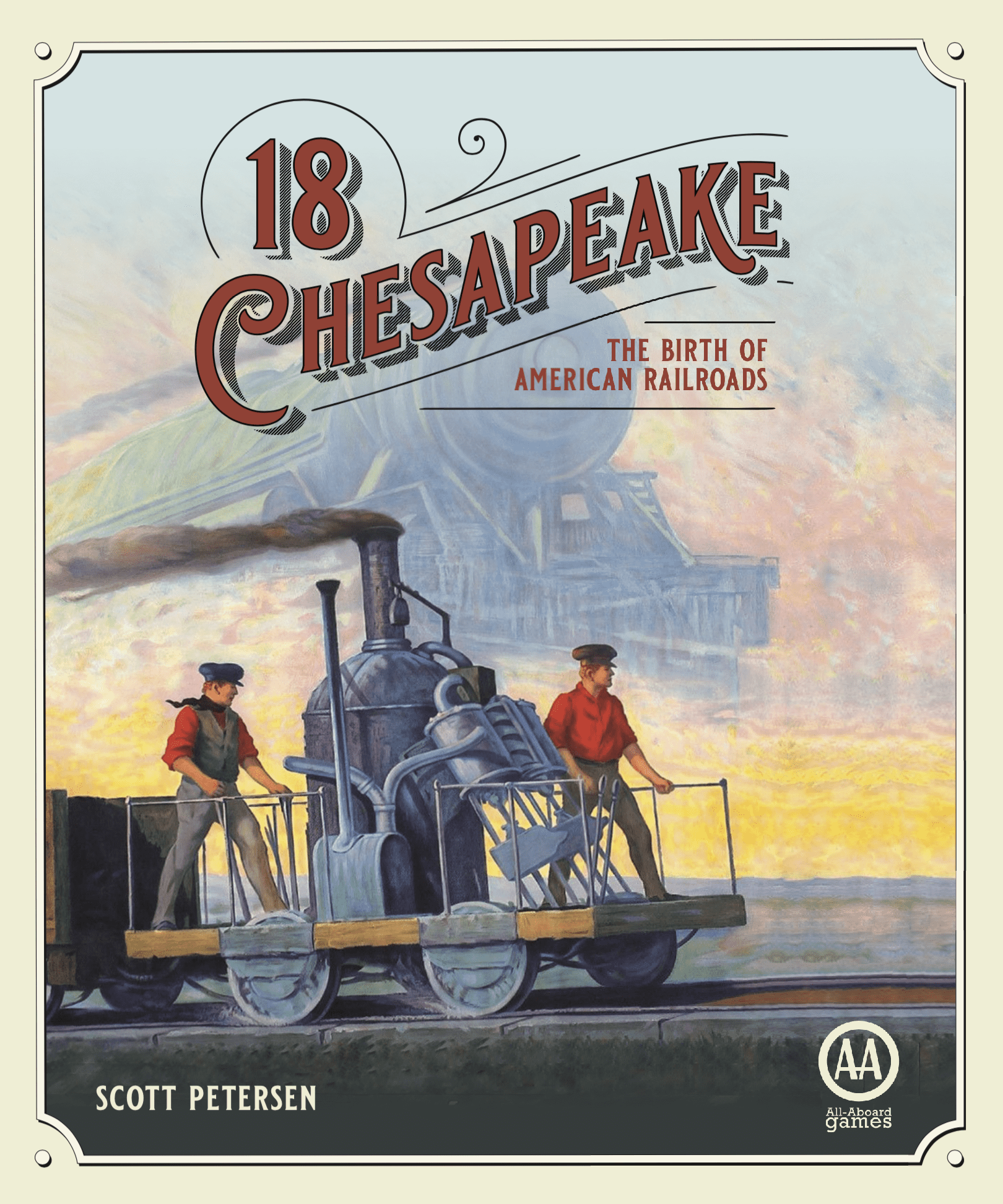
18Chesapeake is a railroad investment game for two to six players set in the Chesapeake Bay region. Players start companies, buy and sell stock, and invest in railroads that lay track, run trains, and earn revenue. The winner is the player with the greatest net worth in stock, private companies and cash.
Preparação
Place the map, stock market, share certificates, trains, track tiles, company markers, charters and round marker, with the round marker on Stock Round. Only yellow track is used at the start. Appoint one or more bankers to handle bank transactions and set aside the $8,000 bank.
Give each player starting capital based on player count: $1,200 for 2 players, $800 for 3, $600 for 4, $480 for 5, or $400 for 6.
Randomly choose one public company and place its president's certificate with the Cornelius Vanderbilt (P6) private company card.
Determine seating order at random or by agreement, and give the priority deal card to the first player.
Um turno
The game opens with a private company auction, starting with the priority deal holder and moving clockwise. On a turn, a player may buy the cheapest private company at face value, bid on a higher-value one, or pass. Bids rise by at least $5 above face value or the current high bid, in multiples of $5. When a company is bought at face value and has bids, those bids are settled first, with a bidding round among the bidders if there is more than one.
Stock round: on each turn a player may sell any number of certificates and then buy one certificate, or pass. Sales must be made to the bank pool, and buying must come from the bank pool or the initial offering. Passing is the only action that doesn't change the round.
Operating round: first, private companies collect their fixed revenue from the bank. Then each floated public company operates in descending order of share price, performing these steps in order: optionally buy private companies (in Phases 3 and 4 only, at a price between half and double face value), optionally lay or upgrade one track tile, optionally place one station marker, run trains to earn revenue, distribute earnings as dividends or retain them, and buy trains.
Fim do jogo
The game ends when the bank runs out of money. If this happens during an operating round, the current set of operating rounds is completed and then the game ends. If it happens during a stock round, that stock round is completed, followed by one set of operating rounds.
The game also ends immediately if a player goes bankrupt during emergency money raising, after that process is completed.
Pontuação
Each player's total wealth equals the market value of their stock, plus the face value of their private companies if the game ends before Phase 5, plus their cash on hand. Company treasuries and trains count for nothing. The richest player wins.
A bankrupt player's score is the value of their unsellable shares plus the face values of their private companies, if any.
The rulebook does not say how ties are broken.
Variantes
Two-player variant: each player starts with $1,200. The P6 president's certificate is a double share. Each other company's president's certificate is a triple share that costs three times par, and the game begins with ten shares per company. When a company floats, its four unsold certificates go to the bank pool, and par value no longer matters afterwards. When a non-president buys shares from the bank pool, one share of that company is removed from the game first. If none of a floated company's shares are in the bank pool at the end of a stock round, its share price rises under the normal rules.
Alterações
- Variantes, por o rascunho do manual de regras, 22 de novembro de 2026 (mostrada agora)
- Pontuação, por o rascunho do manual de regras, 22 de novembro de 2026 (mostrada agora)
- Fim do jogo, por o rascunho do manual de regras, 22 de novembro de 2026 (mostrada agora)
- Um turno, por o rascunho do manual de regras, 22 de novembro de 2026 (mostrada agora)
- Preparação, por o rascunho do manual de regras, 22 de novembro de 2026 (mostrada agora)
- Resumo, por o rascunho do manual de regras, 22 de novembro de 2026 (mostrada agora)