Regras de Agricola (jogo de tabuleiro)
Resumo
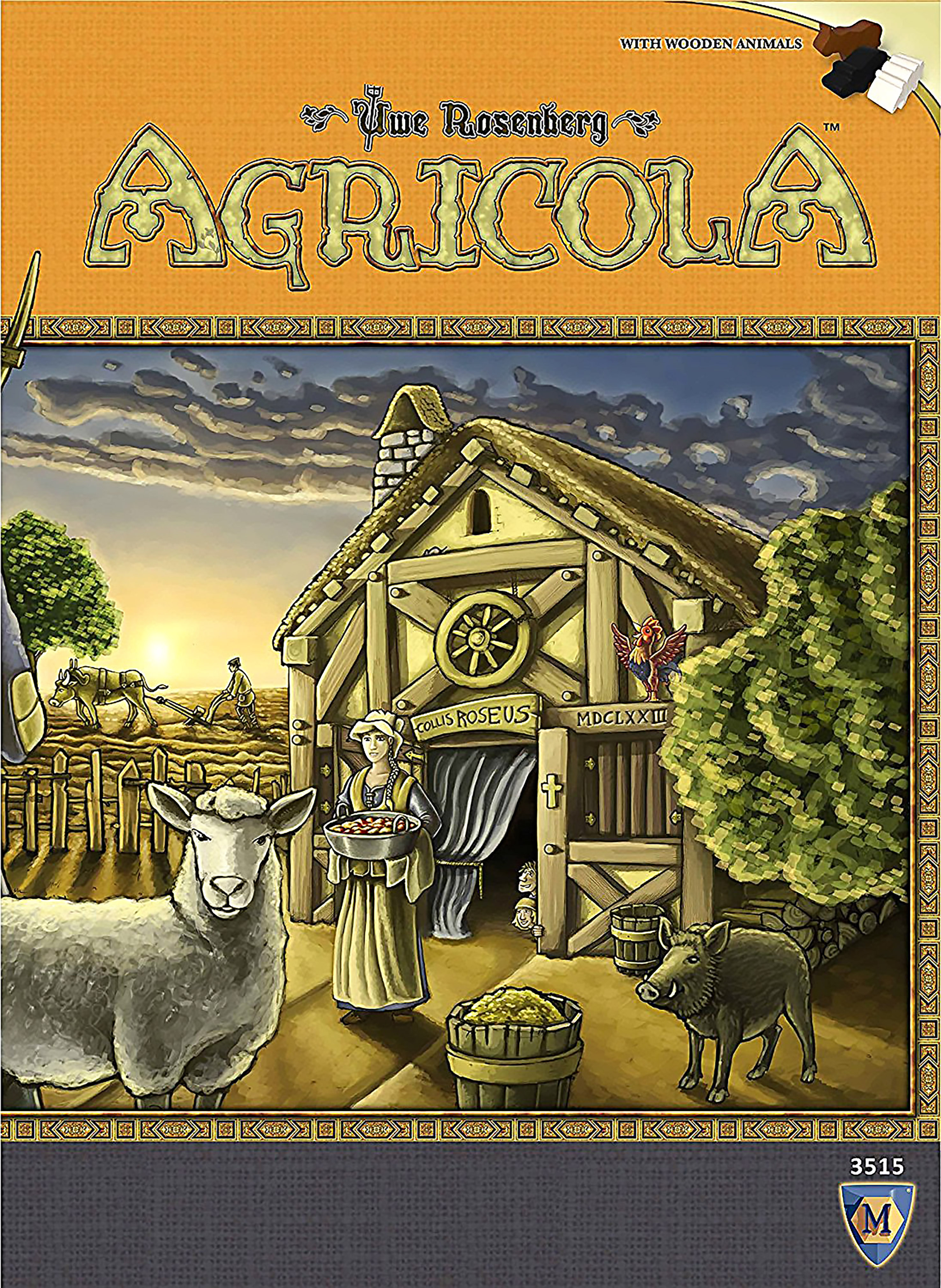
Agricola is a farming game for 1 to 5 players set in 17th-century Central Europe. Over 14 rounds, players use their Family members to take actions that extend their home, plow and sow fields, raise animals, and grow the family. The player who has built the best farmyard by the end of the game, with the most victory points, wins.
Preparação
Place the three game boards in the middle of the table as shown in the rulebook illustration. Each player chooses a color, takes that color's playing pieces and one farmyard, and places two wooden hut room tiles on the building spaces with one Family member in each room. Keep the remaining Family members, fences and stables aside. Sort the Round cards into stages, shuffling each stage and stacking them with Stage 6 at the bottom and Stage 1 on top. In a 3, 4 or 5 player game, lay out the matching set of green Action cards next to the first game board; solo and 2 player games use none. Remove Occupation cards that are not marked for your player count, shuffle the rest and deal each player 7. Shuffle the orange Minor Improvement cards and deal each player 7. Place the red Major Improvement cards face up on the Major Improvements board, place the grey Begging cards beside the play area, and give each player a Summary card. Choose a starting player, who receives the Starting player token and 2 Food. Every other player receives 3 Food.
Um turno
The game is played in 14 rounds, each with four phases.
- Start the round: Turn over the top Round card and place it on its space. Its action is available from this round onward. Resolve any effects that apply at the start of the round, and distribute any items on the current round space to the players who earned them.
- Replenish: Add the new goods, Food and animals shown by arrows to the action spaces that receive them. Goods already on a space stay and new ones are added to them.
- Work: Starting with the starting player and moving clockwise, players take turns placing one Family member from their farmyard on an unoccupied action space and taking that action. Each action space holds only one Family member per round, and a Family member must always take the space's action. Play continues until all Family members are placed. Goods and Food go into the player's personal supply, while animals must be placed in the farmyard or converted to Food at once.
- Return home: Players move their Family members from the board back to their home.
A Harvest follows the Return home phase at the end of rounds 4, 7, 9, 11, 13 and 14. It has three steps: collect the Grain and Vegetables from sown fields, feed the family at 2 Food per Family member (newborns eat 1 this round), and breed animals where a player has at least 2 of the same type and room for the baby.
During the game, players can build rooms and stables, renovate the hut from wood to clay to stone, grow the family, plow and sow fields, bake bread, fence pastures, and buy Occupation and Improvement cards. Each Begging card taken for unfed Food costs 3 points at the end.
Fim do jogo
The game ends after the Harvest at the end of round 14, and then the players score their farmyards.
Pontuação
Score each player's farmyard on the scoring pad, using the Summary card and the back of the Major Improvements board. Categories are scored in order.
- Fields: Fields score -1 with none or one, then 1 point per field up to 4 points for 5 or more.
- Pastures: Enclosed pastures are counted, not the individual spaces inside them. Zero pastures scores -1, then 1 point per pasture up to 4 points for 4 or more.
- Grain and Vegetables: Count those in fields and in the personal supply. Zero Grain scores -1, and 1 to 8 or more Grain scores 1 to 4 points. Vegetables score 1 point each, up to 4 points.
- Animals: Zero of a type scores -1, and more of each type scores a higher point value as numbers rise. The table lists sheep, wild boar and cattle separately.
- Unused farmyard spaces: Each empty, unfenced space loses 1 point. Fenced stables score 1 point each.
- Rooms and family: Each Clay hut room scores 1 point, each Stone house room scores 2 points, and each Family member scores 3 points. Wooden hut rooms score nothing.
- Cards and bonuses: Cards show their points in a yellow circle, and bonus point cards are explained on the card. Each Begging card costs 3 points.
The player with the most points wins. If there is a tie, the tied players share the victory, or they may play another game to break it.
Variantes
Family game: Use this simpler version without Occupation and Minor Improvement cards. Turn the first game board to its Family game side, use the Family game Action cards in a 3 to 5 player game, and limit the Major or Minor Improvement action to Major Improvements. Otherwise the rules stay the same. Scoring counts enclosed pastures, not pasture spaces.
Solo game: Start with 0 Food and leave the left-hand spaces on the left board empty. Adult Family members need 3 Food each at Harvest, and newborns still need 1. The 3 Wood action supplies only 2 Wood in any round. A solo series can keep one chosen Occupation per game as a permanent card, with goal scores rising from 50 points over eight games.
Card and draft variants: 3:1 exchange lets a player discard any 3 cards and draw one from either deck. 10-3 has each player draw 10 of each card type and discard 3. Mulligan allows one redraw of all 7 cards at the start of the game. Draft passes hands of cards to the left until each player has 7 cards, repeated for both card types.
The rulebook also describes the deck-choice options (playing with only one card deck, mixing decks, or shuffling them together).
Alterações
- Variantes, por o rascunho do manual de regras, 22 de novembro de 2026 (mostrada agora)
- Pontuação, por o rascunho do manual de regras, 22 de novembro de 2026 (mostrada agora)
- Fim do jogo, por o rascunho do manual de regras, 22 de novembro de 2026 (mostrada agora)
- Um turno, por o rascunho do manual de regras, 22 de novembro de 2026 (mostrada agora)
- Preparação, por o rascunho do manual de regras, 22 de novembro de 2026 (mostrada agora)
- Resumo, por o rascunho do manual de regras, 22 de novembro de 2026 (mostrada agora)