Regras de Call of Cthulhu: The Card Game
Resumo
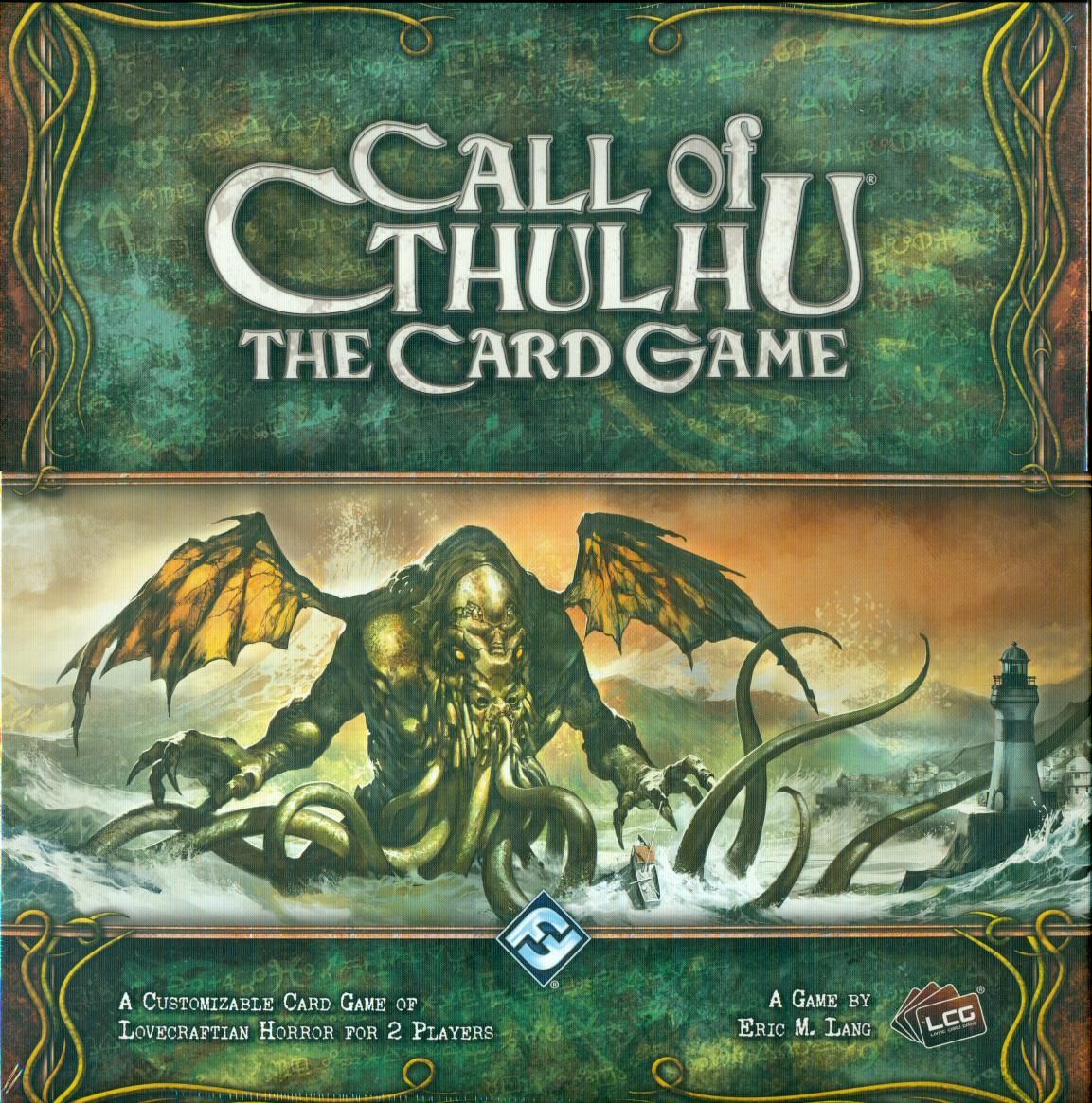
Call of Cthulhu LCG is a two-player dueling card game set in a Lovecraftian world, where players use character and support cards to win story cards. Players commit characters to three stories and try to place five success tokens on their side of a story to win it. The first player to win three stories wins the game.
Preparação
- Each player shuffles his deck.
- Place the game board in the center. Put all success and wound tokens in "The Deep." Shuffle the story deck of ten cards, deal three face up to the center, and place the rest face down as the story deck. Story cards F156–F165 are the fixed stories used in the first game.
- Each player sets aside three cards from his deck as face-down domains in a back row.
- Each player draws eight cards as a setup hand, keeps five as his opening hand, and sets the other three aside as starting resources.
- Each player attaches one of those three cards face up and upside down to each domain as a resource.
Each player may choose a faction pair (any two of the seven factions) and add one neutral card packet. Factions may be chosen randomly or by preference, with a coin flip if both want the same one.
Um turno
Players alternate complete turns, with the first player chosen randomly. The first player skips the story phase and draws only one card on the very first turn. A turn has five phases:
- Refresh: restore one insane character, then ready exhausted cards and clear domain tokens.
- Draw: draw two cards. If a player cannot draw from an empty deck, he is eliminated.
- Resource: attach one card from hand face up and upside down to a domain as a resource.
- Operations: play character and support cards by draining a domain with enough resources equal to the card's cost, with at least one matching faction resource unless the card is neutral. Only one domain may be drained per cost, and extra resources are lost.
- Story: the active player commits ready characters to stories, the opponent may commit to those stories, and then each story with committed characters is resolved in order of the active player's choosing. Characters are then uncommitted at end of turn.
In the story resolution, there are four icon struggles (Terror, Combat, Arcane, Investigation), in the order shown on the story card. The player with more matching icons wins the struggle and gets its effect; ties do nothing. Losing Terror makes a character go insane, losing Combat wounds a character, winning Arcane readies a committed character, and winning Investigation places a success token. Then the active player compares total skill of committed characters; if higher than the opponent's and at least one, he places a success token. If the opponent had zero or less skill, the story is unchallenged and the active player gets an extra token.
Fim do jogo
A player wins the game immediately by winning three story cards (conspiracies count). A player also wins if his opponent cannot draw because his deck is empty during the draw phase. A story is won when a player has five or more success tokens on his side; the winner may choose to use its effect, and the story is replaced from the story deck.
Pontuação
There are no points. Victory is by winning three stories, and the game is won the moment the third story is won. The rulebook does not describe a tie-breaker for points, and simultaneous wins from card effects are decided in favor of the active player.
Variantes
The rulebook covers multiplayer games, stating that its rules for more than two players are found on the official website, and not in this rulebook. Tournament deck-building rules require at least 50 cards, not counting story cards and domains, and no more than three copies of a card by title. The rulebook also describes conspiracy cards as a card type built into a player's deck, and it covers Asylum Packs and booster sets as expansions rather than rule variants.
Alterações
- Variantes, por o rascunho do manual de regras, 23 de novembro de 2026 (mostrada agora)
- Pontuação, por o rascunho do manual de regras, 23 de novembro de 2026 (mostrada agora)
- Fim do jogo, por o rascunho do manual de regras, 23 de novembro de 2026 (mostrada agora)
- Um turno, por o rascunho do manual de regras, 23 de novembro de 2026 (mostrada agora)
- Preparação, por o rascunho do manual de regras, 23 de novembro de 2026 (mostrada agora)
- Resumo, por o rascunho do manual de regras, 23 de novembro de 2026 (mostrada agora)