Regras de Chaos in the Old World
Resumo
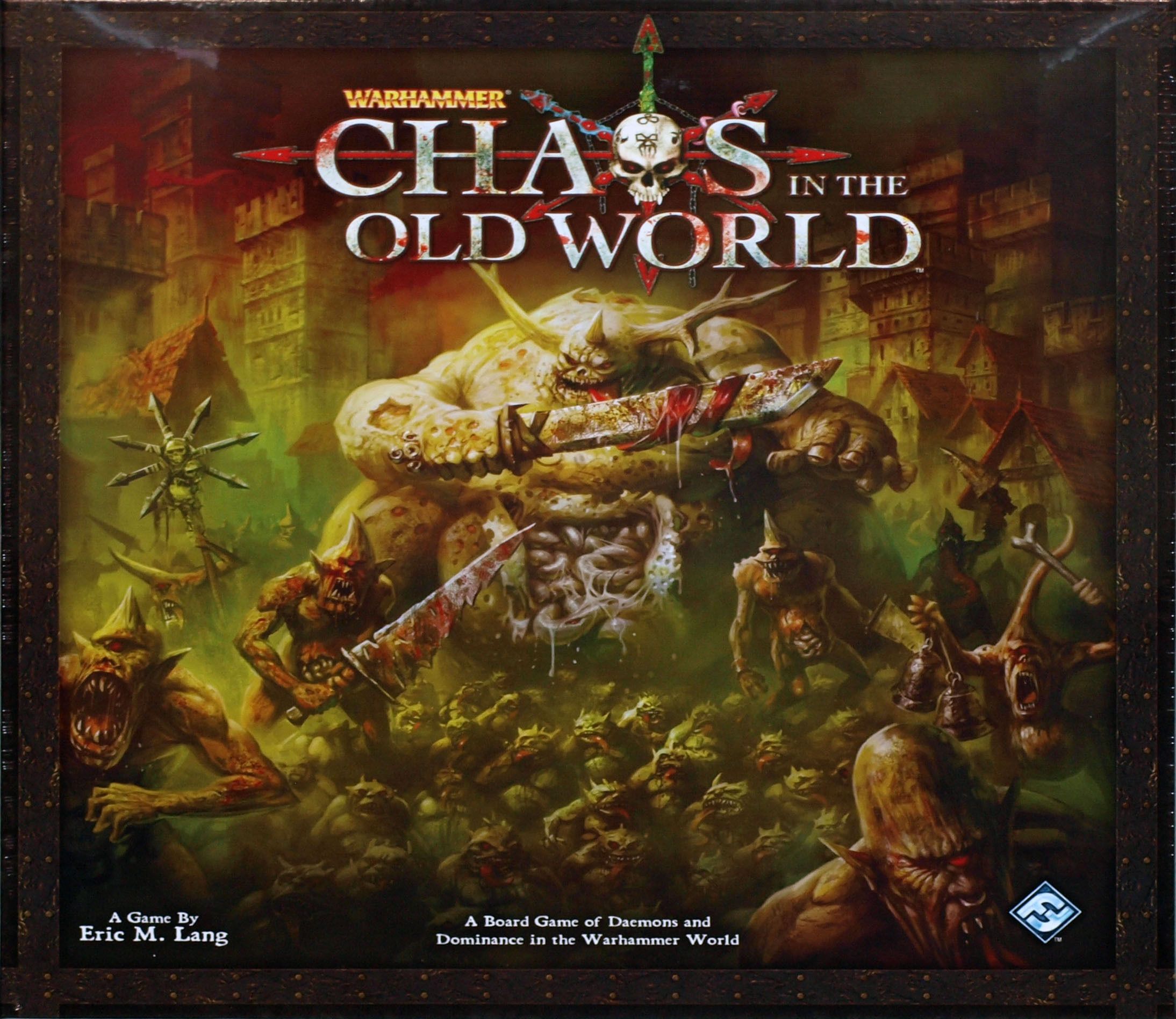
Chaos in the Old World is a territory control game in which each player takes one of the four Ruinous Powers of Chaos and tries to corrupt and dominate the nine regions of the Old World. A player wins either by advancing their Threat dial to its Victory position or by being the leader when a player reaches 50 victory points, five regions are ruined, or the Old World deck runs out with a Power as the leader.
Preparação
Place the game board in the center of the table and set each Threat dial so its start text is visible. Give each player a Power sheet, randomly or by agreement, and seat the players in Power order: Khorne, then Nurgle, Tzeentch, and Slaanesh clockwise, skipping unused Powers.
Each player takes power markers, victory point markers, corruption tokens, Chaos cards and upgrade cards, and followers. Put the power markers on the highlighted starting space of each Power sheet and the victory point markers on 0. Sort the ruination cards with 1 on top and 5 on the bottom and place them on the board. Sort the other tokens into piles by type near the board, and set the dice nearby.
Shuffle all Old World cards and deal a facedown deck of seven cards in a four-player game or eight in a three-player game; return the rest to the box. Take two Noble tokens, three Warpstone tokens, and four Peasant tokens, mix them, and place one at random in each region. Each player shuffles his Chaos cards and draws a hand of three.
Um turno
The game is played in rounds of six phases, always in this order:
- Old World phase: Draw the top Old World card and carry out its immediate instructions, usually decided by the player with the lowest Threat. Place the card on the Old World track in the 1 space, moving any previous 1 card to the 2 space and removing the card that was in the 2 space, unless the card says to discard it.
- Draw phase: Each player draws Chaos cards as shown on his Power sheet and moves his power marker to the highlighted space, plus any upgrade bonus. Unused power points are not carried over.
- Summoning phase: In Power order, each player in turn either summons one follower or plays one Chaos card, spending power points by moving his marker left. A follower must be placed in a region where that Power already has a figure or an adjacent one, except that a player with no figures on the board may place his first anywhere. A Chaos card goes into an empty card space in any region. A player who passes or has no power left has his turn skipped; the phase ends when all markers are on 0.
- Battle phase: Region by region in standard order, each player in Power order rolls battle dice equal to the total attack values of his figures there. Each 4, 5, or 6 is a hit, and each 6 explodes into an extra die. Hits must be assigned to legal targets, and a figure is tipped when hits equal its defense value. Tipped figures are removed after all dice in all regions are rolled. Peasant tokens are removed immediately when hit and placed on the killer's Power sheet.
- Corruption phase: First, the domination step compares each Power's domination value (Chaos card costs plus figure count) in each region with the region's Resistance; a Power exceeding it scores the Conquest Value. Then, in the corruption step, each player places one corruption token per Cultist in each region, and any region with 12 or more corruption tokens is ruined and receives the next ruination card.
- End phase: Remove Chaos cards from the board, resolve Hero tokens, resolve Old World card effects, score ruined regions, advance Threat dials, and check for game end.
Fim do jogo
The game ends at the first of these conditions, checked in order:
- A Threat dial reaches its Victory instruction.
- One or more players have 50 or more victory points.
- Five regions have been ruined.
- The Old World deck is empty.
If the game ends because of the Old World deck running out, all players lose and the Old World wins.
Pontuação
Victory points come mainly from dominating regions during the corruption phase, from ruiners' points when a region is ruined, from the end phase scoring of ruined regions (the player with the most corruption tokens scores the first value and the player with the second-most scores the second value), and from some dial instructions and Old World cards.
If players tie for the highest domination value in a region, none of them dominates it. Ties for ruination points are split by dividing the values among the tied players, rounding down.
When the game ends by Threat dial, ties on victory points are broken by victory points; when it ends on 50 victory points, ties are broken by Threat. When five regions have been ruined, the player with the most victory points wins, with ties broken by the highest Threat. If several players reach Victory on the dial simultaneously, the tied player with more victory points wins, and if still tied, the victory is shared.
Variantes
The rulebook gives a three-player game, in which one Power is left out. Setup uses eight Old World cards instead of seven and returns unused Power sheets and components to the box. The rulebook does not describe other variants such as solo or team play.
Alterações
- Variantes, por o rascunho do manual de regras, 23 de novembro de 2026 (mostrada agora)
- Pontuação, por o rascunho do manual de regras, 23 de novembro de 2026 (mostrada agora)
- Fim do jogo, por o rascunho do manual de regras, 23 de novembro de 2026 (mostrada agora)
- Um turno, por o rascunho do manual de regras, 23 de novembro de 2026 (mostrada agora)
- Preparação, por o rascunho do manual de regras, 23 de novembro de 2026 (mostrada agora)
- Resumo, por o rascunho do manual de regras, 23 de novembro de 2026 (mostrada agora)