Regras de Clans of Caledonia
Resumo
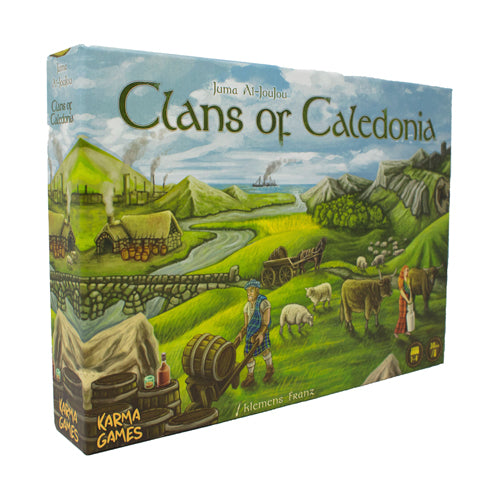
Clans of Caledonia is a strategic economic game set in 19th-century Scotland, where players run clans that produce, trade and export agricultural goods and whisky. Over five rounds, players expand their units across the map, fulfil Export contracts and gain Glory. The player with the most Victory Points after final scoring wins.
Preparação
Assemble the map from four double-sided Map modules, labelled A–D, with each side chosen at random so the module letters run in alphabetical order clockwise around the middle. Place four randomly chosen Port bonus tiles next to factories at the map corners, using the spaces that match the player count, and return unused tiles to the box.
Set up the Market board on the side for your player count, with Price markers on the starting prices, and place the Goods tokens and tiles in separate piles beneath it. On the Export board, pick five Scoring tiles at random and place them face-up in random order in the slots. Shuffle the Export contracts into a face-down draw pile and place one face-up on each box, leaving one box empty in solo and 3-player games. Set Glory and Import tokens aside.
Each player takes a Player board and the tokens in their colour, placing four each of Sheep, Cows, Cheese dairies, Bakeries, Fields and Distilleries on their board, and the eight Workers on the forest and mountain spots. Each player also takes four Port markers, places five Merchant cubes on the Merchant track and keeps two in stock, puts the Shipping token on the first space, places both Technology tiles unflipped, and takes an Export box tile.
Determine a starting player at random. Draw one more Clan tile than there are players, with a Starting tile beside each. Starting with the last player and going counter-clockwise, each player chooses a Clan and its Starting tile, and receives the Goods and money shown. Then, starting with the starting player and going clockwise, each player places one Worker, paying the land cost plus the Worker cost (£6 for a Woodcutter, £10 for a Miner). In reverse order, each player places a second Worker the same way.
Um turno
The game runs five rounds, each with four phases: Preparation, Action, Production and Scoring.
Preparation: Flip the previous round's Scoring tile face-down (skipped in round one), refill empty Export box spaces on the Export board, and retrieve your Merchants from the Market.
Action: In turn order, each player takes exactly one Action per turn until everyone has passed. Actions are:
- Trade: Place Merchants on the buy or sell arrow of one Good, equal to the quantity traded, and pay or receive the current price times the quantity. The price then moves by the same number of steps. Only one Good type may be traded per Trade action, and your Merchants cannot be on both the buy and sell side of the same Good.
- Obtain an Export Contract: Pay the current round's cost (£5 received in round one) to take an Export contract onto your empty Export box. You may hold only one unfulfilled contract at a time.
- Expand: Place a unit from your board onto an empty space neighbouring or within Shipping reach of your units, paying the unit cost and the land cost. Woodcutters go on forest, Miners on mountain, and other units on grassland. Expanding next to another player's unit gives a Neighbourhood bonus to buy discounted goods. Deploying your fourth building of one type with an empty Export box gives a Building bonus.
- Upgrade Shipping: Pay £4 to move the Shipping marker one step, which allows crossing rivers and lochs.
- Upgrade Technology: Pay £10 to flip a Technology tile, raising income from Workers.
- Hire a Merchant: Pay £4 to add a Merchant from your board to your stock.
- Fulfil an Export Contract: Pay the Goods shown on the left of the contract, then take the benefits on the right, such as imports, money or Direct export bonuses.
- Pass: Stop taking Actions for the rest of the round, move your Turn order token to the next round's order and receive the Pass bonus.
At any time during your turn, you may also use a Port bonus tile you have access to, once per tile per player, as a free action alongside your main Action.
Production: Each deployed Worker pays income (Woodcutter £4, Miner £6, plus £2 each with upgrades). Sheep produce Wool, Cows produce Milk and Fields produce two Grain. Optionally, Cheese dairies turn Milk into Cheese, and Bakeries and Distilleries turn Grain into Bread or Whisky.
Scoring: Players gain Glory according to the current round's Scoring tile if they meet its requirement. Glory is tracked on the Export board.
Fim do jogo
After five rounds are completed, final scoring takes place and the player with the most Victory Points is the winner.
Pontuação
Final scoring counts Victory Points as follows:
- Glory: 1 VP per step on the Glory track.
- Basic goods (Wool, Grain, Milk) in stock: 1 VP each.
- Processed goods (Bread, Cheese, Whisky) in stock: 2 VP each.
- Money: 1 VP per £10.
- Hops listed on fulfilled Export contracts: 1 VP each.
- Cotton, Tobacco and Sugar cane on fulfilled Export contracts: 3, 4 or 5 VP each according to rarity, where the most-imported type is worth 3 VP, the middle type 4 VP and the least-imported type 5 VP. Ties in import amounts are broken in the order Cotton, Tobacco, then Sugar cane, with Cotton the rarest.
Export scoring (3–4 players): 12 VP to the player with the most fulfilled Export contracts and 6 VP to the second-most. In a 2-player game, 8 VP goes to the player with the most.
Settlement scoring (3–4 players): 18 VP for the most Settlements within Shipping reach, 12 VP for second and 6 VP for third. In a 2-player game, 12 VP goes to the player with the most and nothing to second. A Settlement is a group of neighbouring units of one colour, and single units count too.
Tied players share the VP of the tiers they tie for, rounded down if needed. Leftover money breaks ties on the final score.
Variantes
Variants can be combined in any way.
Simplifications for a first game:
- Static Import Goods: Each of Cotton, Tobacco and Sugar cane is worth 4 VP at the end, with no tracking on the Export board.
- Without Scoring and/or Port tiles: Ignore the Scoring tiles and/or Port tiles during setup and play.
- Tighter map: In a 2–3 player game, cover any four land spaces with the backs of spare Port tiles, preferably one per module.
- Without Clans: Ignore Clans and give starting bonuses of £0, £2, £4 and £6 by turn order.
- Clan auction (for experienced players): Players bid negative VP for their Clan choice, with 30 VP as the highest bid, and the last player receives the remaining Clan without penalty.
Solo game: Use the 2-player map and place neutral Workers on every £1 space of the active map, which are then unavailable. Neighbourhood bonuses and tracking of Imported goods are not used. Start with five Export contracts face-up. Each pass gives £16. A Market Phase runs at the start of rounds 2–5, changing the prices of three randomly chosen Goods using the Goods and Price dice. Export scoring uses the solo thresholds: 7 or more fulfilled contracts for 12 VP, 6 for 8 VP, and 5 for 4 VP.
Other variants: Clan-specific rules (Buchanan, Campbell, Cunningham, Fergusson, MacDonald, MacKenzie, Robertson, Stewart) and Port and Scoring tiles are described in the appendix. Kickstarter tiles are optional and not playtested by the publisher.
Alterações
- Variantes, por o rascunho do manual de regras, 22 de novembro de 2026 (mostrada agora)
- Pontuação, por o rascunho do manual de regras, 22 de novembro de 2026 (mostrada agora)
- Fim do jogo, por o rascunho do manual de regras, 22 de novembro de 2026 (mostrada agora)
- Um turno, por o rascunho do manual de regras, 22 de novembro de 2026 (mostrada agora)
- Preparação, por o rascunho do manual de regras, 22 de novembro de 2026 (mostrada agora)
- Resumo, por o rascunho do manual de regras, 22 de novembro de 2026 (mostrada agora)