Regras de Detective: City of Angels
Resumo
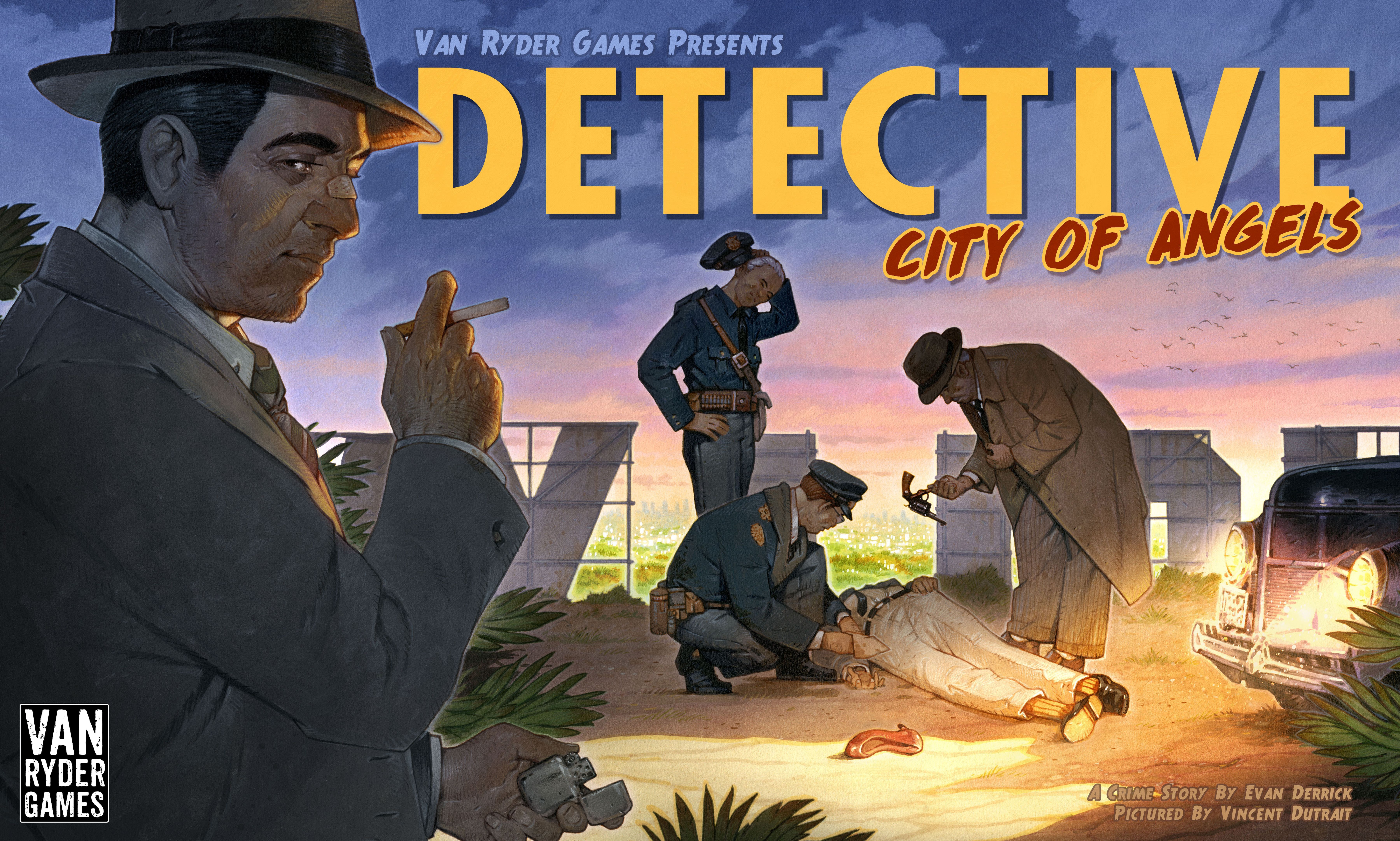
Detective: City of Angels is a noir game set in 1940s Los Angeles. Detectives work a murder case while one player, the Chisel, acts as game master and decides how suspects answer questions. A detective wins by correctly solving the case with their Solve token. If time runs out and no detective solves it, the Case Goes Cold and the Chisel wins.
Preparação
Choose one player as the Chisel and the rest as detectives. Pick a case no detective has played; new players should use Blood on the Pier. Set the Day marker by player count: 4 detectives start on Day 7, 3 on Day 8, 2 on Day 9. Place the Scratch in a pile by the City board.
The Chisel takes the Chisel casebook, Chisel board, and ARC sleeve. The Chisel reads the case's Briefing, Epilogue, Solution, and any Special Rules, then places the case cards facedown on their lettered spaces and sets up the Response and Search cards without showing the detectives. Punch out only the Suspect standees that are public at the start.
Each detective picks a color and miniature and takes a Detective board in Classic mode, plus a Solve token, 2 Bribe-a-Snitch tokens, 4 Action cubes, 8 Leverage markers, and 8 Knowledge markers. Each detective gives one Leverage marker to the Chisel. Starting Scratch: the first player takes 4, then going clockwise 5, 6, and 9.
The detective to the Chisel's right reads the Briefing aloud. The Chisel carries out its setup instructions as they are read, including flipping case cards and placing the Crime Scene marker and suspects. Detectives then make blank Investigation sheets, record the visible cards and suspect names, and the first detective places their miniature at any Police Station before their first action.
Um turno
Days advance in turns. The detective to the Chisel's left goes first, and play moves clockwise until every detective has had a turn. Each detective has 4 actions, which can be taken in any order and repeated. Each action moves an Action cube from the Available area to the chosen action.
- Move: travel within your district, or to a bordering district if your location straddles the border.
- Search Location: the Chisel checks the Search cards for your location and hands over the matching card, or the All Other Locations card.
- Search Suspect: search a suspect at your location for their Search card.
- Question: ask one suspect at your location about a case card you know.
- Analyze: spend the action to earn 1 Scratch.
- Kickback: once per Day, at a Mob Joint, gain Scratch equal to the total number of players, Chisel included.
A Solve token must be spent at the start of your turn, before any actions.
Questioning has several steps. First you ask about a card you know and may spend Leverage over that suspect. Then other detectives may bribe a snitch by placing a Bribe-a-Snitch token facedown. The Chisel then chooses a response: the most useful response is always truthful, and lies or misdirections are shown in red in the case grid. You may challenge the response, giving the Chisel a Leverage marker. A successful challenge gives you Leverage over that suspect and the most useful response. An unsuccessful challenge gives the Chisel Leverage over you. Finally, bribes resolve, and bribing snitches costs 3 Scratch back to supply.
Bribes cost Scratch and are not actions. A Goon (2 Scratch) can force an answer when the Chisel blocks a question. A Detective bribe (2 Scratch) lets you see a card another detective knows, at the same location. An Officer bribe (3 Scratch, Police Stations only) lets you see a card another detective knows. A Snitch bribe (3 Scratch) lets you listen to another detective's question.
Evidence marked for removal is returned to the City board when the Day marker reaches its Evidence Removed marker. At the end of each Day, move the Day marker down one space and resolve Evidence Removed markers.
Fim do jogo
The game ends when a detective solves the case or time runs out. A detective can attempt to solve the case by writing a guess on their Investigation sheet, naming a suspect, weapon, and motive, with the case letters for suspect and weapon. Only cards you know and suspects already on the board may be used, and you name one motive. The Chisel checks the guess against the solution. A correct guess wins immediately.
After the final Day, when the Day marker reaches the Final Guess space, each detective makes one final guess. The Chisel reads the Epilogue and tells each detective whether they were right. If nobody is correct, the case goes cold and the Chisel wins.
Pontuação
There are no points. Winning depends on solving the case. An incorrect guess only costs the Solve token, and the Chisel tells the detective how many parts were correct, not which ones.
If several detectives make correct final guesses, ties are broken in reverse player order.
Variantes
- Sleuth mode (1–5 players): a solo or cooperative game with no Chisel. A Sleuth casebook supplies responses, and you read paragraphs by number. Start on Day 12 with the Final Guess marker. Unsuccessful challenges give Stress, and three Stress moves the Final Guess marker one space earlier. Overtime allows more guesses. Rating depends on when you solve the case: Hard Sleuth, Wisehead, Palooka, or A Sap, Rube, 'n Boob.
- Head-to-Head mode (2–5 players): one Chisel against one detective or a cooperative team. Day 12 is the start, with no bribes and no Scratch. There is only one guess, and an incorrect guess ends the game with the Chisel winning. Leverage works as in Classic mode, but a blocked question costs the detective their action.
- Head-to-Head with multiple detectives on the board: each detective controls a miniature. Start days depend on player count: 4 detectives on Day 3, 3 on Day 4, 2 on Day 6. Leverage is shared, and the Chisel can use any color marker.
- Favor and Grift cards (Classic mode only, optional): each detective gets one Favor card and the Chisel gets one Grift card, used once as stated on the card.
Alterações
- Variantes, por o rascunho do manual de regras, 23 de novembro de 2026 (mostrada agora)
- Pontuação, por o rascunho do manual de regras, 23 de novembro de 2026 (mostrada agora)
- Fim do jogo, por o rascunho do manual de regras, 23 de novembro de 2026 (mostrada agora)
- Um turno, por o rascunho do manual de regras, 23 de novembro de 2026 (mostrada agora)
- Preparação, por o rascunho do manual de regras, 23 de novembro de 2026 (mostrada agora)
- Resumo, por o rascunho do manual de regras, 23 de novembro de 2026 (mostrada agora)