Regras de Deus
Resumo
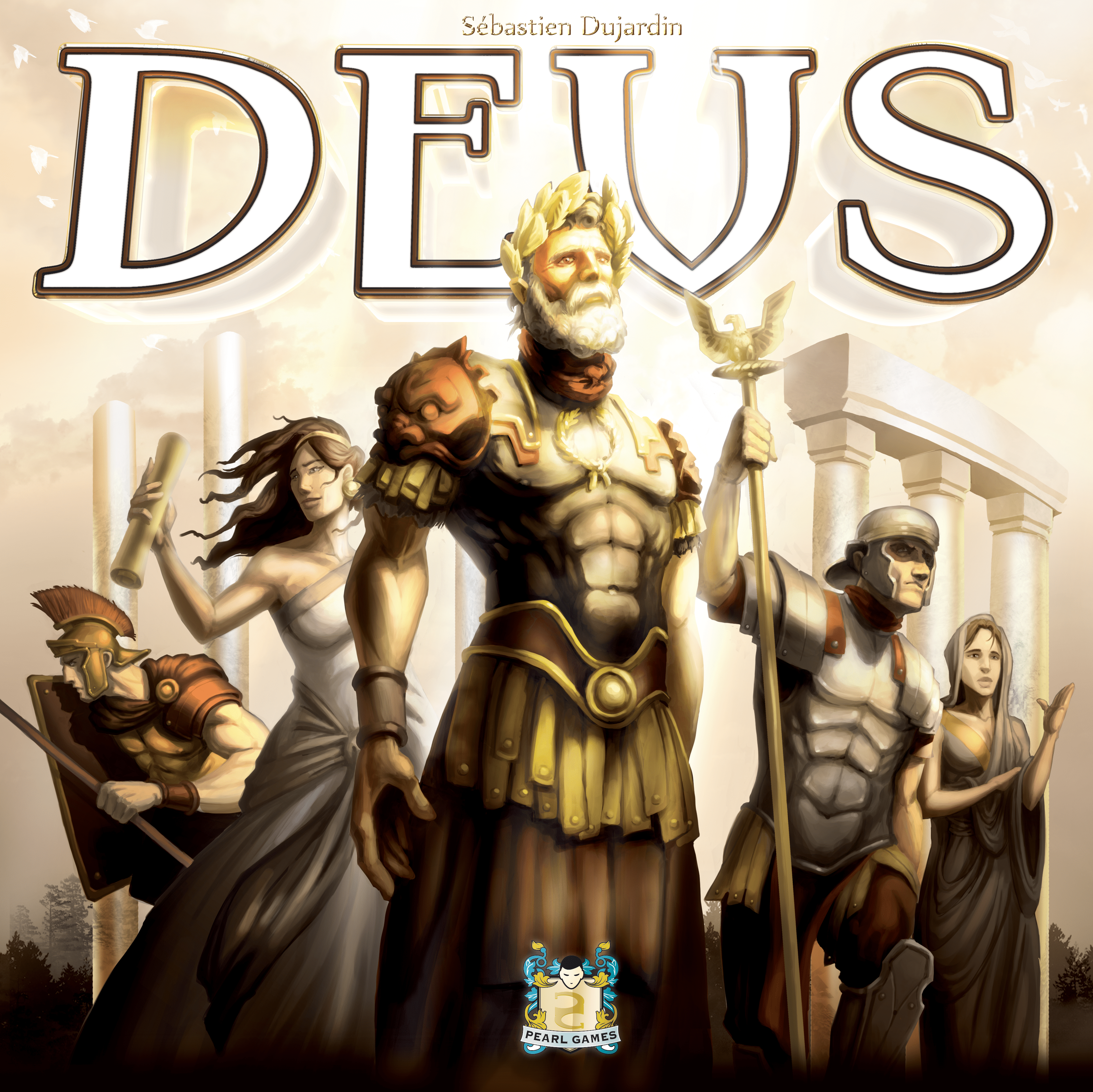
Deus is a civilization-building game where players explore lands, found cities, and construct buildings that produce resources, give victory points, gold, or science, and allow attacks on neighbors. Players also keep the gods happy by making offerings and building temples. The player with the most victory points at the end wins.
Preparação
- Build the gameboard from Continent tiles, using 4 tiles for 2 players, 6 for 3 players, or 7 for 4 players, and never place two barbarian villages next to each other.
- On each barbarian village, place VP equal to the number of regions adjacent to it.
- Make a general supply of temples (one per tile), 5 resources of each type per player, plus VP and gold. Return unused temples and resources to the box.
- Each player takes a player board and the buildings in their color. Place 2 pieces of each type on the matching column of the board and keep the rest as a personal supply.
- Each player takes 5 gold, 4 resources (one each of stone, clay, wheat, wood), and 5 VP.
- Shuffle the 96 building cards, deal 5 to each player, and place the rest as a draw pile.
- Choose a first player and give them the First Player card.
Um turno
On your turn, choose one of two actions:
A. Construct a building
- Play a building card from your hand only if you have at least one wooden piece of that type on your player board.
- Place the card at the top of the column of the same color above your board.
- Pay its cost in resources and/or gold, where each resource can be replaced by 4 gold.
- Place the matching wooden piece on the gameboard, following the placement rules: your first building goes on an edge region, ideally at least two empty regions away from other players' first buildings; later buildings go in a region you control or an empty region adjacent to one you control. A region may not hold two buildings of the same type, and you cannot build in a region with a barbarian village. Ships go only in sea regions, and other buildings only on land. You may instead pay 3 VP to place a building on an empty edge region.
- Activate all cards in that column, from bottom to top.
A temple is built differently: you need one card of each color on your board for your second temple, two of each color for your third, and so on. Pay one of each resource (or gold substitutes), place the card in the temple column, and put a wooden temple in one of your regions, but never two temples in one city. If the temple supply is empty, you may still play the card without placing a piece.
A barbarian village is attacked immediately once all adjacent regions are occupied and at least one army is among them. The player with the most armies adjacent wins the village's VP; ties go to the player who built more buildings there, and any remaining tie shares the VP rounded down.
B. Make an offering to the gods
- Discard any number of cards from your hand, at least one.
- Place them face up on the discard pile, so only the top card is visible.
- Use the power of the god on the top card, scaled to the number of cards discarded. Gods may also give wooden pieces. Jupiter acts as a wild and invokes one god.
- Draw cards to refill your hand to 5. If you invoked Minerva, draw one extra card per card discarded.
If you have no cards left in hand after an action, draw 5 new cards. When the draw pile is empty, shuffle the discards to form a new one.
Fim do jogo
The game ends when either all temples in the general supply have been built, or all barbarian villages have been attacked. When this happens, finish the current round so every player has equal turns, then play one final round where each player takes a last action.
A hand can never hold more than 10 cards; if a draw would exceed 10, stop drawing at 10.
Pontuação
Each player adds up their VP:
- VP gained during the game.
- VP from constructed temples, up to 12 per temple.
- VP from end-of-game effects on building cards.
For each resource type (wheat, wood, stone, clay) and for gold, the player with the most receives 2 VP, and at least one must hold that item to score it. Ties give 2 VP to each tied player.
The player with the most VP wins.
Variantes
Alternative Start: Instead of 2 buildings of each type, each player secretly chooses 10 buildings to place on their board, with the rest in their personal supply. Experienced players may start with 8 or 9 buildings, and expert players with 6 or 7.
Alternative Gameboard Setups: Tiles may be arranged in other ways, keeping the correct tile count for the number of players and never placing two barbarian villages next to each other.
Building Wildcard: Once per game, you may construct a building without regard to the card's color. Play the card face down into any column you choose. It costs 1 gold if it is the first card in the column, 2 gold if second, 3 gold if third, and so on. It has no effect itself but still lets you activate the other cards in that column. It counts toward the cards needed for a temple, but cannot itself be the temple.
Alterações
- Variantes, por o rascunho do manual de regras, 23 de novembro de 2026 (mostrada agora)
- Pontuação, por o rascunho do manual de regras, 23 de novembro de 2026 (mostrada agora)
- Fim do jogo, por o rascunho do manual de regras, 23 de novembro de 2026 (mostrada agora)
- Um turno, por o rascunho do manual de regras, 23 de novembro de 2026 (mostrada agora)
- Preparação, por o rascunho do manual de regras, 23 de novembro de 2026 (mostrada agora)
- Resumo, por o rascunho do manual de regras, 23 de novembro de 2026 (mostrada agora)