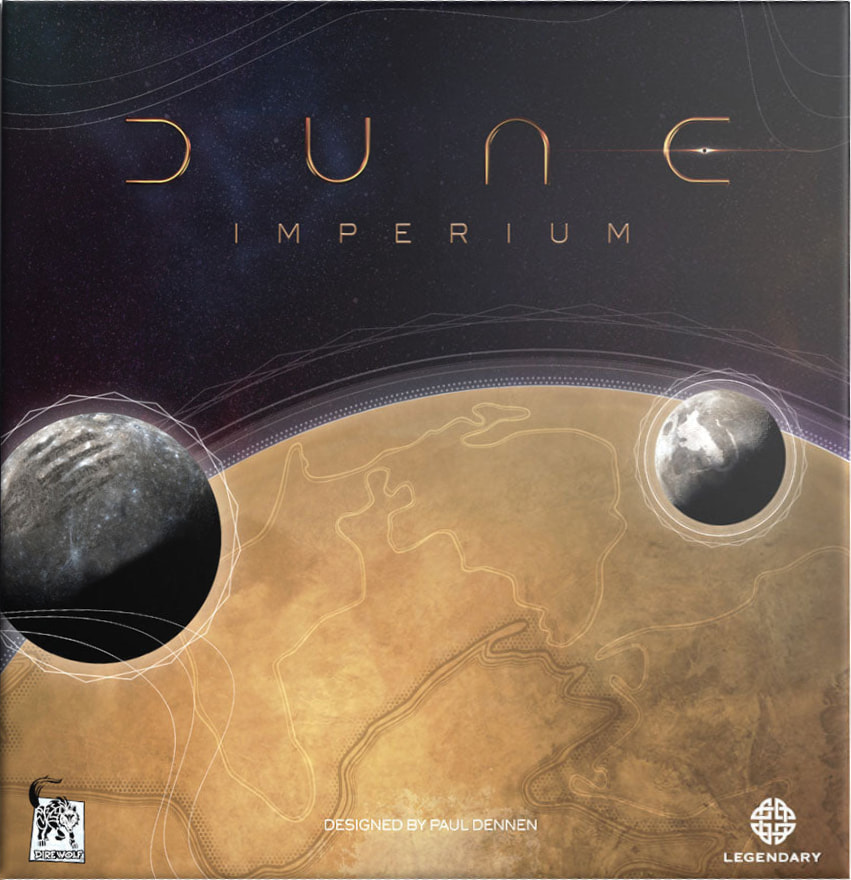
Regras de Duna: Imperium
Resumo
Dune: Imperium is a deck-building worker placement game set in the Dune universe. Each player leads a Great House competing for spice, Influence with four Factions, and Victory Points (VP). The game is played in rounds, and the player with the most VP when the game ends wins.
Preparação
- Build the Conflict Deck: shuffle the four Conflict III cards and place them face down on the board. Shuffle the ten Conflict II cards and deal five on top. Shuffle the four Conflict I cards and deal one on top. Return the unused Conflict cards to the box unseen.
- Each player chooses or randomly draws a Leader. For a first game, use Leaders with one icon.
- Shuffle the Intrigue Deck and place it face down. Shuffle the Imperium Deck, then deal five cards face up as the Imperium Row.
- Place the Reserve cards in three stacks (Arrakis Liaison, The Spice Must Flow, Foldspace) beside the Imperium Row.
- Place the Mentat in the Mentat space and the four Alliance tokens on the marked spots of the Faction Influence tracks.
- Each player takes a color and its components. Put two Agents on your Leader and set your third Agent (Swordmaster) beside the board. Place your Combat marker on 0, one cube on the bottom of each Faction track, and three troops in your garrison. Place your Score disc on 1 in a 4-player game, otherwise on 0.
- Each player shuffles their 10-card starting deck and places it face down to the left of their Leader. Each player takes 1 water.
- Pick the first player at random and give them the First Player marker.
- Set up a bank of Solari, spice, and water near the board.
Um turno
A round has five phases.
1. Round Start: Reveal the top Conflict card face up beside the Conflict Deck. Each player draws five cards as their hand.
2. Player Turns: Starting with the First Player and going clockwise, each player takes either an Agent turn or a Reveal turn. Players usually take Agent turns until out of Agents, then a Reveal turn. Once you take a Reveal turn, you skip the rest of this phase.
- Agent turn: Play one card face up and send one Agent from your Leader to an unoccupied board space whose upper-left icon matches one of the card's Agent icons. Pay any cost or meet any requirement. Gain the space's effect and the card's Agent-box effect. Cards without Agent icons cannot be played this way.
- Reveal turn: Reveal your remaining hand and gain the Reveal-box effects. Use Persuasion to acquire cards into your discard pile. Your strength equals 2 per troop in the Conflict plus 1 per sword revealed, and you need at least one troop there. Move your Combat marker to match. Then clean up by moving your cards to your discard pile.
3. Combat: Starting with the First Player, players with troops in the Conflict may play Combat Intrigue cards or pass. Once everyone passes in a row, rewards go to the highest strength (first reward), second highest (second reward), and in a 4-player game third highest (third reward). Players with 0 strength get nothing. Then return troops from the Conflict to supply and reset Combat markers.
4. Makers: Each Maker space with no Agent gains 1 bonus spice.
5. Recall: Return the Mentat and recall all Agents to their Leaders. Pass the First Player marker clockwise and begin the next round.
Fim do jogo
At the end of a round, if any player has 10 or more VP, or the Conflict Deck is empty, the game ends. Before final scoring, each player may play any Endgame Intrigue cards they hold.
Pontuação
VP are tracked on the Score track. You gain VP from Conflict rewards, from reaching 2 Influence with a Faction, and from earning Alliances. The first player to reach 4 Influence with a Faction takes its Alliance token and its VP; an opponent who passes you on that track takes the token and the VP.
The player with the most VP wins. If tied, compare in this order: spice, then Solari, then water, then garrisoned troops.
Conflict ties: if players tie for first, no one wins the Conflict and the tied players each get the second reward. If players tie for second, they each get the third reward. Players tied for third get nothing.
Variantes
- Two-player game: A third, automated spoiler player called House Hagal joins. It uses House Hagal cards to send Agents and deploy troops, but it does not collect resources, build a deck, or score VP. Remove the three Arrakeen cards marked 1P from the House Hagal deck.
- Solo game: You play against two automated Rivals who use only the Signet ability on their Leaders. Choose a difficulty: Novice, Veteran, Expert, or Expert+ (which also prevents you from gaining a Swordmaster). Each level changes starting resources, troops, Swordmaster cards placed in the Conflict Deck, and whether a 5-Solari token goes on the Mentat space. Remove the cards marked 2P from the House Hagal deck.
- Expert difficulty for Rivals: Rivals hold back troops from Conflict I and II when already leading by two or more.
- Leader combinations: The rulebook allows nonstandard Leader combinations and What If? scenarios, but recommends that two Leaders from the same House not be used together for the authentic story.
Alterações
- Variantes, por o rascunho do manual de regras, 22 de novembro de 2026 (mostrada agora)
- Pontuação, por o rascunho do manual de regras, 22 de novembro de 2026 (mostrada agora)
- Fim do jogo, por o rascunho do manual de regras, 22 de novembro de 2026 (mostrada agora)
- Um turno, por o rascunho do manual de regras, 22 de novembro de 2026 (mostrada agora)
- Preparação, por o rascunho do manual de regras, 22 de novembro de 2026 (mostrada agora)
- Resumo, por o rascunho do manual de regras, 22 de novembro de 2026 (mostrada agora)