Regras de Egizia
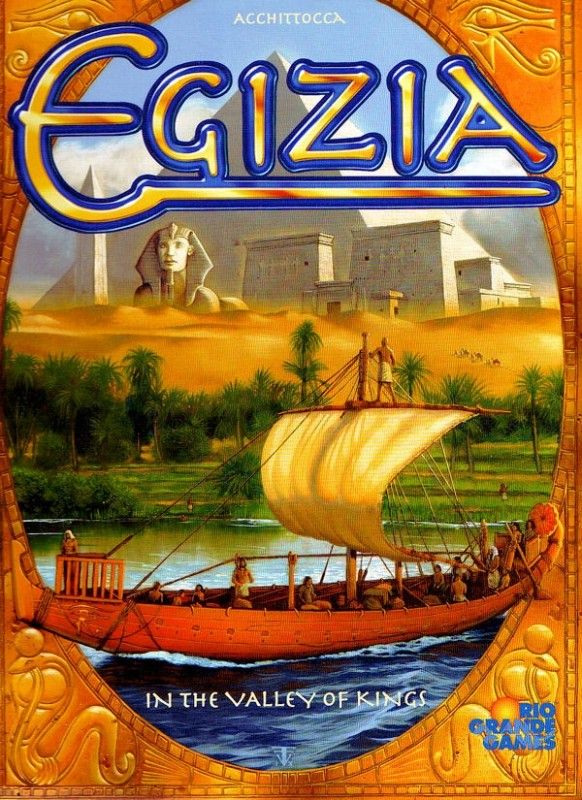
Resumo
Egizia is a game for 2 to 4 players that lasts five rounds. Each round, players add construction crews, quarries and fields, take Nile and sphinx cards, and build monuments such as graves, obelisks, pyramids and temples. Points come from building, from feeding crews and from the final scoring, and the player with the most points at the end wins.
Um turno
Each round has seven phases in order. 1) Lay out Nile cards: draw 10 Nile cards from the supply for the current round and place them face-up beside the Nile. Rounds 1 and 2 use the 1/2 supply, rounds 3 and 4 the 3/4 supply, and round 5 the 5 supply. 2) Place ships along the Nile: players take turns in sequence placing one ship at a time. Each new ship must go further downriver than the player's previous ships, and only one ship may be on each space. Ships can go on a Nile card (take the card, then place the ship, then use or keep the card), on a round space (carry out its action), or on an empty building site. If all three spaces of a building site are taken, a player may place a ship beside it to speculate that someone will not build there. When no one wants to place more ships, ships not on building sites return to their owners' play areas. 3) Feed construction crews: starting with the player furthest along the scoring track, compare total crew strength with available grain. Any shortfall costs points according to the grain market marker position, and the score may go below zero. 4) Produce stones: starting with the player whose number is first, add stones from quarries to the tableau, up to a maximum of 25. 5) Build: the sphinx, obelisk/graves and pyramid/temple are resolved from top to bottom. Each building needs a construction crew and stones, and each crew can be used once per round before it is turned over. The Joker crew can only be used alongside another crew. 6) Bonus for cooperation: players who used stones for building score bonus points for ships on building sites, with 1 ship giving 1 point, 2 ships 3 points and 3 ships 6 points, then they retrieve their ships. 7) Determine player sequence: the player with the fewest points takes the first sequence tile, and ties go to the player who reached that space later.
Fim do jogo
The game ends after the fifth round. The final scoring then takes place, including the player sequence for the following round.
Pontuação
Points are scored during play for building, for feeding shortfalls and for cooperation bonuses. When scoring bonuses or final points, players score in order from the front of the scoring track. Final scoring, in player order: 1) a player whose stone is on one of the bottom two stone market spaces may sell remaining stones at 2 stones for 1 point, rounded down; 2) grave tiles are totaled and scored as 1-10 value for 2 points, 11-20 for 5 points, and 21 or more for 9 points; 3) sphinx cards are checked and points are scored for each condition fulfilled. The player with the most points wins. If players are tied, the player whose stone is furthest ahead on the scoring track wins.
Variantes
With 2 or 3 players, use only the first two spaces at each building site. Cover the third space at each site with a stone of an unused color. The rulebook gives no other variants.
Alterações
- Variantes, por o rascunho do manual de regras, 23 de novembro de 2026 (mostrada agora)
- Pontuação, por o rascunho do manual de regras, 23 de novembro de 2026 (mostrada agora)
- Fim do jogo, por o rascunho do manual de regras, 23 de novembro de 2026 (mostrada agora)
- Um turno, por o rascunho do manual de regras, 23 de novembro de 2026 (mostrada agora)
- Resumo, por o rascunho do manual de regras, 23 de novembro de 2026 (mostrada agora)