Regras de Ezra and Nehemiah
Resumo
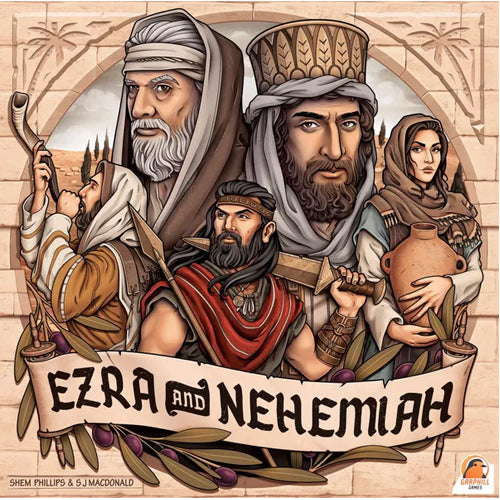
Ezra and Nehemiah is a worker-placement game set in rebuilding Jerusalem over three weeks. Players spend Banners, Resources and Workers to build the Temple, rebuild walls and gates, teach the Torah and move on the Altar Track. The player with the most Victory Points at the end wins.
Preparação
Place the Main Board in the centre and set up the Gate Cards, Neutral Walls, Main Supply and Scroll Tiles as the setup card shows, adjusting for player count. Fill Wall and Gate spaces with Resources drawn randomly from the Rubble Bag, then return the bag to the box. Place Food on the Scroll rows, choose one Altar Card and place the Prophets on its track, and place the three Hero Cards alongside the Main Board. Randomly choose a first player and give them the Shofar.
Each player takes a Player Board, Player Aid and one random Development Tile of each type, plus 16 Workers (6 in their Supply and the rest in the Main Supply), a Tent, an Altar Marker, a VP Marker on the 10 VP space, 10 Character Cards (draw 4 to hand) and 12 Wall Cards. Each player takes the Resources shown on their Guards Tile, plus 5 Silver and 3 Food, and places one of each Blessing Marker on the 0 spaces.
Place one Worker of each player colour at the bottom of the Levite Track, then have each player place a Gatekeeper on a corner Gate in reverse turn order from the player right of the Shofar. With fewer than three players, place White Workers on the bottom row as shown on the setup pages.
Um turno
The game is played over three Rounds, each made of six work days followed by a Sabbath. On each work day, every player takes one turn clockwise from the Shofar holder. A turn has these steps:
- Play one Character Card from your hand to one of the three piles on your Player Board. Each pile holds two cards.
- Take one Main Action, using Banners of a single colour from your visible Character Cards, tucked cards, Elders, Traders and Scroll abilities.
- Draw one Character Card, if possible.
You may also take one Auxiliary Action (a Trade or turning over a Development Tile) and may use one Trader and one Elder per turn.
Main Actions:
- Temple and Altar (Red Banners): place Levites to gain rewards, place Resources in the Temple or on the Altar, which scores VP and moves your Altar Marker.
- Rubble, Walls, and Gates (Grey Banners): clear rubble on one Wall or Gate space, then build it. Connections between walls and gates give rewards.
- Torah and Tenting (Blue Banners): place one Scribe on a Scroll Tile, move your Tent around the City, or both.
Sabbath phase (after six turns each): pay for Farmers and Labourers, then resolve the Prophets' Judgment based on Altar position. At the Sabbath itself, feed your Workers (1 Food each, excluding Levites), tuck 1 Character Card in Rounds 1 and 3 or 2 in Round 2, and score all tucked cards.
Fim do jogo
The game ends after the third Sabbath is completed. Skip the Prophet movement and Round setup and go straight to end game scoring.
Pontuação
During end game scoring, players first convert leftover Gold, Stone, Wood, Cinders and Food to Silver (Gold 3, Stone, Wood and Food 2, Cinders 1). Then they score:
- 1 VP per 5 Silver
- 2 VP per Development Tile turned over
- 3 VP if they are the Altar Leader
- VP printed on their Walls and Gates
- VP from Scribes based on row
- VP from top-row Scroll Tiles
The highest final score wins. A tie is broken in favour of the player whose Altar Marker is furthest to the right on the Altar Track. When markers share a space, the lower marker counts as ahead.
Variantes
Fewer players: with one or two players, neutral Walls and Gates are set up, the Temple Mount is used, and White Workers are added to the board. With one or two players, the third Temple Sector effect is ignored.
Solo mode: you play against an automated opponent using Focus Cards, Scheme Cards and the Solo Board. Setup is as in the multiplayer game, with the opponent receiving their Workers, Silver and Gold from the Focus Card area and one Levite. The opponent takes turns by revealing Focus Cards and resolving the top possible action on Scheme Cards. Their Sabbath scoring uses the Solo Board conditions. You win if you score higher than the opponent, and a tie goes to you only if you are the Altar Leader. The Solo Board has two sides, with side B being the harder opponent.
Alterações
- Variantes, por o rascunho do manual de regras, 22 de novembro de 2026 (mostrada agora)
- Pontuação, por o rascunho do manual de regras, 22 de novembro de 2026 (mostrada agora)
- Fim do jogo, por o rascunho do manual de regras, 22 de novembro de 2026 (mostrada agora)
- Um turno, por o rascunho do manual de regras, 22 de novembro de 2026 (mostrada agora)
- Preparação, por o rascunho do manual de regras, 22 de novembro de 2026 (mostrada agora)
- Resumo, por o rascunho do manual de regras, 22 de novembro de 2026 (mostrada agora)