Regras de Firenze
Resumo
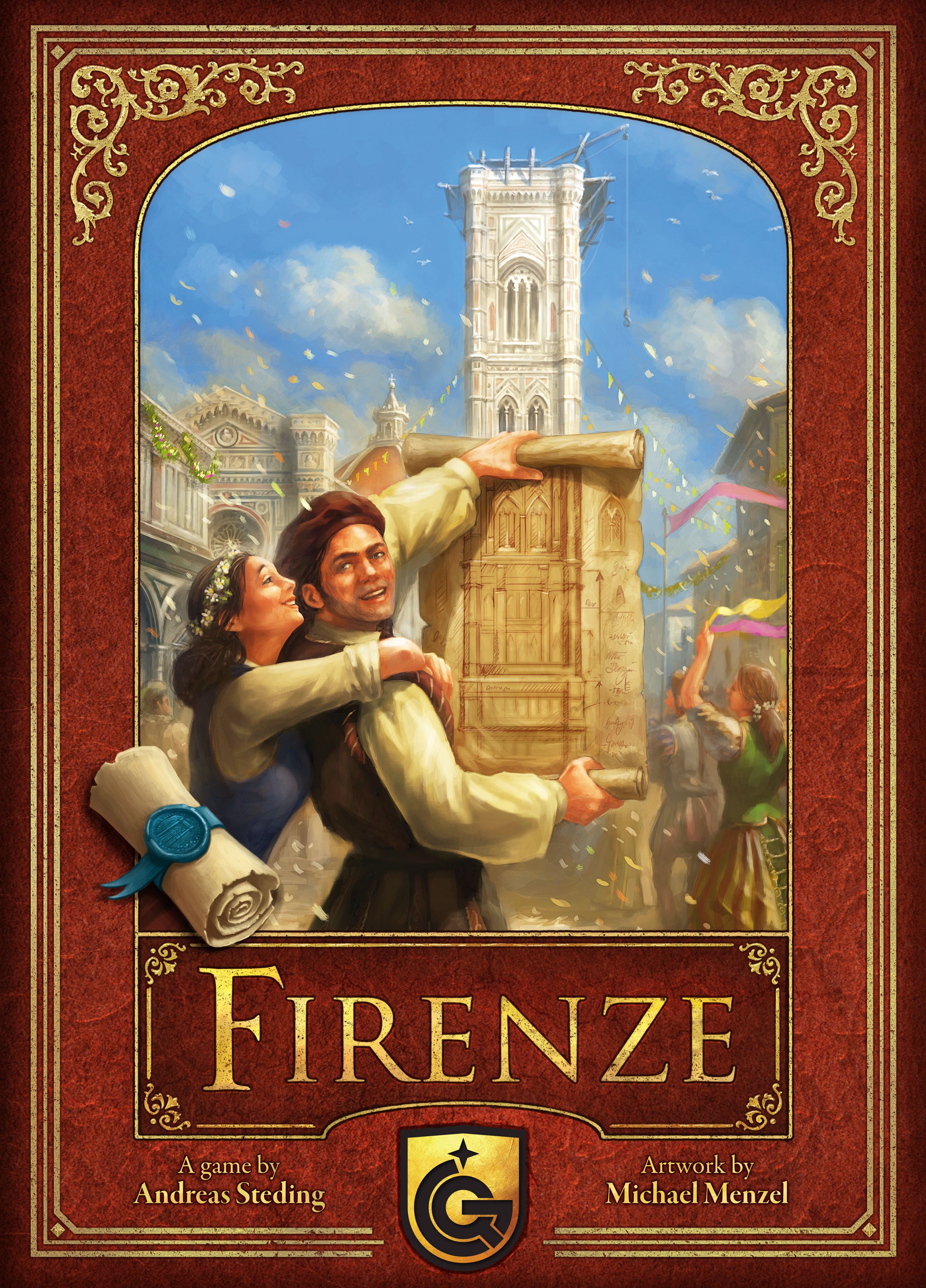
Players are master builders in 12th-14th century Florence, constructing towers from colored bricks for family commissions. Once you start a tower you must keep building it each turn or it is torn down. You earn Prestige Points for completing commissions, and the player with the most Prestige Points at the end wins.
Preparação
Place the board in the middle of the players. Shuffle the Action Cards and set aside the 10 Start Cards. Make the deck from the rest, then shuffle the Start Cards and place them on top, face down. Turn over six cards into the Card Row from left to right, then put 4 bricks from the pouch on each card. Each player takes a Construction Site, both Overview Cards, a Prestige Marker (placed on 0) and a Small Seal, plus seals in their color: 9 each with 2 players, 7 with 3, or 6 with 4. The most recent tower builder starts and receives 2 white bricks as a Storehouse. Each other player clockwise gets one more white brick than the previous player (3, 4 or 5). Put all other bricks in the pouch and mix them. Place the End of Game Tile above the two middle towers. Shuffle the Balcony Tiles, turn up one each of I, II, III and IV, and cover those commissions on the matching towers. Place 5 neutral seals on commissions of your choice, avoiding towers that already have a Balcony, and keep no more than two tiles per tower. Put the Level Tiles beside the white tower. For a first game, remove the Campanile card from the deck.
Um turno
Starting with the starting player and going clockwise, each player takes a turn in six phases:
- Choose a card (mandatory): Take one face-up Action Card. The leftmost card is free, and each card to the right costs one more brick. Pay the cost from your Storehouse by placing bricks on the cards to the left. You cannot use the bricks on the card you take to pay for it. Then take the card and its bricks into your Storehouse. Event Cards are resolved immediately and discarded. Personnel Cards go into your hand. Celebration Cards go into your hand and normally stay there. Building Cards are placed face up in front of you. Church Cards go on a Church Space. Then slide the cards right of the gap left, refill the open right slot from the deck, and add 4 bricks from the pouch.
- Exchange bricks (optional): Once per turn, put 3 bricks from your Storehouse on a card and take one brick from that card. You choose the colors of the three bricks.
- Build towers (optional): Build or extend towers on your Construction Site. Each tower has one color, and towers cannot shrink. Each brick adds one level, up to 6 bricks per turn. The first 2 bricks are free. Extra bricks cost additional bricks paid to the pouch: 3 bricks cost 1, 4 cost 3, 5 cost 6, and 6 cost 10. The cost depends only on the total bricks used this turn, and you may pay it with any colors.
- Tear down abandoned construction (mandatory): Any tower that was under construction at the start of your turn but received no bricks this turn is abandoned. Put half its bricks in the pouch, rounding odd numbers up, and the rest in your Storehouse.
- Fulfill commissions (optional): A tower may complete an uncovered commission only if its level count matches exactly. Only the lowest-numbered available Balcony commission may be completed. To complete one, move your Prestige Marker forward by the indicated points, cover the commission with one of your seals, and return the tower's bricks to the pouch. Completing a Balcony lets you attempt the next Balcony in the same turn. If a tower reaches a level shown on a Level Tile, you also gain that bonus and remove the tile.
- Check limits (mandatory): Your Storehouse may hold at most 10 bricks, and any extra go to the pouch. You may hold at most 5 Action Cards in total, counting hand cards and Buildings in play. Discard Personnel or Building Cards to meet this limit. Celebration Cards cannot be discarded, except through the Patrician card. Discards form a pile, and when the deck runs out, the pile is shuffled to form a new deck.
Fim do jogo
The first player to place their last seal on the board receives a 5-point bonus and takes the End of Game Tile face down. Every other player then gets exactly one more turn. The game ends after the turn of the player to the right of the End of Game Tile holder.
Pontuação
First, each tower color gives a Majority Bonus (shown on the flag atop that tower) to the player with the most seals on towers of that color, Balconies included. If players tie, the bonus goes to the tied player whose highest seal on that color is placed higher, meaning the larger commission. Next, every player turns over their Celebration Cards and adjusts their Prestige Marker accordingly. The player with the most Prestige Points wins. If players tie, they share the victory.
Variantes
Setup variants from the rulebook:
- Seal count: Use more or fewer neutral seals to change difficulty. Fewer seals make the game run more smoothly, while more seals make commissions more contested and rival plans more important.
- Placement: Place neutral seals at random, by rolling dice (one roll for color and one for level), or deliberately. Placing more seals on levels 3 and 4 makes small commissions and the Recognition card harder to use.
- Dead color: Pick one color, such as green, and cover all six of its commissions with neutral seals. Replace any Balconies of that color with others. The bricks of that color are then mainly useful for exchanges and paying costs.
- Campanile: Leave out the Campanile card in your first game, and in later games make sure everyone knows its effect before play begins.
Alterações
- Variantes, por o rascunho do manual de regras, 23 de novembro de 2026 (mostrada agora)
- Pontuação, por o rascunho do manual de regras, 23 de novembro de 2026 (mostrada agora)
- Fim do jogo, por o rascunho do manual de regras, 23 de novembro de 2026 (mostrada agora)
- Um turno, por o rascunho do manual de regras, 23 de novembro de 2026 (mostrada agora)
- Preparação, por o rascunho do manual de regras, 23 de novembro de 2026 (mostrada agora)
- Resumo, por o rascunho do manual de regras, 23 de novembro de 2026 (mostrada agora)