Regras de Flamme Rouge
Resumo
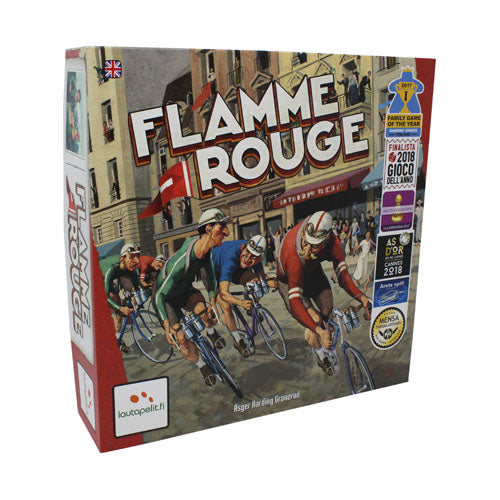
Flamme Rouge is a fast, tactical bicycle racing game for 2 to 4 players. Each player controls a team of two riders, a Rouleur and a Sprinteur, and moves them by drawing and playing numbered energy cards that set how far each rider goes. The first player to cross the finish line with one of their riders wins.
Preparação
- Build the track from the chosen stage card. For a first game, use the Avenue Corso Paseo stage card and the sides marked with lowercase letters.
- Each player takes a Sprinteur and a Rouleur model in their colour, the matching energy cards, and a player board.
- Shuffle each rider's energy cards into a face-down deck and place it on the player board. Place all exhaustion cards face up within reach of everyone.
- The player who most recently rode a bike (youngest if tied) places their two riders one at a time in any free lane behind the Start line. Continue clockwise until all riders are placed.
- A square with no riders is always entered in its right-hand lane.
Um turno
The race is played in rounds, each with three phases.
- Energy phase (all players at the same time): For one rider, draw four cards from that rider's energy deck, play one face down beside the deck as the movement value, and recycle the rest. Then do the same for the other rider. You cannot draw for your second rider before playing the card for your first.
- Movement phase: Reveal all played cards. Starting with the frontmost rider, move each rider forward the exact number of squares on its card. Lane changes are free. A rider can pass other riders but cannot end on them. If a rider's move would end on a fully occupied square, it stops in the first square behind it that has a free lane.
3. End phase:
- Remove all played cards from the game.
- Apply slipstreaming: starting with the rearmost pack, a pack with exactly one empty square in front of it moves forward one square to merge with the pack ahead. Check the merged pack again and keep going through the packs.
- Exhaustion: a rider with an empty square directly in front of it (an empty lane does not count) is exhausted and receives an exhaustion card matching its type.
Recycled cards go face up at the bottom of the rider's deck. When a deck runs out of face-down cards, shuffle the recycled cards and place them face down as a new deck. If fewer than four cards remain in total, draw them all.
Fim do jogo
The game ends when a rider crosses the finish line. The first player to get a rider across wins. If more than one rider crosses the line in the same round, the rider who got furthest across wins.
Variantes
- Alternative stages: The six suggested stages each have their own stage card. You can also design your own track.
- Handicap for new players: Players who have already played may add one exhaustion card to both of their energy decks during setup. Very experienced players may add an additional exhaustion card to both decks.
- Mountains: Red Ascent squares cap any rider's movement at 5 squares, with extra value wasted. A rider moving onto the first square of an Ascent stops on the last free lane before it. Riders on an Ascent cannot give or receive slipstreaming. Blue Descent squares set a minimum card value of 5 for a rider starting its turn there. Slipstreaming works normally on Descents.
Alterações
- Variantes, por o rascunho do manual de regras, 22 de novembro de 2026 (mostrada agora)
- Fim do jogo, por o rascunho do manual de regras, 22 de novembro de 2026 (mostrada agora)
- Um turno, por o rascunho do manual de regras, 22 de novembro de 2026 (mostrada agora)
- Preparação, por o rascunho do manual de regras, 22 de novembro de 2026 (mostrada agora)
- Resumo, por o rascunho do manual de regras, 22 de novembro de 2026 (mostrada agora)