Regras de Glass Road
Resumo
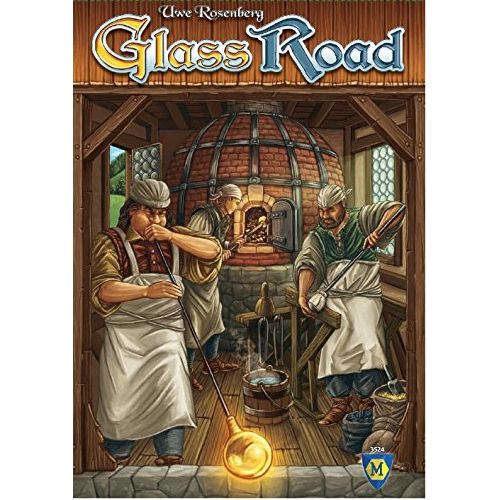
Glass Road is a game for 1 to 4 players in which you run a Glassworks and a Brickworks on rotating production wheels and use the goods they produce to build buildings over four building periods. Specialist cards you play each round supply materials, Landscape tiles and building actions. Only the total value of your buildings counts, and the player with the highest score wins.
Preparação
Each player takes a Landscape board and a Production board and assembles the two wheels: the green Glassworks wheel on top and the red Brickworks wheel below. With fewer than 4 players, remove the leftover boards, Good tokens and Forest tiles.
Use the Building board side that matches the player count (one side for 1 to 3 players, the other for 4). Sort the Building tiles into three stacks by back symbol and shuffle each stack. Place about half of each stack face-down beside the board. Then draw 4 tiles per stack for 1 to 3 players, or 5 per stack for 4 players, and place them in the spaces next to the stacks. The rulebook suggests a first game use only buildings with a wayside shrine in the top right corner.
Each player takes a set of 15 Specialist cards in one colour as their hand. Give the Start player goblet to a random player.
Starting goods: on the Glassworks wheel you begin with 0 Glass, with Quartz sand in the brown sector 0, Food in sector 1, Charcoal in sector 2, Water in sector 3 and Wood in sector 4. On the Brickworks wheel you begin with 0 Bricks and 0 Charcoal, with Clay in sector 1 and Food in sector 2.
Landscape: place 6 Forests (each covering two spaces), 2 Pits, 2 Groves and 2 Ponds as shown on the board. Your three Start buildings are printed on the left of your Landscape board.
Um turno
Each building period has three card rounds. At the start of a building period, secretly choose 5 of your 15 Specialist cards as your hand and set the other 10 aside. You may choose from the full set each period.
In each card round, pick one card from your hand and place it face-down. Then reveal the cards in clockwise order, starting with the Start player. Resolve each card as it is revealed. If you reveal a card that another player has also picked, they must play their copy from hand into one of the two indentations on their Landscape board, and it resolves right after yours. Once both indentations are full, you cannot be forced to play more cards on other players' turns. Revealed cards are set aside face-up, and the next card round begins.
If you are the only player to play a card, you may use both of its abilities in any order, but each ability can be used only once per building period. If other players also played it, each player may use only one ability. You may refuse an ability, and you pay any entry fee only once and only if you use the card.
Production wheels: basic goods are gained clockwise and paid counter-clockwise. Whenever both brown sectors of a wheel are empty at the same moment, that wheel must rotate one sector clockwise, repeatedly if needed. You may not rotate a wheel in the middle of a transaction, such as while paying building costs.
Anytime-actions: once you own a Processing building, you may use its trade at any time, even outside your turn, as long as you finish one action before starting another. You may also remove your Pits, Groves and Ponds at any time, but not Forests or buildings.
Building: when a card lets you build, pick a building from the Building board or your private offer, pay its costs, and place it on an empty space of your Landscape board. Upgrade tiles, which show a brick pattern, go on top of a matching Start building instead. Processing buildings can be used right after they are built, and Immediate buildings take effect at once.
At the end of each building period, refill empty spaces on the Building board from the stack to the left of each row and pass the Start player goblet clockwise. In the 3-player game the goblet instead goes to the player with the fewest buildings at the end of the third period, with ties broken clockwise among the tied players.
Pontuação
Add up the point values of all your buildings. Bonus buildings score according to their requirements at the end of the game, and goods used for them are not lost. Glassmaker's Colony scores half a point per Quartz sand, with no rounding, so it is the only building that can have a non-integer value. If you upgraded a Start building, you score only the upgrade and not the building underneath it.
The player with the highest score wins. If players tie, they all share the win.
Variantes
Five building periods: for a longer game, play five periods. For the fifth period, the Start player is the player with the fewest buildings after period four, with ties broken clockwise, and in a 3-player game the player who was Start player in period four cannot be Start player again.
2-player game: the cards are played face-up in turn order, beginning with the Start player, until one player runs out of hand cards. The period ends then. You may have no more than 2 cards left in hand. A player with 3 leftover cards may play one and use it alone. You must play a copied card if your opponent plays one you hold, unless both your indentations are full.
Solo game: the goal is the highest score after seven building periods, where 30 points is considered remarkable. Choose cards per period as follows: period 1 uses 3, period 2 uses 4, period 3 uses 5, period 4 uses 6, period 5 uses 3, period 6 uses 4 and period 7 uses 5. Shuffle the chosen cards and draw one at random, using only one of its abilities. Keep drawing until two cards remain, then pick one of those to use with both abilities and ignore the other. Set all chosen cards aside face-up and fanned out, and they cannot be chosen in the next period. The solo Supplier gives only 1 good.
Alterações
- Variantes, por o rascunho do manual de regras, 23 de novembro de 2026 (mostrada agora)
- Pontuação, por o rascunho do manual de regras, 23 de novembro de 2026 (mostrada agora)
- Um turno, por o rascunho do manual de regras, 23 de novembro de 2026 (mostrada agora)
- Preparação, por o rascunho do manual de regras, 23 de novembro de 2026 (mostrada agora)
- Resumo, por o rascunho do manual de regras, 23 de novembro de 2026 (mostrada agora)